
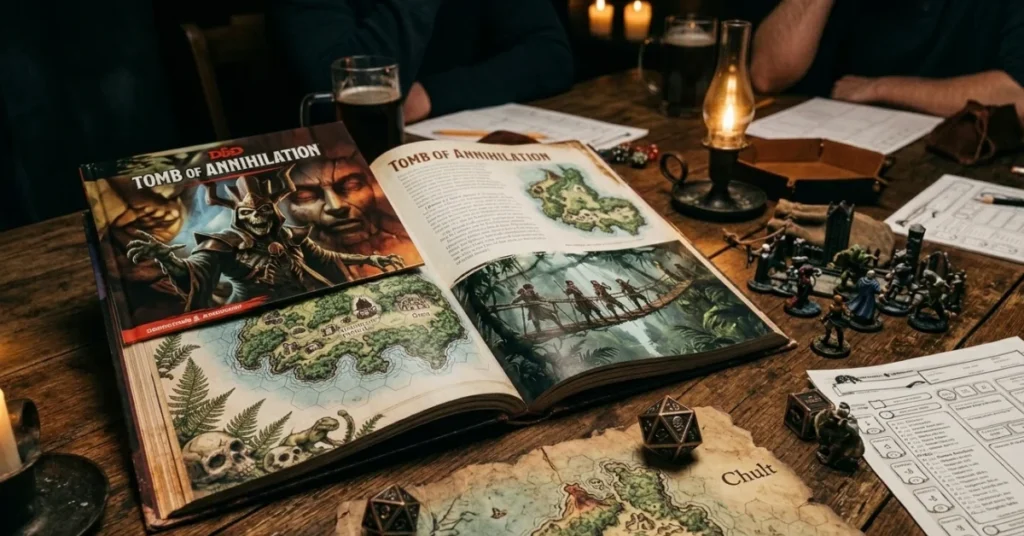
When you crack open Tomb of Annihilation for the first time, something unusual greets you before a single dice roll happens. Right there on the credits page, printed like an official notice, is a short warning that has since become one of the most talked-about pieces of text in all of Dungeons & Dragons. The Tomb of Annihilation disclaimer isn’t boilerplate. It isn’t filler. And it turns out, there are actually two different disclaimers attached to this adventure — one funny, one serious — and both carry more weight than most players realize.
Here’s a proper breakdown of what they are, where they came from, and why this module keeps sparking conversation even years after its 2017 release.
The Witty Warning Printed in Every Copy
The in-book disclaimer reads: “This adventure will make your players hate you — the kind of simmering hatred that eats away at their souls until all that remains are dark little spheres of annihilation where their hearts used to be.”
That’s not corporate legal language. That’s a threat delivered with a grin.
Every D&D 5th Edition book carries a short disclaimer on its credits page, written in a playful and humorous tone. These are not serious legal warnings — they’re jokes that match the theme and personality of each individual adventure. For Tomb of Annihilation, the joke is perfectly on-brand. This is a module that will eat your characters alive, and the designers want you to know that upfront.
The adventure was inspired by an older and very famous D&D module called Tomb of Horrors, created by Gary Gygax, one of the inventors of Dungeons & Dragons. Tomb of Horrors was known for being extremely deadly, and Tomb of Annihilation carries that same spirit forward. Wizards of the Coast even used more playtesters for this adventure than any other module they had released before — the reason was simple: they were worried no one would be able to survive it.
So yes, the lighthearted disclaimer earns every word.
What Makes This Adventure Actually Dangerous
Before digging into the cultural side of things, it helps to understand exactly why that first disclaimer exists — and why so many Dungeon Masters wave it like a caution flag at their players before session one.
Tomb of Annihilation is a fifth-edition D&D campaign set in the dangerous jungles of Chult. The story revolves around a magical curse that prevents resurrection, raising the stakes significantly for player characters. Think about what that means in practical terms. In standard D&D, character death is often a temporary inconvenience. A companion casts a spell, a diamond is consumed, and your hero wakes up. Not here. The Soulmonger—the necrotic artifact at the heart of the campaign—traps the souls of the dead and slowly devours them over time. While your party has a brutal ticking clock to destroy the artifact and save a fallen friend, any character who dies cannot be resurrected by normal means while the Soulmonger stands.
The campaign includes deadly traps, diseases, curses, wilderness survival, undead horrors, and difficult encounters. Characters may die permanently, and the story does not always provide forgiving outcomes. That’s a major reason many groups discuss the disclaimer before session one.
And here’s the thing players often underestimate: the jungle itself is the enemy long before you ever reach the tomb. Resource management, disease rolls, guide reliability — the hexcrawl through Chult has ended more campaigns than any trap inside the dungeon. Groups that treat it like a casual romp discover this the hard way, usually somewhere around week three.
The disclaimer isn’t meant to scare players — it’s meant to shift their mindset. Characters with higher survivability tend to last longer. A well-balanced party is essential. And many players underestimate the campaign, rush in unprepared, and assume their character can survive anything — which often leads to quick failure.
The Second Disclaimer — And Why This One Is Harder to Laugh Off
Here’s where the conversation gets more layered.
In 2020, Wizards of the Coast responded to community concerns. They announced changes to some text in newer printings of Tomb of Annihilation to remove parts considered racially insensitive. They also added disclaimers to older titles across their digital collection, letting readers know that the content might contain outdated views.
This disclaimer reads as an acknowledgment that the content may feature “outdated cultural depictions” and does not reflect the company’s present values. That’s a very different tone from the credits page joke. This one is serious, and its origins go back to the way Chult itself was designed.
Tomb of Annihilation is set in Chult, a fictional region inspired by African, Caribbean, and Central American cultures and landscapes. When the book first came out in 2017, some players and critics pointed out that the way Chult was shown felt too much like old adventure stories that treated non-European cultures as “exotic” or “dangerous” without giving them real depth.
What the Research Shows: The Chult Representation Debate
Critics highlighted specific problems in the Chultean cultural representation: the Chultan language is described with click-based pronunciations drawn from Khoisan languages, their outfits resemble those of East African cultures, and Chultans are notably absent from much of their own lands. For a setting billed as an African-inspired culture, that’s a significant disconnect.
During an interview about the adventure with Kotaku, it was revealed that in the writing of this adventure, there were no people of color involved, and when time came to determine whether to go into detail about Chultean culture and history, the decision was “no” — because it would supposedly be “boring.”
That revelation landed hard in the tabletop community.
Critics noted that while the literary and visual content the module borrows from makes for interesting design, Wizards could have done more to interrogate those source texts and their complicated relationship with representations of Africa. Kotaku’s Cecilia D’Anastasio highlighted that the adventure uses dated stereotypes of African cultures and themes of colonialism that date back to the original creation of the Chult setting.
The core issue is that the people of Chult are woefully underserved. Most readers and players don’t have the cultural reference points for an African analogue in fantasy that they do for European-based settings — which discourages players from engaging with the Chultean people as anything more than background figures. The module also missed an opportunity to develop the region into something as vibrant as better-supported areas of the Forgotten Realms.
What’s worth noting is that Tomb of Annihilation wasn’t starting from zero. Chult was first introduced in 1992, and the Tomb of Annihilation campaign represented a major improvement on the previous material — the people of Chult were no longer depicted as spear-wielding “savages” but as merchants and traders. Progress, yes. Enough? Many in the community felt not.
Experts and community commentators generally agree that disclaimers are only a first step, and that meaningful change requires deeper structural inclusion — community-led rewrites show that players actively reshape fantasy worlds to align with modern values.
How DMs Are Handling Both Disclaimers at the Table
The tabletop community hasn’t sat idle waiting for corporate updates. As of 2026, many DMs run Tomb of Annihilation with their own layered approach to both the difficulty warning and the cultural content.
The disclaimer encourages Dungeon Masters to talk with their players before the campaign begins. That conversation has expanded well beyond “expect character death.” Modern groups often address:
- Death and permanence mechanics — making sure all players genuinely understand the Soulmonger’s rules before play begins
- Tone alignment — confirming everyone is on board for a darker, grittier campaign than typical D&D fare
- Cultural framing — several DMs actively reframe Chult as a thriving, independent civilization and give Chultan NPCs deeper roles than the module provides
Not every player sees the cultural issues as a problem — but the conversation has grown stronger, and Wizards of the Coast has since acknowledged that some of their older modules need updates to better handle representation.
The beauty of tabletop gaming is that the module is a starting point, not a script. DMs can and do adjust the tone, expand NPC depth, and rewrite problematic framing without losing the core experience.
Why This Disclaimer Matters Beyond One Module
Tomb of Annihilation sits at an interesting crossroads in the history of D&D publishing. It’s a genuinely excellent adventure — challenging, atmospheric, and rewarding for groups who commit to it properly. But it also reflects choices made at a specific moment in the hobby’s history, before broader conversations about representation caught hold across the industry.
The controversy surrounding Tomb of Annihilation didn’t arise in isolation. It’s part of a longer conversation about fantasy role-playing games and their relationship to real-world cultures. The region of Chult has roots in late-20th-century fantasy design that often drew from African, Caribbean, and Central American geography and culture without consulting the communities being represented.
That broader conversation has produced results. The industry looks different in 2026 than it did in 2017. More diverse creative teams, sensitivity consultants, and player-facing content notices are all more standard across tabletop publishing now.
Whether you think the disclaimer is enough, too little, or unnecessary entirely, the fact that it exists reflects something real: this is a hobby that takes the experience of its players seriously — both the fear of a deadly dungeon trap and the question of who gets to see themselves reflected with dignity in the worlds they explore.
Practical Tips Before You Start the Campaign

If you’re a DM planning to run this module, or a player about to jump in, a few things worth doing before session zero:
- Read the disclaimer out loud — the humorous one sets the tone perfectly and gets the table laughing and alert at the same time
- Discuss resurrection rules — make sure every player understands permanent death is real in this campaign
- Consider expanding Chultan culture — fan supplements and community resources offer rich additions to the module’s thinner NPC work
- Brief players on content — undead horror, body horror elements, colonial undertones, and survival pressure are all present throughout
Players who go in with eyes open almost always have a better experience than those who waltz into the jungle expecting a typical fantasy romp.
FAQs About the Tomb of Annihilation Disclaimer
1. What exactly does the Tomb of Annihilation disclaimer say?
The famous in-book disclaimer warns players, with dark humor, that the adventure will make them hate their Dungeon Master because of how deadly and punishing it is. A second, more serious disclaimer was added digitally in 2020 by Wizards of the Coast acknowledging that the module contains outdated cultural depictions.
2. Is the disclaimer a legally binding warning or a joke?
The credits-page disclaimer is intentionally playful — it’s a tradition in D&D 5th Edition books to include a thematic joke on that page. The 2020 cultural sensitivity notice is a genuine acknowledgment, not played for laughs.
3. Why did Wizards of the Coast add a cultural disclaimer in 2020?
Following community feedback about the portrayal of the Chult setting — an African-inspired fictional region written without POC involvement — Wizards acknowledged that the content contained outdated representations and didn’t reflect the company’s current values.
4. Does the disclaimer change the content of the module?
The disclaimer itself is just an advisory notice and does not alter the book. However, alongside adding the disclaimer, Wizards of the Coast did issue official text updates (errata) in newer printings to alter specific descriptions of Chultan culture that the community found problematic.
5. Should new players start with Tomb of Annihilation?
Generally, no. The difficulty, permanent death mechanics, and survival systems are better suited to players with some D&D experience. New players may find the stakes overwhelming before they’ve learned the fundamentals.