This article is for informational and educational purposes only. It does not constitute financial advice. Always consult a qualified financial advisor before making any investment decisions.
How many pennyweights in an ounce? The answer is 20 — and knowing that number could save you real money the next time a gold buyer slides a quote across the counter. There are 20 pennyweights in a troy ounce, a relationship defined in 15th-century England when the weight of an English penny was set at exactly 1/20th of a troy ounce and 1/240th of a troy pound of sterling silver.
That isn’t just historical footnote. It’s the calculation behind every scrap gold quote, every jewelry appraisal, and every dental gold refiner payout in the United States and the UK right now, in 2026.
Why “How Many Pennyweights in an Ounce” Is a Question Worth Asking
Most people assume gold gets weighed in grams or ounces. Walk into a pawn shop, a scrap gold dealer, or a jewelry buyer and you’ll often hear a completely different unit — dwt. And that unfamiliar abbreviation is where confusion — and sometimes exploitation — lives.
A pennyweight (dwt) is defined as a unit of mass equal to 24 grains, 1/20 of a troy ounce, and exactly 1.55517384 grams. The abbreviation “dwt” uses “d” from denarius, the ancient Roman coin that later became the symbol for the pre-decimal British penny.
The London Bullion Market Association (LBMA), which sets the global gold price benchmark, quotes all prices in US dollars per troy ounce. Since 1 troy ounce = 20 pennyweights, that LBMA spot price divides directly into per-dwt values. Any buyer quoting you a dwt price is working backward from that same figure — which is why understanding how many pennyweights in an ounce gives you the power to verify their math before agreeing to anything.
And that’s the thing. A buyer who knows you don’t understand the conversion has an informational advantage. One who knows you do is far more likely to deal straight.
The Full Pennyweight Conversion Table You Actually Need
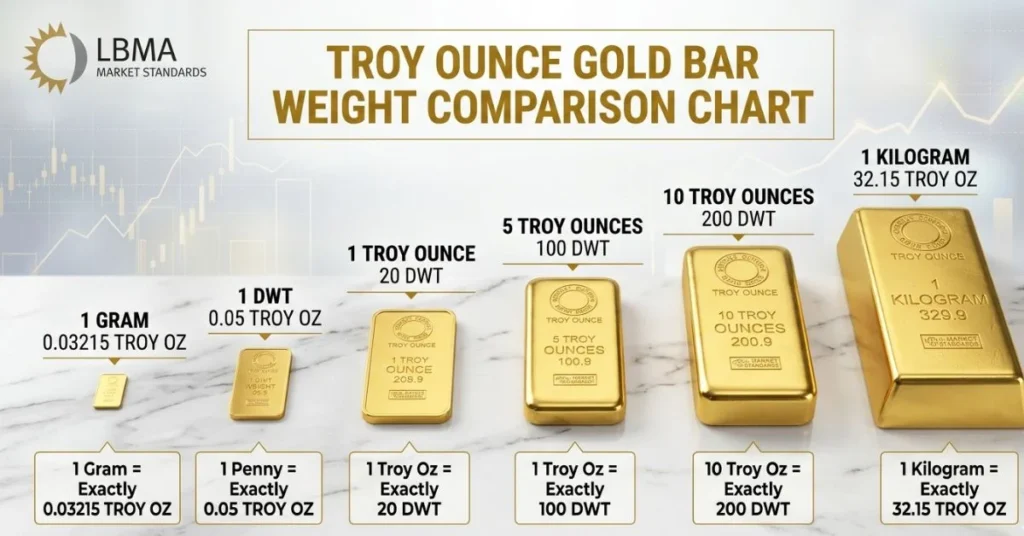
Before exploring where the unit gets used in practice, here are all the hard numbers verified against NIST (National Institute of Standards and Technology) conversion data:
- 1 troy ounce = 20 pennyweights = 480 grains = 31.1035 grams
- 1 pennyweight = 0.05 troy ounces = 24 grains = 1.55517384 grams
- 1 gram = 0.6430 pennyweights = 0.03215 troy ounces
Two conversions that trip people up most often:
Troy ounce vs. standard ounce. A troy ounce weighs 31.1035 grams. A standard avoirdupois ounce — the one on your kitchen scale — weighs only 28.35 grams. Unlike a standard ounce, which weighs 28.35 grams, a troy ounce is equivalent to 31.103 grams and has been the industry standard for centuries, providing consistency in precious metals trading, investing, and valuation across the globe. Someone who doesn’t know that difference and asks how many pennyweights in an ounce might accidentally apply the wrong ounce — and their calculation will be off by nearly 10%.
Price conversion. To find the price per pennyweight from a spot price per troy ounce, divide by 20. With spot gold at $5,294.00 per troy ounce, dividing by 20 gives a pure gold value of $264.70 per pennyweight. Every karat then discounts proportionally from that figure.
What Experts Say About Pennyweight in the Gold Trade
Investors who track gold market standards know that the pennyweight occupies a specific and persistent niche. Although it is uncommon in modern bullion trading, the pennyweight plays a critical role in the jewelry, dentistry, and scrap metal industries.
The LBMA notes that while the pennyweight is hardly used in the bullion market itself, it remains in active use in dentistry and jewellery in the UK. The troy pound and pennyweight lost their official status in the UK under the Weights and Measures Act of 1878 — only the troy ounce and its decimal subdivisions remained official, and only for use in the precious metals market.
APMEX, one of the largest precious metals retailers in the United States, confirms that the pennyweight remains standard for jewelry casting, scrap gold buying, and dental gold recovery — even as grams dominate in bullion investment contexts.
Here’s something most sellers never think about: the use of pennyweight vs. grams is partly geographical. Pennyweight is most common in Florida, while states like California and Nevada primarily use grams. States like New York use both, which creates additional confusion for consumers trying to compare offers.
So the question of how many pennyweights in an ounce isn’t just academic — it’s geographically relevant depending on where you walk in to sell.
What People Get Wrong About the Pennyweight
The most common mistake: treating a pennyweight quote the same as a gram quote.
A buyer offering “$150 per dwt” for your 14K gold sounds generous. Divide that by 1.555 to convert to per-gram terms and you get roughly $96.46 per gram. Whether that’s a good offer or not depends entirely on the current spot price — not on how large the number sounds.
Most US pawn shops and jewelers weigh gold in pennyweights when making offers, so converting your gram weight to pennyweights helps verify their math. No dealer pays 100% of melt value — they must cover refining costs, assaying fees, shipping, insurance, and operating expenses.
The second mistake is assuming “pennyweight” refers to something small and therefore cheap. Twenty of them make a full troy ounce worth — at June 2026 spot prices — over $4,500 for pure gold. A single pennyweight of 24K gold is worth well over $200 at current market levels. That’s not a trivial unit.
And one that catches sellers off guard: a US penny doesn’t actually weigh one pennyweight. It weighs 1.6 pennyweights, or 2.5 grams. The unit’s name comes from the historical penny’s weight in sterling silver, not from today’s copper-zinc coin sitting in your pocket.
How Many Pennyweights in an Ounce When You’re Selling Scrap Gold
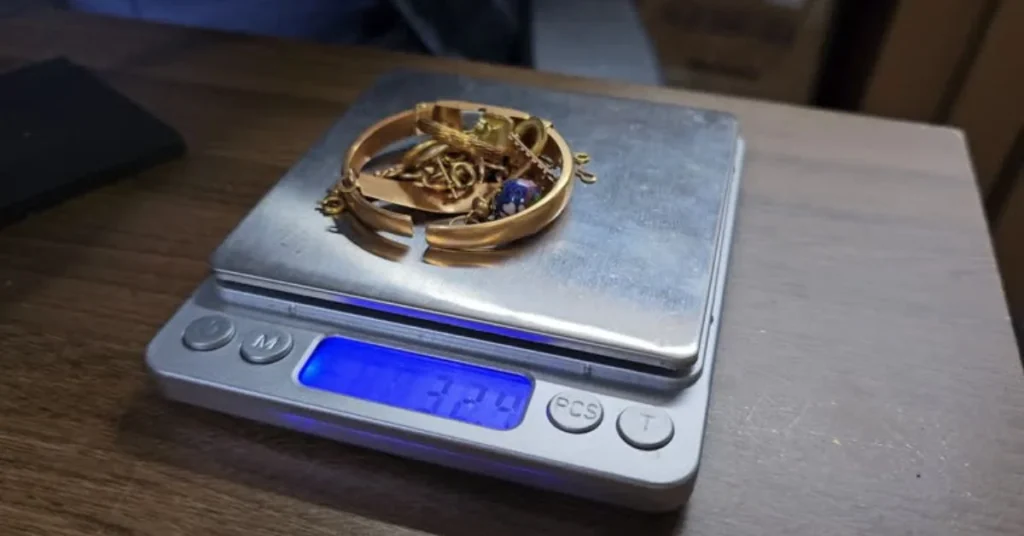
This is where the conversion becomes money — literally. Anyone selling scrap gold jewelry needs to know exactly how many pennyweights in an ounce before they walk into any buying appointment.
To calculate scrap gold value in pennyweights: take the weight of the item in dwt, multiply by the purity percentage for that karat, then multiply by the current price per pennyweight. For a 14K chain weighing 24.2 pennyweights with 58.3% pure gold content, that yields 14.1 pennyweights of pure gold.
Step-by-step formula:
- Weigh your gold item in pennyweights (dwt)
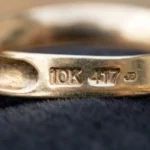
- Multiply by karat purity factor (10K = 0.417, 14K = 0.583, 18K = 0.750, 24K = 1.0)
- Divide current spot price per troy ounce by 20 to get price per pennyweight
- Multiply pure dwt weight × price per pennyweight = melt value
To get the pennyweight price from a spot price, divide the daily gold price per troy ounce by 20, since one troy ounce equals 20 dwt. Every reputable buyer in the market runs this same calculation — which means you can too, before anyone makes you an offer.
Past performance does not guarantee future results, and gold prices fluctuate daily. These calculations reflect intrinsic melt value, not what any dealer will necessarily pay.
The Counter-Intuitive History Behind the Pennyweight
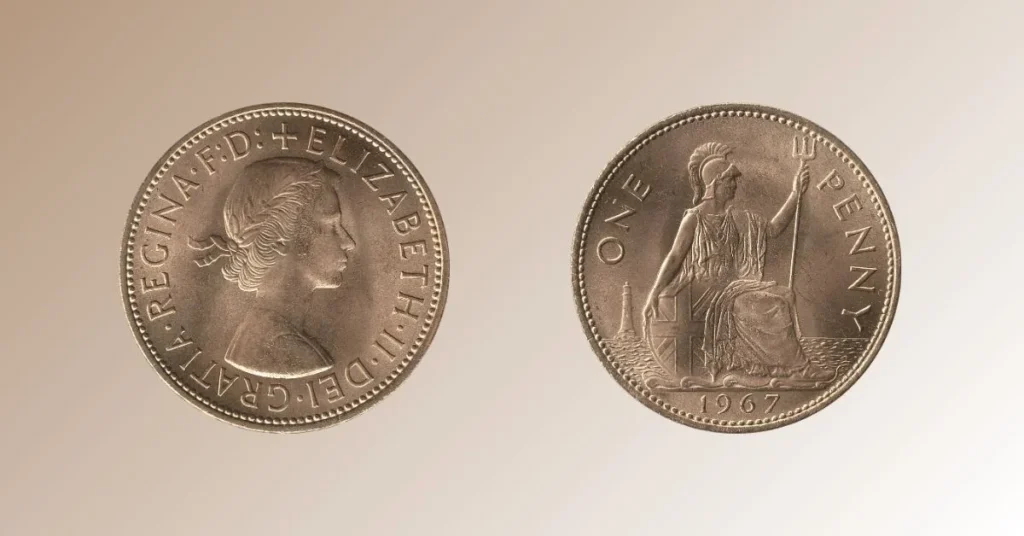
Source: Scan: Retroplum, Public domain, via Wikimedia Commons
Here’s what most gold weight guides skip entirely: the pennyweight predates modern monetary systems by over a millennium, yet it’s still pricing gold jewelry in Miami, London, and Sydney in 2026.
The first modern pennies were introduced by King Offa of Mercia around 775 AD. His early series were equal to 1/240 of a Saxon pound of silver — defined as 5,400 grains, or approximately 350 grams — giving a pennyweight of about 1.46 grams. That’s different from the modern 1.555-gram definition, which was later standardized under the troy system.
The troy ounce and its relatives, the grain and the pennyweight, have been used for weighing precious metals in England since the 12th century or earlier. The smallest measure was the grain, supposedly equal to the weight of a grain of wheat from the middle of the ear.
In 1527, England transitioned from the Tower to the troy weight system under Henry VIII, aligning English gold measurement with international trade standards and facilitating transactions throughout Europe. That 1527 transition is why asking how many pennyweights in an ounce today gets you the same answer — 20 — that an English goldsmith would have given you five centuries ago.
The troy system didn’t just survive metrification. It got a legal exemption. The European Union specifically carved out the troy ounce from metrication requirements for precious metals trading in the UK — a distinction that still holds today.
Practical Consequences: What Happens If You Skip This
If you sell a gold chain without knowing how many pennyweights in an ounce, you can’t verify whether the buyer’s dwt price is fair. You’re accepting a number in a unit you don’t understand, referenced against a spot price you can’t cross-check.
Some unscrupulous gold buyers deliberately use pennyweights to confuse customers. While some legitimate buyers also use the unit, the lack of consumer familiarity creates opportunities for underpayment that can go completely undetected.
The practical consequence is this: a buyer paying $150 per dwt for 14K gold when the fair melt rate is $175 per dwt pockets $25 per pennyweight — multiply that across a 20 dwt item and the seller loses $500 on a single transaction. Twenty pennyweights, one troy ounce, and a gap that only shows up if you already know the conversion.
How Many Pennyweights in an Ounce — Quick Reference
For anyone who needs the answer fast and clean:
- Troy ounce to pennyweights: 1 troy oz = 20 dwt
- Pennyweight to grams: 1 dwt = 1.55517 grams
- Pennyweight to troy ounce: 1 dwt = 0.05 troy oz
- Troy ounce to grams: 1 troy oz = 31.1035 grams
- Standard (avoirdupois) ounce: NOT the same — only 28.35 grams, not used for gold pricing
That last point is worth repeating. Spot prices, LBMA benchmarks, COMEX futures contracts, and every bullion transaction on earth are denominated in troy ounces. Knowing that 20 pennyweights equal one troy ounce — and that troy differs from standard — is the baseline literacy for any precious metals transaction.
Also Read: oz Pennyweight in Gold: The Hidden Unit Explained
FAQ
Q1: How many pennyweights in an ounce of gold?
There are 20 pennyweights in one troy ounce of gold. One pennyweight equals exactly 1.55517 grams, and the troy ounce — the global standard used by the LBMA, COMEX, and every major bullion market — weighs 31.1035 grams total.
Q2: Is a pennyweight the same as a regular ounce?
A pennyweight is 1/20th of a troy ounce, not a standard ounce. A troy ounce weighs 31.1035 grams while a standard avoirdupois ounce weighs only 28.35 grams — roughly 10% lighter. Gold is always priced in troy ounces, never standard ounces.
Q3: How do I calculate gold price per pennyweight from the spot price?
The formula is straightforward. Divide the current spot price per troy ounce by 20 to get the price per pennyweight. If gold spot is $4,500 per troy ounce, one pennyweight of pure 24K gold is worth $225. For 14K gold, multiply that figure by 0.583 to account for the 58.3% purity.
Q4: Do all gold buyers use pennyweights, or do some use grams?
Not all buyers use pennyweights. Pennyweight is most common in Florida, while states like California and Nevada primarily use grams, and states like New York use both units interchangeably. The LBMA and global bullion markets quote exclusively in troy ounces. Pennyweight pricing is concentrated in jewelry, scrap gold, and dental gold sectors.
Q5: Does a US penny actually weigh one pennyweight?
A US penny weighs 1.6 pennyweights, or 2.5 grams — not one pennyweight. The unit’s name comes from the historical weight of the medieval English silver penny, which was literally defined as 1/20th of a troy ounce of sterling silver, a standard set centuries before the modern copper-zinc coin existed.
This article is for informational and educational purposes only. It does not constitute financial advice. Always consult a qualified financial advisor before making any investment decisions. Past performance does not guarantee future results.