This article is for informational and educational purposes only. It does not constitute financial advice. Always consult a qualified financial advisor before making any investment decisions.
Walk into almost any jewelry store in the United States and the piece you’re most likely looking at is 14 karat gold. Not 18k. Not 24k. 14k. Around 90% of engagement and wedding rings sold in the US are made in 14k gold — a number that makes you stop and ask: is there actually a compelling reason for that, or is it just what the industry pushes?
The answer turns out to be more layered than most buyers expect. Whether 14 karat gold is “good” depends entirely on what you’re asking it to do, and the answer is different for someone buying a daily-wear ring versus someone trying to protect wealth in a gold market that, as of 2026, has been through some historic volatility.
What 14 Karat Gold Actually Is (And Why Pure Gold Can’t Do the Job)
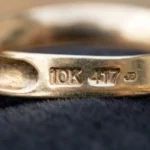
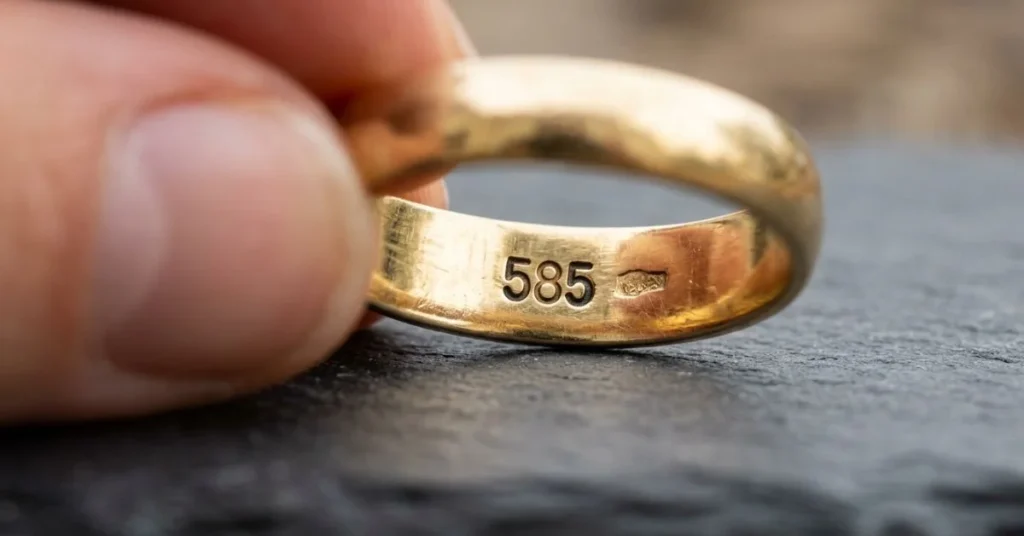
14k gold consists of 14 parts pure gold and 10 parts alloy metals — a 14/24 ratio that equals 58.3% purity, often stamped as “585” on European-made pieces. The alloying metals typically include copper, silver, zinc, and sometimes palladium, with the specific combination determining whether the result is yellow, white, or rose gold.
Pure gold — 24 karat, 99.9% fine — sounds ideal, but it presents a real problem for wearable pieces. Pure gold on its own is too soft for daily wear, so blending it with other metals creates a material that holds its shape, protects gemstone settings, and resists the bumps of real life. Think of it this way: 24k gold has roughly the same hardness as a pencil eraser. Drop a pure gold ring and it dents. Wear it for a month and prongs deform. The alloy mix in 14k gold solves this problem without sacrificing much visual warmth.
The millesimal fineness system, commonly used alongside the karat system, expresses 14k gold as either .583 or .585, with the latter used in European designs due to production standards. So when you see “585” stamped on a piece, you’re looking at 14 karat gold — nothing different, just a different notation system used across international markets.
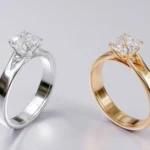
One detail most buyers don’t realize: the alloy composition — copper, silver, zinc, or palladium — determines the color outcome, with copper creating rose gold and other blends producing white gold. Same karat, different character. This gives 14k gold an unusual versatility that higher-purity options can’t match.
Is 14 Karat Gold Good for Everyday Jewelry? The Durability Case
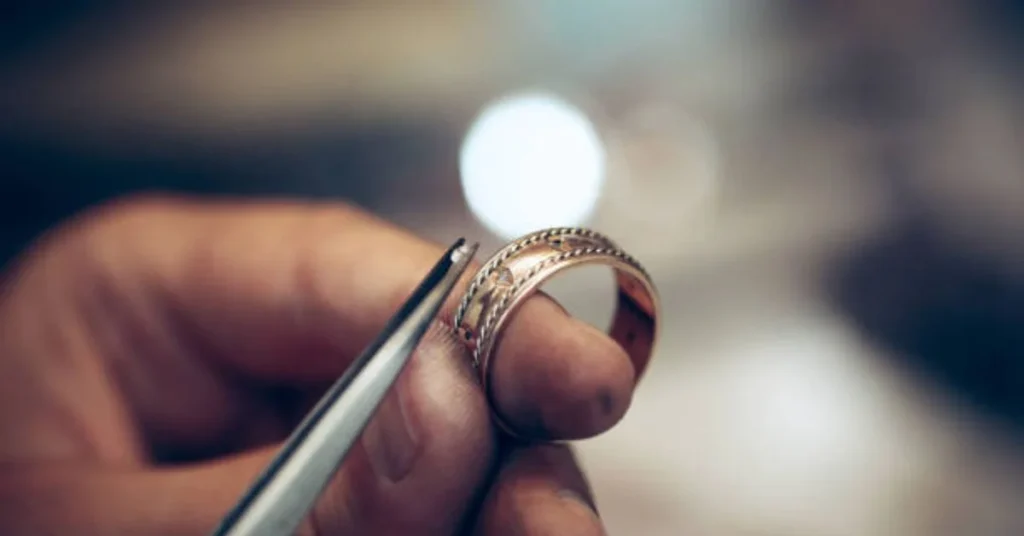
Here’s where 14k gold genuinely excels. For most jewelry, especially rings, 14k offers the best balance of strength and value, while 18k provides a richer color. That’s not marketing language — it reflects a real mechanical reality.
At 58.3% pure gold, 14k contains enough precious metal to maintain value and aesthetic appeal while incorporating sufficient alloying metals to ensure durability for daily wear. By comparison, 18k gold at 75% purity is noticeably softer. Prongs on 18k settings can deform more quickly under regular contact. For rings in particular, this matters — your hands interact with surfaces constantly.
Because 14 karat gold is more than half pure gold, the alloy is naturally resistant to discoloration. Over time, oils from your skin may create a light film on the surface, but that is buildup, not tarnish. A gentle cleaning with warm water, mild dish soap, and a soft-bristle brush brings back the original shine in minutes.
And that’s the thing most people skip over: 14k gold doesn’t require special storage, replating, or expensive maintenance schedules. Platinum and white gold often need rhodium replating every year or two to maintain their appearance. 14k yellow gold maintains its color permanently because the gold itself provides the hue.
Practical consequence: if you skip choosing 14k for a daily-wear ring in favor of 18k or higher, expect to check prong integrity more frequently and budget for professional re-tipping sooner.
What the Research Shows: 14 Karat Gold and the Investment Question
This is where the conversation shifts — and where many buyers get it wrong.
In 2026, investment-grade bullion is standardized at 999.9 fineness, while jewelry markets utilize alloys like 18k and 14k for increased strength. The LBMA’s Good Delivery standards require gold bars to be at least 99.5% pure. No 14k gold bar has ever traded on the London bullion market. Full stop.
18k and 14k grades are generally not considered pure investment vehicles. While they contain gold, their value is a combination of the gold content and the value of the alloys, plus the craftsmanship and design. They are primarily purchased for their aesthetic appeal and wearability rather than as a direct investment in the commodity price of gold.
There’s a specific number worth understanding. 14k trades at roughly 42% below the 24k price despite retaining over 50% pure gold content. This compression occurs because jewelry retailers bundle alloy material with pure gold content and then add craftsmanship premiums — typically 20–40% markup — to 14k pieces, making them poor investment vehicles.
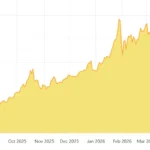
The World Gold Council’s Q1 2026 report adds context here. The LBMA gold price set a new quarterly average record of US$4,873 per troy ounce in Q1 2026, with the price hitting a historical high of US$5,405/oz in January. At that price level, the melt value of a 14k piece carries real weight — but the spread between what you buy jewelry for and what a scrap dealer will pay you remains wide.
Investors who track gold closely know this distinction: the gold in 14k jewelry has value tied to spot price movements, but the piece itself doesn’t trade at spot. Past performance does not guarantee future results.
What People Get Wrong About 14 Karat Gold
The single biggest misconception: that 14k gold is somehow “fake” or “low quality” compared to 18k or 22k. It isn’t.
14k gold represents the most common karat in modern jewelry because it offers an exceptional balance of practical and aesthetic qualities. The perception that higher karat automatically means better quality is backwards for wearable pieces. A 22k ring that deforms after six months of daily wear has failed its purpose more completely than a 14k ring that looks perfect after a decade.
What experts say: resale prices for 18k are consistently strong worldwide, based on weight and confirmed purity, according to Rapaport and London Bullion Market Association benchmarks. The tradeoff is real — 18k does hold more melt value per gram. But unless you’re reselling by weight in a scrap market, the difference in everyday use is minimal.
Another thing buyers get wrong: assuming 14k is hypoallergenic. Higher karat gold tends to be more hypoallergenic because it contains more pure gold with fewer potentially reactive alloy metals. However, individual sensitivity varies, and the specific alloy composition matters more than karat alone. Someone reacting to nickel in a 14k white gold alloy needs to look at the specific metals used, not just the karat number. Rose gold 14k (with high copper content) may irritate sensitive skin while a nickel-free 14k yellow gold won’t. The karat number alone doesn’t tell you everything.
14 Karat Gold vs. Other Karats: Where It Wins and Where It Doesn’t
A direct comparison helps:
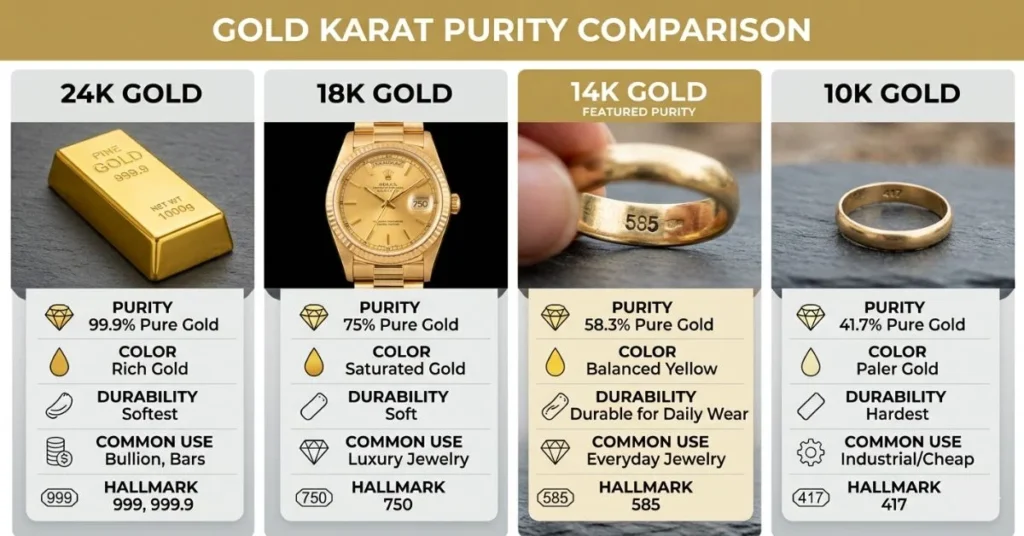
- 10k gold (41.7% pure): more durable and cheapest, but visibly paler and carries skin-reaction risks from higher base-metal content
- 14k gold (58.3% pure): strongest all-around performer for jewelry; dominant in US and European markets
- 18k gold (75% pure): richer color, higher resale melt value, but softer and 15–25% more expensive per gram
- 24k gold (99.9% pure): investment-grade bullion standard; too soft for jewelry; highest resale value tied directly to spot price
24k is more valuable and better as a store of value or investment, while 10k gold is more durable and better for practical use. 14k and 18k are in the middle, and generally best for jewelry.
One counterintuitive point: in markets like India, China, and the Middle East, 24k gold is viewed not just as jewelry but as a savings instrument, with purchasing tied to cultural and wealth-preservation traditions. Western buyers approaching gold purely through a jewelry lens may underestimate how differently 24k functions in those markets. For an international audience, this matters when assessing secondhand value.
The 2026 Market Context: Why Karat Choice Matters More Now
According to Louise Street, Senior Markets Analyst at the World Gold Council, gold’s volatility markedly increased in 2026, with prices peaking above US$5,400/oz in January before a significant but contained correction.
At those price levels, the gold content in a 14k piece carries more dollar value than it did two years ago — mechanically. A 14k gold chain weighing 20 grams now contains a melt value that would have seemed significant even to professional dealers a decade ago. Jewelry industry analysts have noted that 14k gold chain has good market liquidity and stable recycling prices in the secondary market as of 2026.
Anyone who has studied gold markets understands that jewelry resale and bullion resale operate by different rules. But when spot prices hit record highs — as they did in Q1 2026 — even the scrap channel for 14k pieces becomes more financially meaningful than it was at $1,500 spot.
Conclusion: Is 14 Karat Gold Good?
For jewelry that gets worn and lived in, 14 karat gold is genuinely hard to beat. The 58.3% gold content delivers real warmth and real value, while the alloy structure gives it the durability that higher-karat pieces sacrifice. As of 2026, with gold prices at record highs, the melt value in a 14k piece carries more weight than ever before.
For pure investment, 14 karat gold isn’t the right tool. That job belongs to 24k bullion products meeting LBMA and World Gold Council standards.
Know which question you’re actually asking — and 14 karat gold has a very good answer for most of them.
Also Read: 10 Karat versus 14 Karat Gold: Surprising Differences Revealed
FAQ
Is 14k gold real gold?
It contains 58.3% pure gold by weight, confirmed by the “14k” or “585” hallmark stamp. The remaining 41.7% is strengthening alloy metals.
Does 14k gold tarnish or turn your finger green?
Not under normal circumstances. A green mark from gold jewelry typically results from copper in the alloy reacting with skin acids or moisture — it’s a skin reaction, not tarnish on the gold itself, and it can be resolved by choosing a different alloy composition or keeping the piece clean and dry.
Is 14k gold good for an engagement ring?
14k gold accounts for approximately 90% of engagement and wedding rings sold in the United States because it combines sufficient purity with the durability needed for a piece worn every day under physical stress.
Can I sell 14k gold at spot price?
Scrap dealers and buyers pay a percentage of the melt value, not the full spot price. The 58.3% gold content sets the ceiling; the actual payout depends on the buyer’s margin, typically 70–90% of melt value.
Is 14k gold good for investment?
Not as a primary gold investment. 14k and 18k gold are generally not considered pure investment vehicles because their value combines gold content, alloy material, and craftsmanship premiums, making them poor vehicles for tracking the commodity price of gold. For investment purposes, 24k bullion coins or bars are the standard.
This article is for informational and educational purposes only. It does not constitute financial advice. Always consult a qualified financial advisor before making any investment decisions. Past performance does not guarantee future results.