This article is for informational and educational purposes only. It does not constitute financial advice. Always consult a qualified financial advisor before making any investment decisions.
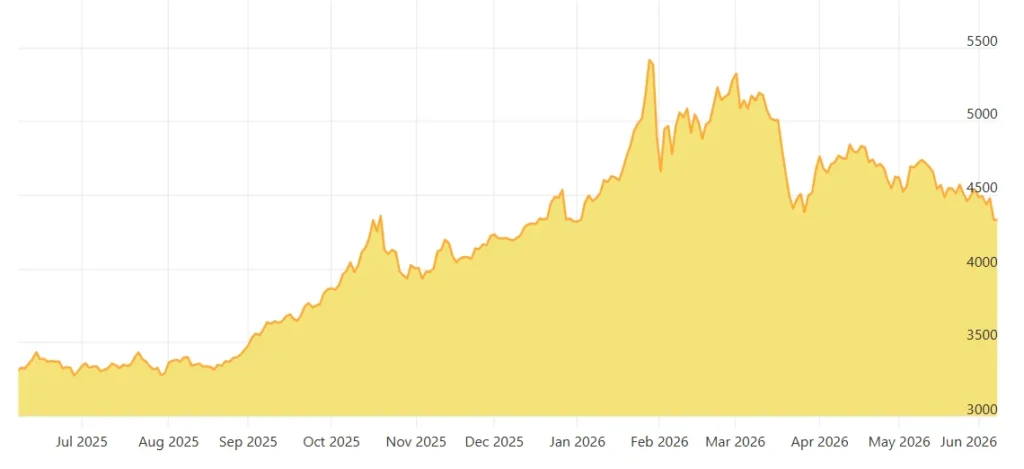
Is now a good time to sell gold? By almost every measurable market indicator available in June 2026, the answer is yes — with conditions attached. Gold set an all-time high of $5,602.22 per troy ounce on January 28, 2026, according to APMEX price records. The precious metal rose a staggering 80% since January 2025, driven by persistent inflationary pressures, ongoing geopolitical instability, and heightened economic and tariff uncertainty.
That kind of run doesn’t happen without consequence. Prices have since corrected, with spot gold trading near $4,324 as of June 8, 2026 — still up roughly 30% year-over-year. Whether that pullback from the peak is a reason to wait or a reason to act is a question every seller has to answer for themselves. But the data that frames that decision is clear, verifiable, and available right now.
The Market Context: Why 2026 Is Historically Unusual for Gold Sellers
Gold sellers haven’t seen a market environment like this in living memory. The 2026 price above $5,000 was the first time gold exceeded its 1980 peak in real terms — representing genuine new price discovery, not simply inflation catching up. That distinction matters. Previous gold rallies in 2011 and 2020 reflected temporary crisis spikes. The 2025–2026 run is being driven by deeper structural forces that market analysts at major institutions are treating differently.
According to the World Gold Council’s Gold Demand Trends Q1 2026 report, total gold demand reached 1,231 tonnes in Q1 2026, with the total value surging to a record $193 billion. Bar and coin investment drove gains while central banks continued buying in healthy volume. Demand at record dollar value while prices are elevated tells you something important: buyers aren’t fleeing at these price levels. They’re still absorbing supply.
Central banks purchased a net 244 tonnes in Q1 2026 alone — up 3% year-over-year and the fastest quarterly pace in over a year, according to the World Gold Council’s Q1 2026 Gold Demand Trends report published April 29, 2026. When the institutions responsible for anchoring global monetary systems are accelerating purchases at $4,000+ prices, the floor under gold isn’t arbitrary.
And that’s the thing. A seller deciding whether now is a good time to sell gold is operating in a market with structural buyers who aren’t going anywhere. That context doesn’t make selling wrong — it makes the timing calculus more nuanced than a simple “high price, sell now” logic.
What Drives Gold Prices — and Why They’re Where They Are
Understanding whether now is a good time to sell gold requires understanding what pushed prices here in the first place. Four forces are active simultaneously in mid-2026, and they don’t all point in the same direction.
De-dollarisation and central bank strategy. The shift began in earnest in 2022, when Russia’s approximately $300 billion in foreign exchange reserves were frozen as part of international sanctions. That single event was a wake-up call for central banks worldwide: paper assets held abroad can be frozen overnight. Gold cannot. BRICS+ nations now hold 17.4% of global gold reserves, up from just 11.2% in 2019. This is a multi-decade rebalancing, not a trade. It won’t reverse in a quarter.
Geopolitical risk premium. Goldman Sachs had forecast two Fed rate cuts in March and June 2026 toward a 3.0–3.25% target. Those cuts did not materialise as Iran-driven inflation repriced expectations. Markets now assign approximately 50% probability to a rate hike by year-end — a stark reversal. Rate hikes historically pressure gold. That’s why the correction from $5,602 to the current $4,300 range happened, and why analysts are divided on the second half of 2026.
Investment demand holding firm. US gold demand more than doubled to 679 tonnes in 2025, driven almost entirely by strong investment demand in physically gold-backed ETFs. US-listed ETFs added 437 tonnes of demand, pushing holdings to a record 2,019 tonnes with $280 billion AUM. ETF holders don’t sell at the first sign of correction — they represent sticky institutional and retail capital that tends to hold through volatility.
Jewellery demand under pressure. Jewellery demand volumes remained under pressure in Q1 2026 amid record-high prices. This is a consistent pattern: consumers buy less jewellery when prices are high, which reduces one demand channel. For sellers of scrap or unwanted jewellery, this is relevant — refiners and dealers are pricing based on spot, not retail sentiment.
Is Now a Good Time to Sell Gold? It Depends Which Gold You Own
Not all gold is the same asset when it comes to selling decisions. The answer to whether now is a good time to sell gold shifts significantly depending on what form your gold takes.
Scrap jewellery and broken pieces. Expect to receive 90% to 95% of current market value or spot price when selling gold coins or bars, and closer to 60% to 80% for gold jewellery or other scrap. With spot near $4,300, a troy ounce of pure scrap gold yields $2,580–$3,440 at typical dealer margins — still historically exceptional by any benchmark. Anyone sitting on broken chains, mismatched earrings, or outdated jewellery is holding an asset that has never been worth more in nominal terms.
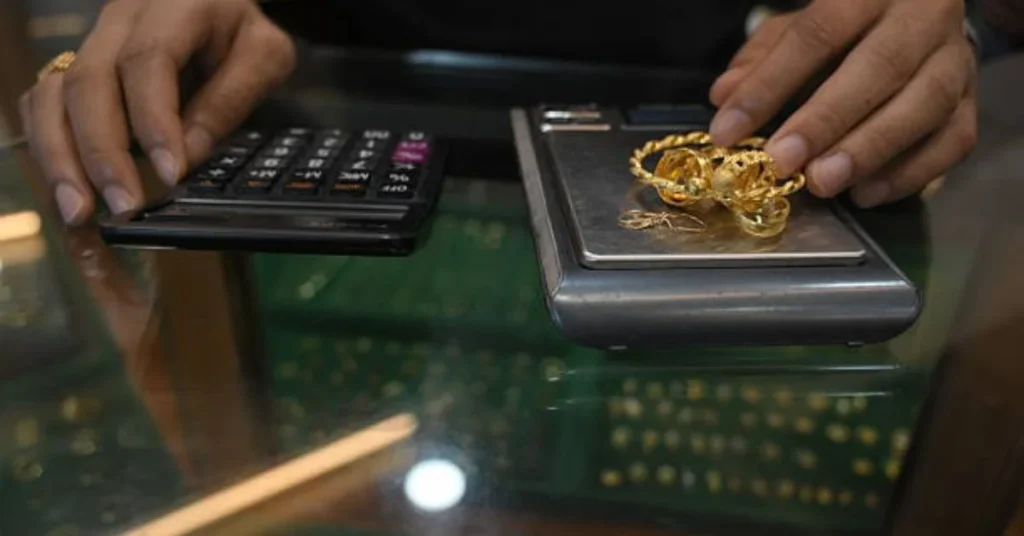
Bullion coins and bars. These trade closest to spot and carry the tightest dealer spreads. Selling gold coins or bars returns approximately 90% to 95% of spot price. At $4,300 spot, that’s $4,085–$4,085 per troy ounce before any numismatic premium. Sellers who bought at $1,800–$2,000 per ounce in 2020–2021 are looking at 100%+ gains on cost. Past performance does not guarantee future results, but the current gain window is objectively wide.
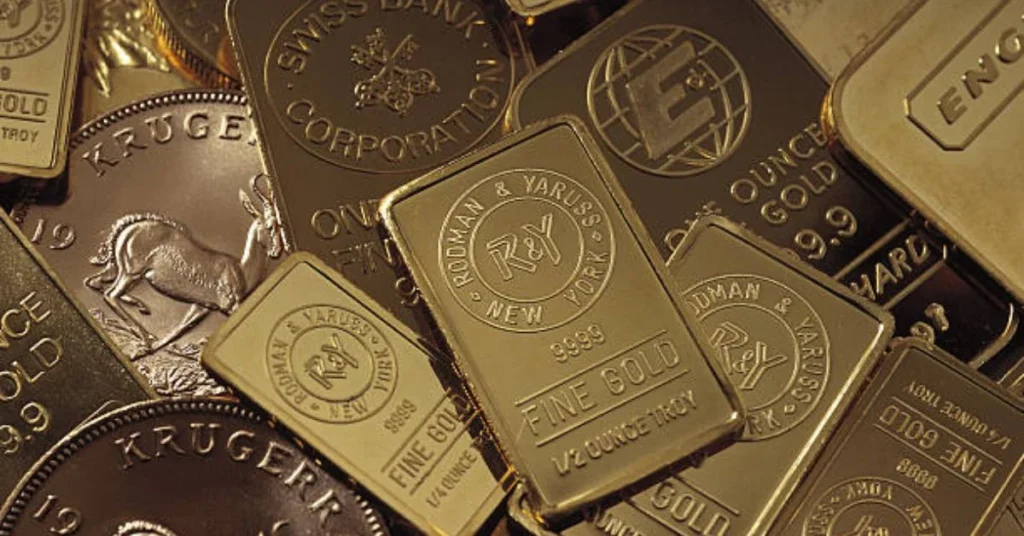
Collector and numismatic pieces. These should never be sold for scrap weight alone. Certain designer pieces can sell above melt value if condition is great. A ‘costume’ brooch might hide real diamonds. Always ask to test stones before scrapping. Getting a specialist appraisal before any high-value piece is quoted for scrap is non-negotiable.
Dental gold and industrial scrap. With gold prices hovering around record levels in 2026, this is an excellent time to sell any gold, including dental gold components and broken jewellery. Refiners buy all of it, and their per-gram payouts scale directly with spot price.
What Experts Say About Selling Gold in 2026
The institutional view on whether now is a good time to sell gold is split — not on current value, but on what comes next.
JP Morgan forecasts gold will reach $6,300 per troy ounce by end of 2026, stating they remain “firmly bullishly convicted in gold over the medium-term on the back of a clean, structural, continued diversification trend that has further to run.” Deutsche Bank similarly projects prices above $6,000 by year-end, with UBS and Société Générale targeting $6,200 and $6,000 respectively.
That’s a meaningful upside case — roughly 40% above current spot levels. If those forecasts materialise, a seller who acts in June 2026 at $4,300 would leave significant value on the table. That’s the bull case for waiting.
The bear case is equally credible. Analysts remain bearish on near-term gold prices, expecting the metal to decline toward $4,370–$3,816 by year-end 2026 amid ongoing geopolitical uncertainty and the possibility of further Fed rate hikes. A potential rate hike — currently priced at 50% probability — would strengthen the dollar and pressure gold simultaneously. Sellers who wait for $6,000 and see $3,800 instead locked in nothing.
Gold has been trading at historically strong levels heading into mid-2026, supported by central bank purchasing, geopolitical uncertainty, and inflationary pressures across major economies. Waiting for a marginally higher price carries the risk that conditions may shift, and the cost of waiting often outweighs the potential marginal gain.
Anyone who has studied gold markets understands what this divergence between bull and bear forecasts actually means: no one knows with certainty which way the next 20% moves. Selling at $4,300 after a 30% year-over-year gain and an 80% two-year gain is objectively not a poor decision, even if prices go higher afterward.
What People Get Wrong About the Right Time to Sell Gold
The biggest mistake sellers make is waiting for the absolute peak. Nobody rings a bell at $5,602. Trying to pick the single best day of the year is a stress recipe. Instead, think in ranges. If spot prices have been strong over the last few months and your quotes reflect that strength, you’re operating in a favorable window. Tiny day-to-day moves rarely change a solid offer by much — especially compared to the relief of achieving your financial goal today.
Second mistake: comparing to the all-time high and treating the current price as a loss. Gold at $4,324 today is not gold that has “fallen.” It’s gold that ran to an all-time high and corrected — which is exactly what healthy markets do. Sellers who bought at any point before 2023 are in profit regardless of whether they act now or at the peak.
Third: ignoring the difference between spot price and what a dealer actually pays. If you need cash or want to avoid the uncertainty of fluctuating markets, selling gold jewellery and other gold assets now could be a lucrative decision — especially with the price of gold at record highs. But getting that value requires shopping quotes. Comparing quotes from different gold buyers before making a move can make a significant difference — a few percentage points on a large holding represents real money.
The Personal Decision Framework
Market conditions are only one input. The other inputs are yours alone:
- Do you need the liquidity? If yes, $4,300 spot gold is a seller’s market by any historical standard. Waiting for $6,000 while carrying a financial need is speculation, not strategy.
- Is this your only inflation hedge? If gold represents a meaningful portion of your portfolio, selling everything at once removes your protection against the very conditions driving the price up.
- How long have you held it? Tax treatment on gold gains varies by jurisdiction and holding period. A qualified financial advisor should review capital gains implications before any significant sale.
- Is it insured and stored properly? The carrying cost of physical gold — storage, insurance, security — is a real ongoing expense. If you’re paying to hold it and don’t need the hedge, high prices make the exit more favourable.
The best approach is to get a professional valuation, compare offers from at least two or three buyers before accepting, and set a personal threshold and act when market conditions and your circumstances align.
Is Now a Good Time to Sell Gold — The Honest Answer
Yes — with nuance. Gold at $4,300+ in June 2026 is trading at prices that were considered extreme upper-bound scenarios just three years ago. Prices have risen over 25% since the start of 2025, fuelled by ongoing inflation and economic uncertainty. Sellers who act now are not mistiming the market. They’re locking in gains that took six years of holding to build, in a market where the next move is genuinely uncertain.
The case for waiting is legitimate if you don’t need the cash, believe the structural drivers remain intact, and can stomach the volatility between now and any higher price. The case for selling now is equally legitimate if you have financial goals the proceeds serve, or simply want to convert paper gains into real ones before conditions shift.
What’s not legitimate is waiting indefinitely because a better price might materialise. That’s not a strategy — that’s hope. And hope isn’t a position.
Also Read: Why Is Platinum So Expensive? Hidden Forces Behind the Price
FAQ
Q1: Is now a good time to sell gold in 2026?
By historical standards. Gold set a record high of $5,602.22 per troy ounce on January 28, 2026, and the current bull market has driven prices up consistently since 2020. With spot prices still near $4,300 in June 2026 — up 30% year-over-year — sellers are operating in one of the strongest gold markets on record.
Q2: Will gold prices go higher before the end of 2026?
Institutional forecasts are divided. JP Morgan projects gold reaching $6,300 by end of 2026, while Deutsche Bank targets $6,000 and UBS forecasts $6,200. On the downside, other analysts see gold declining toward $3,816 by year-end if the Federal Reserve raises rates. No forecast is guaranteed, and past performance does not guarantee future results.
Q3: How much will a gold buyer pay compared to spot price?
Sellers of gold coins and bars can expect 90% to 95% of spot price. Gold jewellery and scrap typically returns 60% to 80% of spot, reflecting refining costs, assay fees, and dealer margin. Always compare at least two or three buyer quotes before accepting any offer.
Q4: Does central bank buying affect whether now is a good time to sell gold?
Central banks purchased a net 244 tonnes of gold in Q1 2026 alone, according to the World Gold Council’s Q1 2026 Gold Demand Trends report — up 3% year-over-year and the fastest quarterly pace in over a year. Sustained central bank demand supports the price floor, which means sellers are less likely to see a sharp collapse in the near term — but it does not guarantee price direction.
Q5: Is gold jewellery worth selling for scrap right now?
Particularly broken, unworn, or outdated pieces. Even damaged rings, single earrings, or outdated designs retain value — refiners and buyers assess these pieces based on their pure gold content, allowing sellers to receive cash for jewellery that would otherwise sit unused. At current spot prices, the melt value of jewellery that has been sitting in a drawer for a decade is likely higher than at any previous point in that period.
This article is for informational and educational purposes only. It does not constitute financial advice. Always consult a qualified financial advisor before making any investment decisions. Past performance does not guarantee future results.