This article is for informational and educational purposes only. It does not constitute financial advice. Always consult a qualified financial advisor before making any investment decisions.
Picture this: you’ve got your grandfather’s gold coins sitting in a drawer, gold is trading near record territory, and your first instinct is to walk into your local Chase or Wells Fargo branch. Can you sell gold to a bank? For most people in the US, the honest answer is no — and the reason has nothing to do with trust or paperwork.
Can You Sell Gold to a Bank? Here’s the Real Answer
Let’s settle this upfront. Banks are in the currency business, not the commodities business. Most banks as we know them don’t buy gold from consumers, even though central banks sometimes buy gold to diversify reserves. That’s a different transaction entirely — central banks trade with governments and other institutions, not with someone carrying a coin tube into a branch lobby.
So when someone asks “can you sell gold to a bank,” the short version is: technically possible in rare cases, practically unlikely almost everywhere. Some banks in the United States do sell gold and other precious metals, but this isn’t widespread, and a bank that sells gold typically charges more than a dedicated precious metals dealer. The reverse — banks buying gold from individuals — is rarer still.
Here’s the practical consequence: if you’re holding physical gold and assuming your bank is a backup buyer, you’re wrong. Branch staff usually aren’t trained to assay metal, verify purity, or price bullion against the day’s spot rate. That’s not their job, and it never was, post-1971, once the dollar stopped being gold-backed.
Why People Keep Asking “Can You Sell Gold to a Bank”
The question makes intuitive sense. Banks feel official. They’re insured, regulated, and they handle money for a living, so why wouldn’t they handle gold too? But that logic is exactly what people get wrong.
Local and regional banks or credit unions are somewhat more likely to offer gold-buying services than large national banks, since smaller institutions sometimes cater to local markets with more personalized service. Even then, expect a catch.
When a bank does buy gold bullion, it tends to focus narrowly on bars or coins with at least 99.5% purity, because that standardized form is easier to assess and value — jewelry and scrap gold are usually off the table entirely.
And that’s the thing. Even the rare bank willing to buy will lowball you. On the rare occasion a smaller regional bank is willing to buy gold, the price will likely be less than what other buyers offer. So if you’re still wondering can you sell gold to a bank for a fair price, the answer leans firmly toward no.
How Gold Pricing Affects Whether You Can Sell Gold to a Bank
To understand why banks struggle here, you need to understand how gold gets priced globally. The LBMA Gold Price is administered independently by ICE Benchmark Administration and serves as the global benchmark for unallocated gold delivered in London. That benchmark is set through electronic auctions where banks, refiners, and institutional investors submit buy and sell orders until supply and demand reach equilibrium.
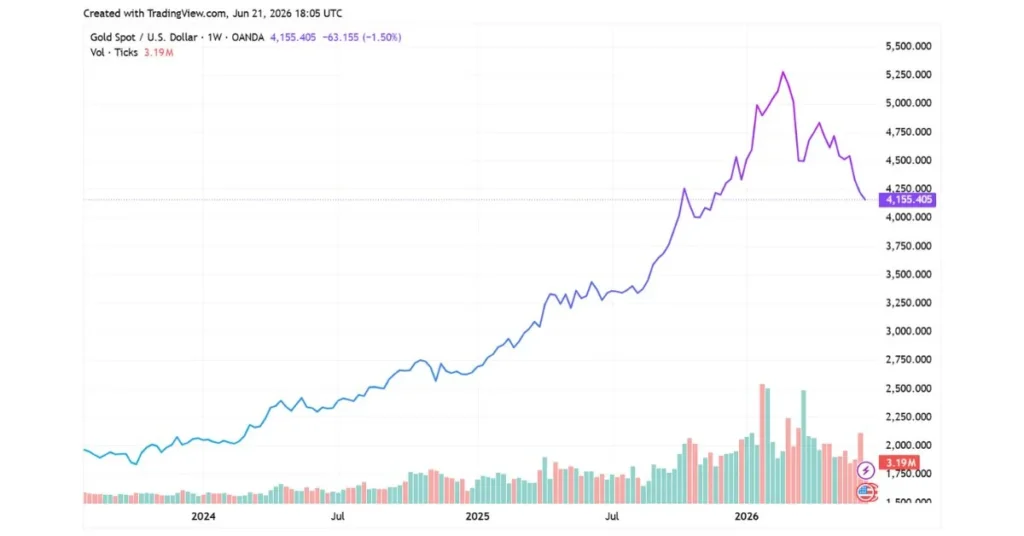
As of June 20, 2026, gold’s live spot price sat around $4,169 an ounce — well below January’s record high of $5,602.22, but still historically elevated. A bank teller isn’t watching this number in real time the way a dedicated bullion dealer is, and that gap shows up directly in what they’ll offer you.
Here’s an insight that surprises most readers: even when banks do quote a price, it rarely tracks spot closely. Many US banks that sell gold price it 7-10% above market value, with transaction fees often layered on top. Their gold volume is low, which limits their ability to compete on price the way a specialist retailer can. That pricing gap is the real reason the answer to can you sell gold to a bank rarely works out in the seller’s favor.
If You Can’t Sell Gold to a Bank, Where Do You Go?

If banks aren’t the answer, who is? Most US cities have precious metals or coin dealers with the expertise to authenticate, weigh, and value gold quickly. Local coin shops and bullion trading firms tend to be the better bet once you’ve confirmed their credentials, since banks largely stopped taking bullion directly after the gold standard ended.
A few practical steps before you sell anywhere:
- Get multiple quotes. Calling several dealers before deciding where to sell is good practice, and getting as many quotes as you feel necessary costs nothing.
- Watch for red flags. A shop with no track record or few online reviews is a warning sign worth taking seriously.
- Know your melt value first. The melt price reflects the actual metal content based on weight and purity, while spot price is simply the current market value of one troy ounce — knowing both before you walk in protects you from a lowball offer.
- Avoid generic “we buy gold” storefronts. These shops are notorious for paying low percentages of true value despite advertising heavily.
Once you’ve compared a coin dealer’s offer against what a bank would give you, the question of can you sell gold to a bank for top dollar tends to answer itself.
What the Research Shows
The pattern holds internationally, with one telling exception. In the United States, selling or buying gold through a bank fell out of favor after the transition away from the gold standard, and most banks never resumed the practice — a situation notably different from Germany, Switzerland, and India, where banks commonly sell gold bars and coins directly to customers.
Investors who track gold markets closely know this distinction matters when reading advice written for a global audience. A reader in Frankfurt asking “can you sell gold to a bank” gets a very different answer than a reader in Ohio — what’s routine at a German bank is nearly impossible to replicate at a US branch.
There’s also a tax wrinkle people frequently miss, regardless of where you sell. Net capital gains from selling collectibles, including coins, are taxed at a maximum 28% federal rate — a rate that applies to physical gold bullion and bars specifically because the IRS classifies them as collectibles. That’s notably higher than the standard long-term capital gains brackets most stock investors are used to. Past performance does not guarantee future results, and tax treatment can change, so confirm current rules before you sell, whether your buyer is a bank or a dealer.
Also Read: Sp500 vs Gold: The Real Numbers Behind the 2026 Rivalry
FAQ
Can you sell gold to a bank in the US?
No. Most US retail banks do not buy gold from customers, and the rare regional bank or credit union willing to do so typically offers below-market pricing.
Do banks pay more or less than coin dealers for gold?
Less, in nearly every case. Banks have lower gold transaction volume and less specialized expertise, which translates into weaker offers than dedicated bullion or coin dealers provide.
Is it safer to sell gold to a bank than a dealer?
Not necessarily safer, just different. A reputable, well-reviewed coin dealer with an established track record is generally as trustworthy as a bank branch, and usually pays closer to spot price.
Will I pay capital gains tax if I sell gold to a bank or dealer?
Physical gold is taxed as a collectible by the IRS, with long-term gains capped at a 28% federal rate regardless of whether you sell to a bank, dealer, or private buyer.
Can you sell gold to a bank outside the US more easily?
Banks in countries like Germany, Switzerland, and India routinely buy and sell gold bars and coins directly to retail customers, a service that’s the exception rather than the rule in the US.
This article is for informational and educational purposes only. It does not constitute financial advice. Always consult a qualified financial advisor before making any investment decisions.