
This article is for informational and educational purposes only. It does not constitute financial advice. Always consult a qualified financial advisor before making any investment decisions.
You’re scrolling a dealer’s website, you see “Gold Spot: $4,236.15,” and you have no idea why that number matters or where it comes from. What does spot price of gold mean, exactly? Here’s the short version: it’s the price for buying or selling gold right now, for immediate delivery, as opposed to some future date. Everything else builds on that one idea.
What Does Spot Price of Gold Mean in Practice?
Let’s get specific. The gold spot price is the value at which physical gold can be bought or sold for immediate delivery — set “on the spot” at the moment of the transaction, offering investors real-time quotes. In the wholesale bullion market, “immediate” usually means within two business days, often described as T+2.
So when someone asks what does spot price of gold mean compared to the price on a coin, the answer is: spot is the wholesale starting point, not the retail price. Dealers add premiums on top for fabrication, shipping, and their own margin.
Here’s what surprises a lot of new buyers. The gold spot price emerges organically from the worldwide over-the-counter market of physical gold trading rather than being determined by a single entity, with bullion banks, refiners, dealers, and retail investors collectively shaping it through constant bid and ask quoting. There’s no single boardroom where someone bangs a gavel and declares the price. It’s a continuous, global negotiation.
Who Actually Sets the Number Behind Spot Price
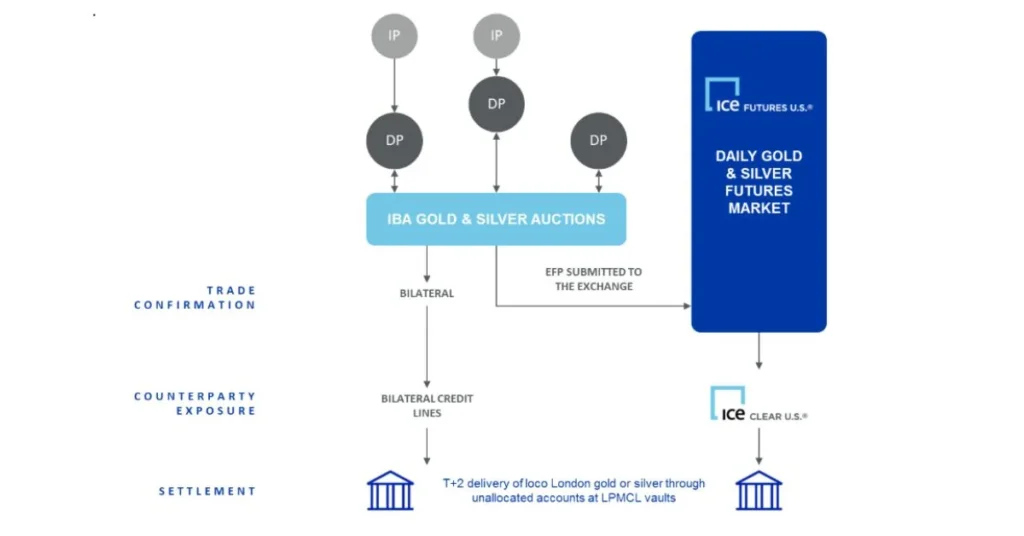
Two markets do most of the heavy lifting, and understanding both is the real answer to what does spot price of gold mean for international buyers.
LBMA (London Bullion Market Association). Twice daily, the LBMA chairperson sets a starting price, and participants — banks, refiners, institutional investors — submit buy and sell orders by volume until supply and demand reach equilibrium, establishing the benchmark price. This LBMA Gold Price is set twice a day, at 10:30am and 3:00pm UTC, in US dollars.
COMEX. COMEX, a division of the CME Group, is prominent in gold futures and options trading, and the prices established there — particularly the most actively traded futures contracts — directly influence spot prices. COMEX gold futures effectively set the floor for what buyers pay for physical coins and bars, which matters because the two markets are connected but not identical.
Investors who track gold markets closely know these two systems talk to each other constantly. When prices diverge significantly between New York and London, capital and metal flow between the markets to close the gap, usually quickly.
What Does Spot Price of Gold Mean vs. the Futures Price?
This is where most people get confused, and it’s worth untangling properly. The spot price is the value of gold for immediate or near-immediate settlement in the physical and OTC markets, while the futures price is the value of a standardized contract for delivery at a later date on an exchange like COMEX.
Futures normally trade slightly above spot in a condition called contango, reflecting the cost of storing and financing gold until delivery. When the futures curve is upward sloping — futures priced higher than spot — that’s typical for gold and generally reflects the cost of carry.
Occasionally the relationship flips. Backwardation, where futures trade below spot, typically signals physical scarcity or very high near-term demand, and happened briefly in March 2020 when COVID-19 disrupted Swiss refinery operations and physical delivery became constrained. That’s the kind of event that tells you something real is happening underneath the price, not just speculation.
Here’s a practical consequence worth remembering: less than 1% of COMEX gold futures contracts actually result in physical delivery. Most traders never touch real metal — they’re betting on price direction, not buying bars.
Why the Spot Price You See Online Isn’t Always the Same
Open three gold price websites at once and you’ll likely see three slightly different numbers. Unlike stocks with a single exchange price, gold trades continuously across global markets through a network of banks, exchanges, and data providers, and each site is quoting the spot price, the current market value for immediate delivery, though small variations appear because platforms pull data from different sources.
One mild observation here: this inconsistency trips up a lot of first-time buyers who assume gold should have one definitive price the way a stock does. It doesn’t, and that’s by design — it reflects a genuinely global, decentralized market rather than a flaw in any single platform.
Overnight price moves driven by Fed announcements, Chinese economic data, or geopolitical events happen in the COMEX futures market while London is closed, which is why a Monday morning price can look noticeably different from Friday’s close.
The Unit Spot Price Is Quoted In
Gold is typically priced in troy ounces — one troy ounce equals 31.1 grams, heavier than a standard avoirdupois ounce — and internationally it’s most often quoted in US dollars. If you see a price in another currency, it’s usually the US dollar price converted using the relevant exchange rate.
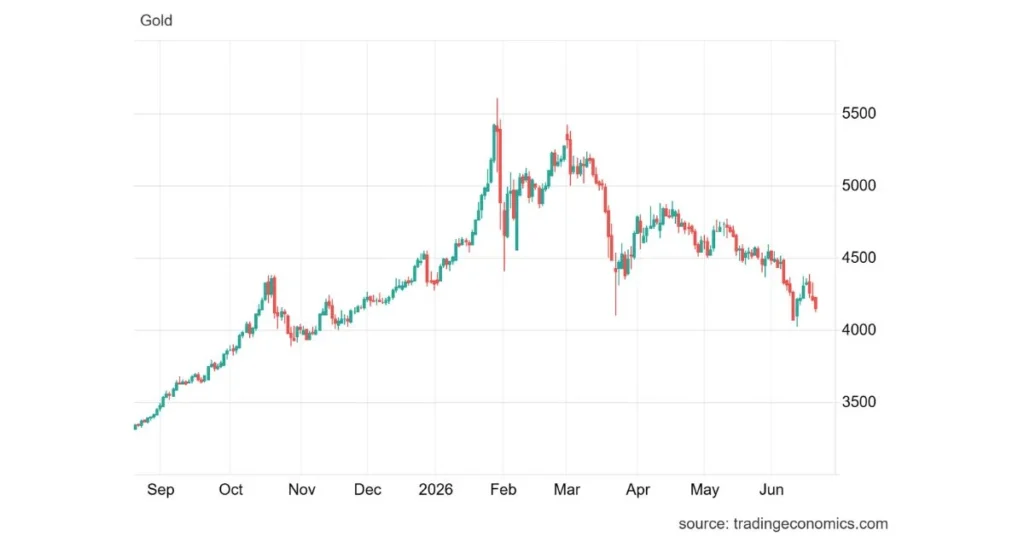
As of June 19, 2026, the LBMA PM gold price settled around $4,236 per troy ounce, down from January’s record high of $5,602.22. Past performance does not guarantee future results, and gold prices can move sharply in either direction within a single trading session.
What the Research Shows
The gap between spot and what you actually pay matters more than most buyers realize. The spot price is generally a wholesale benchmark, and retail products often trade above it due to fabrication, logistics, distribution, insurance, and dealer operating costs.
What people get wrong: assuming spot price is what they’ll pay at checkout. It isn’t, and it was never meant to be — it’s the reference point everything else is priced against, similar to how a wholesale lumber price isn’t what you pay at a hardware store. Physically-backed gold ETFs hold actual gold in vaults and their price tracks the spot price closely, minus the annual management fee — that’s about as close as a retail product gets to pure spot exposure.
Also Read: How Much Is a Kilo of Silver Worth UK? 2026 Price
FAQ
What does spot price of gold mean exactly?
It means the current wholesale price for gold delivered immediately, typically within two business days, as opposed to a price locked in for a future date.
Is spot price the same as what I’ll pay for a gold coin?
No. Retail products trade above spot because of fabrication, distribution, dealer overhead, and insurance costs layered on top of the wholesale benchmark.
Why do gold prices differ slightly between websites?
This is normal. Different platforms pull from different data sources and weight COMEX futures or LBMA auction data differently, creating small variations in the displayed number.
Does the futures price affect the spot price of gold?
COMEX futures trading volume and price discovery directly influence the spot price, and the two markets stay connected through arbitrage that closes any significant gap quickly.
Can the spot price of gold change overnight?
Gold trades nearly 24 hours a day across Asia, London, and New York, so events occurring while one market is closed still move the price before the next session opens.
This article is for informational and educational purposes only. It does not constitute financial advice. Always consult a qualified financial advisor before making any investment decisions.