This article is for informational and educational purposes only. It does not constitute financial advice. Always consult a qualified financial advisor before making any investment decisions.
Right now, on June 14, 2026, 1 grain of gold value is approximately $8.80 USD. That’s based on a live spot price of $4,224.41 per troy ounce, sourced from JM Bullion at 11:19 AM EDT — and the simple math of dividing by 480, the fixed number of grains in a troy ounce.
Most people have never heard the grain used in a gold conversation. That’s because modern bullion markets operate almost entirely in troy ounces and grams. But the grain is the oldest surviving unit of gold measurement in the world, and knowing its value opens up a different way of understanding just how expensive — and how precisely priced — this metal really is.
How 1 Grain of Gold Gets Its Value
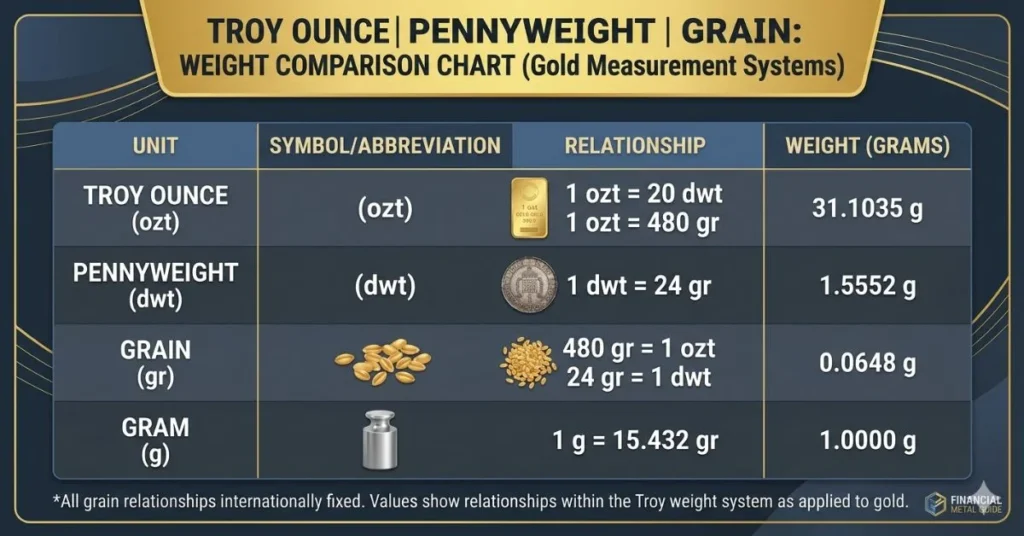
The grain isn’t arbitrary. One grain equals exactly 0.06479891 grams, and 480 grains make up one troy ounce. That relationship has been mathematically fixed since 1959, when the international grain standard was formally defined.
Here’s the calculation that matters:
- Spot price per troy ounce: $4,224.41 (June 14, 2026, per JM Bullion)
- Divided by 480 grains per troy ounce
- = $8.80 per grain (approximately, at the moment of writing)
So a single grain of gold — a piece smaller than a sunflower seed — holds about the same value as a cup of coffee in central London. Except this one you could theoretically lock in a safe and sell decades later.
The price won’t sit still. Gold spot price can fluctuate by the second, driven by investment supply and demand, and other factors. That means your grain of gold is worth slightly more or slightly less every few seconds during market hours. A $100 swing in the spot price of gold per troy ounce moves the grain value by roughly $0.21 — small in absolute terms, but proportionally identical to the full ounce.
Where the Grain Came From — and Why It Still Matters
This unit isn’t just a trivia footnote. In Troyes, medieval merchants measured 480 grains of barley to equal one troy ounce, and 12 troy ounces made up one troy pound. That French trade town, which hosted merchants from across Europe during the Middle Ages, gave the entire modern precious metals system its name. The troy ounce used by the LBMA, COMEX, and every major bullion exchange today descends from that barley-based standard.
The grain is the smallest unit in the troy system, and grains are still used today for measuring small amounts of gold, gunpowder, and some pharmaceuticals.
What surprises most people: the grain predates the gram by centuries. Metric grams became the dominant scientific standard only in the 19th century. The grain was already embedded in coinage law, pharmacy, and precious metals trading across Europe long before metric measurement existed. By the 1400s, English traders had adopted the troy system, and when King Henry VIII ruled in the 1500s, that same measure became the official way to price and mint silver and gold in England — the foundation for every coin struck in the royal mints.
What the Research Shows About Grain-Scale Gold Buying
You won’t find grain-denominated gold bars stocked at the London Bullion Market Association or traded on COMEX futures. The LBMA’s Good Delivery standard requires bars of 350 to 430 troy ounces — roughly 168,000 to 206,400 grains in a single bar. Spot gold prices are derived from exchange-traded futures contracts such as those that trade on the COMEX Exchange, with the nearest month contract with the most trading volume used to determine the spot gold price.
But at the retail level, grain-sized gold does exist. Physical 1-grain gold products — typically assay card bars of .9999 fineness — trade on secondary markets, frequently on platforms like eBay. The catch? Premium costs become extreme at this scale.
Consider the math: at $8.80 in pure metal value per grain, a retail 1-grain bar often sells for $12 to $20 or more. That’s a premium of 36% to over 100% above spot. Compare that to a 1-troy-ounce gold bar, where dealer premiums typically run 3% to 8% above spot. The smaller the unit, the larger the spread — a rule that applies from grams down to grains.
For anyone tracking small amounts of gold, that premium structure is the single most important practical fact to understand before buying.
What People Get Wrong About 1 Grain of Gold Value
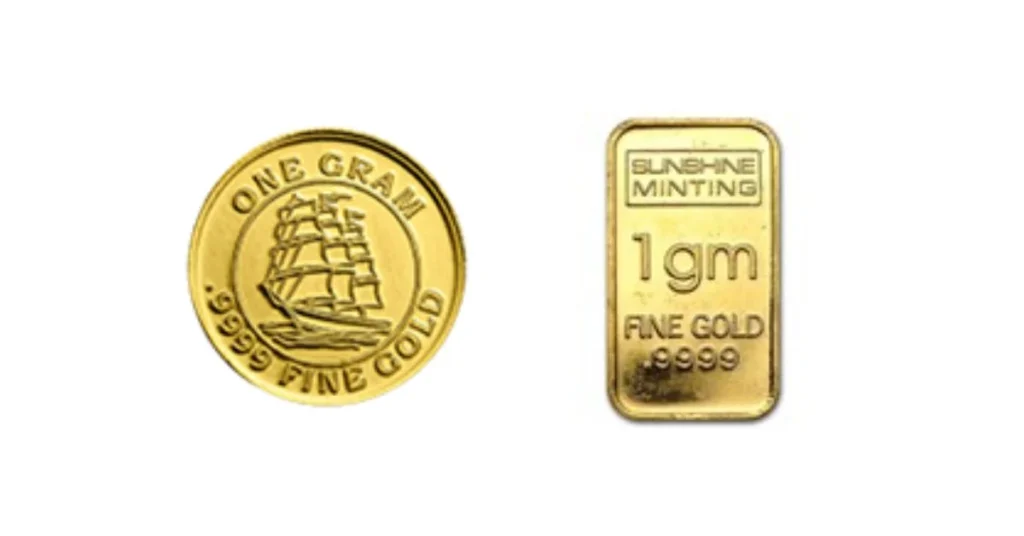
The most common mistake is confusing grams and grains. They sound similar. They are not.
- 1 gram of gold = approximately $135.82 (June 14, 2026, per JM Bullion)
- 1 grain of gold = approximately $8.80
One gram equals 15.432 grains — which means someone who confuses the two units will overestimate a grain’s value by more than 15 times. In a transaction, that misreading could mean paying grain prices for gram-scale product, or selling a gram for grain-level compensation.
A second misunderstanding involves purity. A 1-grain piece sold as “gold” could be .999 fine, .9999 fine, or 22-karat — and only .9999 fine gives you the full $8.80 per-grain spot value. A 22-karat piece, at 91.67% purity, would be worth roughly $8.07 per grain. Small difference per grain; catastrophic miscalculation if you’re scaling to hundreds of grams.
Third: many buyers assume grain-denominated gold is a good entry point for new investors. It’s not. The premium-to-metal ratio is the worst of any gold format. Investors who track gold closely know that 1-gram bars already carry thin margins by bullion standards. Grain bars are a novelty, not an investment vehicle.
1 Grain of Gold VALUE in 2026’s Record Market
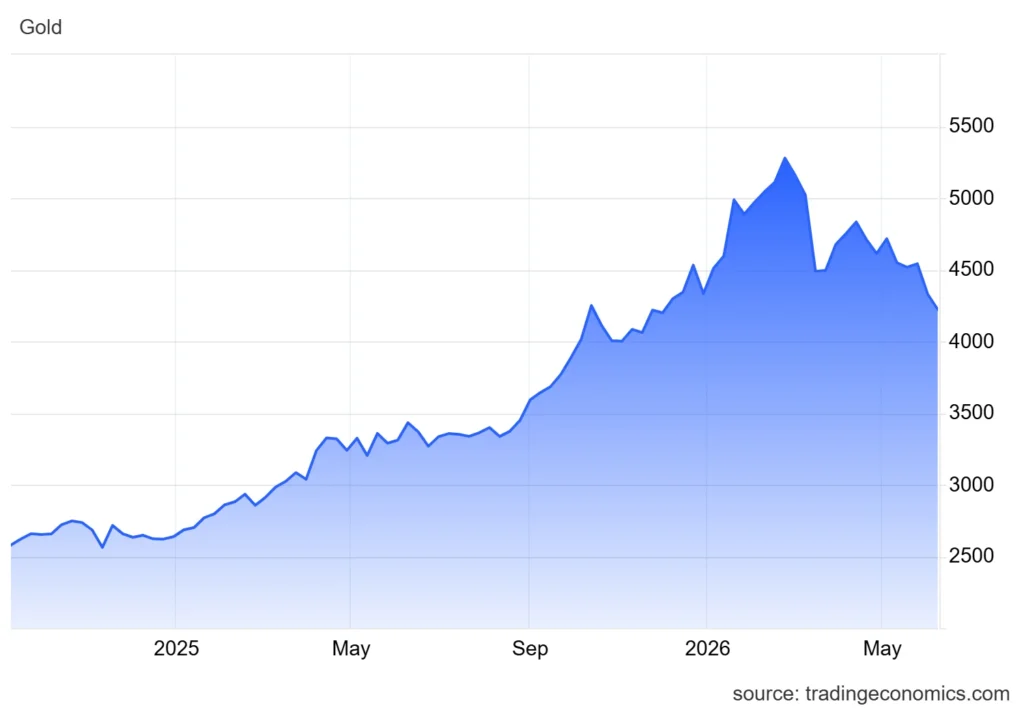
The grain’s current value only makes sense against the backdrop of where gold stands right now. Gold’s record high was achieved on January 28, 2026, at $5,602.22 per troy ounce — which would place a single grain at roughly $11.67 at that peak. In 2025, gold set 53 new all-time highs and the annual average price increased 44% over 2024, ending the year at $3,431 per ounce, according to the World Gold Council.
At those 2024 year-end prices, 1 grain of gold value was worth about $7.15. Today it’s $8.80. That’s a per-grain gain of roughly $1.65 in under six months — which sounds modest until you realize it represents a 23% move in a single unit that can barely be seen with the naked eye.
Gold is still 22.99% higher than a year ago, according to trading on a contract for difference (CFD) that tracks the benchmark market for this commodity. That macro trend is what makes even grain-level awareness relevant: it shows how the entire pricing structure — from 400-oz LBMA bars down to a single grain — moves in lockstep with global monetary pressures.
The Practical Conversion Table Every Buyer Should Know
For anyone working with small gold units, these conversions anchor every calculation:
| Unit | Weight (grams) | Value at $4,224.41/ozt (June 14, 2026) |
| 1 grain | 0.0648 g | ~$8.80 |
| 1 pennyweight (dwt) | 1.555 g | ~$211.20 |
| 1 gram | 1.000 g | ~$135.82 |
| 1 troy ounce | 31.1035 g | $4,224.41 |
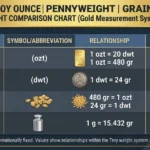
24 grains equals one pennyweight, and 480 grains equals one troy ounce — making the pennyweight a middle layer that shows up in jewelry appraisals and dental gold estimates, even though it’s largely invisible to retail bullion buyers.
If you want to calculate a grain value yourself at any moment: divide the current spot price by 480. Nothing more required.
How to Verify Gold Grain Prices in Real Time
The ISO currency code for gold is XAU. Spot prices quoted under XAU/USD on any major data terminal represent one troy ounce of gold against the US dollar. The spot price is the current market rate for one troy ounce of .999 fine gold for immediate delivery, determined primarily by COMEX — the Commodity Exchange — in Chicago, the most significant exchange for precious metals pricing.
To convert that price to a per-grain value at any moment:
- Check XAU/USD spot (available on LBMA, Kitco, JM Bullion, or Bloomberg in real time)
- Divide by 480
- That’s your 1-grain gold value
Anyone who has studied gold markets understands that this arithmetic stays constant — what changes is the numerator. The 480-grain structure of the troy ounce has been internationally fixed and isn’t subject to revision.
Gold prices increased over 70% in the last year alone, which means a grain value that was below $6 in mid-2024 has moved significantly. Tracking it as a fraction of the troy ounce lets smaller investors follow market movements without needing six-figure positions.
Conclusion
The 1 grain of gold value — approximately $8.80 at June 2026 spot prices — gives you a precise window into how gold is priced at its smallest measurable unit. That number is simple math: $4,224.41 divided by 480. But the grain’s significance goes beyond arithmetic. It’s the oldest surviving unit in the troy system, the original measure that Troyes merchants used before the troy ounce spread across every major global exchange.
For practical investors, the grain is mostly a conversion tool, not a buying unit. The premiums on grain-sized physical gold make them poor value. But knowing 1 grain of gold value tells you something important: that gold’s pricing is transparent, consistent, and scalable from a fraction of a gram all the way to the 400-ounce LBMA good delivery bar. Every grain, gram, and ounce moves in perfect proportion.
Past performance does not guarantee future results.
Also Read: DWT to Troy Ounces: The Conversion Jewelers Don’t Explain
FAQ
How much is 1 grain of gold worth today?
Approximately $8.80 USD as of June 14, 2026, based on a spot price of $4,224.41 per troy ounce divided by 480 grains. This price changes in real time during market hours.
Is a grain of gold the same as a gram of gold?
No. One gram equals 15.432 grains, making a gram worth roughly $135.82 compared to a grain’s ~$8.80 at current spot prices. Confusing these two units is one of the most common mistakes in small-scale gold transactions.
Can you buy physical gold by the grain?
1-grain gold bars exist in assay card format at .9999 purity, but they typically sell at premiums of 36% to over 100% above spot — far higher than 1-gram or 1-troy-ounce bars — making them a collector item rather than an investment product.
How many grains are in a troy ounce of gold?
Exactly 480 grains. This has been fixed internationally since 1959 and is the same standard used by mints, refineries, and the LBMA globally.
Does the grain unit affect the spot price calculation?
No. Spot price is always quoted in troy ounces. The grain is a subdivision of the troy ounce used for conversion purposes, not a traded unit on any major exchange like COMEX or LBMA.
This article is for informational and educational purposes only. It does not constitute financial advice. Always consult a qualified financial advisor before making any investment decisions.