This article is for informational and educational purposes only. It does not constitute financial advice. Always consult a qualified financial advisor before making any investment decisions.
Walk into any gold souk in Dubai, Riyadh, or Kuwait City and 21 karat gold isn’t a specialty item — it’s the default. Ask for gold jewelry in these markets and a piece stamped 875 will land in front of you before any other option. Yet outside the Middle East, most Western buyers have never bought 21 karat gold, many don’t know what the hallmark means, and a surprising number couldn’t explain why this specific karat exists at all.
As of June 14, 2026, with spot gold trading at $4,224.41 per troy ounce (per JM Bullion), one gram of 21 karat gold carries a melt value of approximately $118.88 USD. That figure positions it squarely between 18K ($98.44/g) and 22K ($120.31/g) — a deliberate middle ground that millions of jewelry buyers across three continents choose on purpose.
The Exact Math Behind 21 Karat Gold
Karat is a purity measurement out of 24 parts. Pure gold is 24 karat, and 21 karat is 21 parts gold to 3 parts other metals — equivalent to 875 fineness, meaning 875 parts of gold per 1,000 parts total, or 87.5% pure gold.
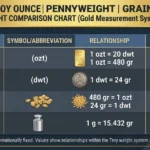
The 21K price is calculated by multiplying the 24K spot price by 0.875 (87.5%). At today’s spot of $4,224.41 per troy ounce:
- $4,224.41 × 0.875 = $3,696.36 per troy ounce of 21K gold
- Divided by 31.1035 grams per troy ounce = ~$118.88 per gram
That’s the melt value — the raw metal worth before any jeweler’s making charge, retail markup, or premium. What most buyers pay at the counter will run higher. The gap between melt value and retail price is one of the most important numbers in any gold jewelry transaction, and most buyers never ask for it.
The alloy metals blended into that remaining 12.5% vary by manufacturer and region. Copper produces warmer, reddish tones. Silver pushes the color toward a cooler yellow. Zinc hardens the alloy further. The classic 875 gold composition uses a mix of silver, copper, or zinc to enhance durability while maintaining the luxurious appearance of high-purity gold.
Why the Middle East Made 21 Karat Its Cultural Standard
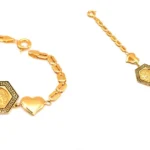
This isn’t a random market preference. 21 karat gold sits at 87.5% purity, hallmarked 875, and is the cultural standard across the UAE, Saudi Arabia, Kuwait, Qatar, Bahrain, and Oman. For Emirati and Khaleeji buyers, 21K is the default — family heirloom pieces, bridal sets, and traditional ceremonial jewelry are almost always 21K, and the hallmark 875 carries cultural resonance that other numbers do not.
The UAE’s gold hallmarking system, governed by Federal Law No. 11, formally recognizes four standard gold fineness levels: 999 (24K), 916 (22K), 875 (21K), and 750 (18K). That federal recognition means every piece sold in Dubai’s Gold Souk — one of the world’s largest gold jewelry markets — is legally required to carry the 875 mark if it’s 21 karat.
Middle Eastern gold is typically 18 karat or 21 karat, bright golden yellow in color, and because of its purity will never show signs of tarnish or rust. Gold from this region may be inscribed with ‘875’ or the numerals may be written in Arabic.
Here’s what surprises most Western buyers: the gold souk preference for 21K isn’t purely cultural sentiment — it’s rational economics. In markets where gold jewelry is treated as savings and inheritance rather than fashion accessory, buyers want the highest purity that still holds its shape under daily wear. That logic points directly to 21K.
How 21 Karat Gold Compares to Other Karats
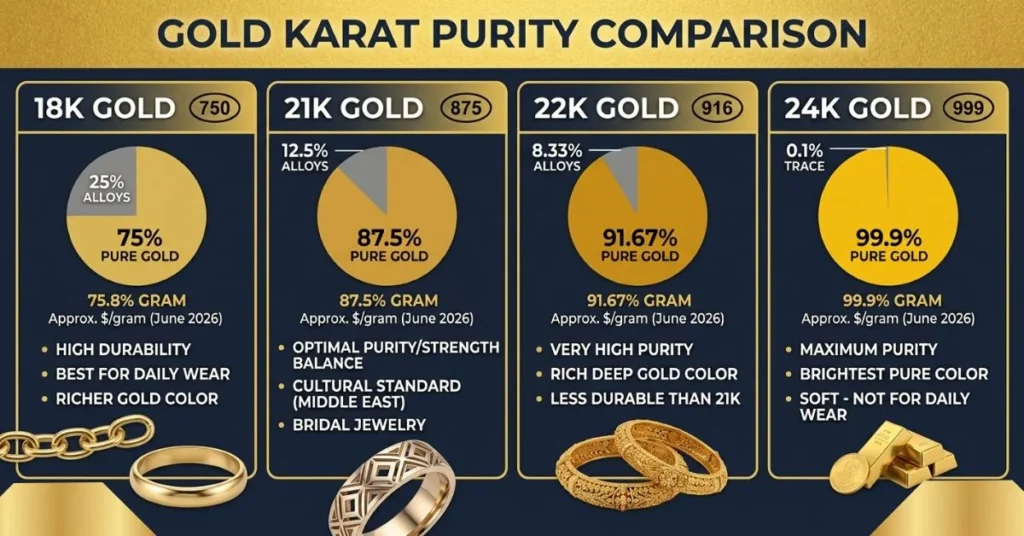
18K gold contains 75% gold and 25% other metals, making it the most durable of the three options. 21K gold contains 87.5% gold and 12.5% other metals, offering a great balance between purity and strength. 22K gold contains 91.6% gold and 8.4% other metals, making it the purest form commonly used for traditional jewelry.
A side-by-side breakdown of what each karat delivers in June 2026:
| Karat | Purity | Fineness | Approx. $/gram (June 2026) | Best For |
| 18K | 75.0% | 750 | ~$101.87 | Daily wear, set diamonds |
| 21K | 87.5% | 875 | ~$118.88 | Bridal jewelry, Middle East markets |
| 22K | 91.67% | 916 | ~$124.49 | Indian bridal, high-purity jewelry |
| 24K | 99.9% | 999 | ~$135.82 | Bullion bars, coins, investment |
The color difference between 21K and 22K is nearly invisible to the naked eye. Visually, it is difficult to distinguish 21K from 22K gold without close inspection, as both share a similar vibrant yellow hue. The practical difference shows up in durability. That extra 4.17% alloy in 21K gives it measurably better scratch resistance than 22K — a real advantage for rings and bracelets worn daily.
21K gold holds better resale value than 18K but is not as commonly traded as 22K in traditional gold markets where 22K commands the highest resale premium due to its higher purity. Past performance does not guarantee future results.
What the Research Shows About 21K Gold’s Investment Position
Investors who track gold closely know that the karat purity of physical jewelry directly affects its resale calculation. Melt value for 21K gold is determined by 87.5% of the weight multiplied by current gold values, minus any gemstones. A gemstone-studded 21K necklace, for example, will never return its full retail price at melt — the stones are excluded from the gold calculation, and making charges are not refunded.
In 2025, gold set 53 new all-time highs and the annual average price increased 44% over 2024, ending the year at $3,431 per ounce, according to the World Gold Council. At that 2024 year-end price, a gram of 21K gold was worth approximately $96.94. By June 2026, at $118.88, that’s a gain of roughly 22.6% in under six months on the melt value alone — before any jewelry premium is even considered.
Gold’s record high was achieved on January 28, 2026, at $5,602.22 per troy ounce — which pushed 21K’s per-gram melt value to approximately $157.53 at that peak. Anyone holding 21K jewelry bought at 2024 prices saw extraordinary paper gains in early 2026. The market has since corrected, with gold trading around $4,224 in mid-June 2026, but remains significantly above its historical averages.
And that’s the thing. Physical 21K jewelry carries dual value: the intrinsic metal content tracked daily by the spot price, and the cultural or aesthetic premium from craftsmanship. The metal value is always there regardless of fashion cycles. The craftsmanship premium can evaporate the moment a design goes out of style.
What People Get Wrong About 21 Karat Gold
Mistake 1: Assuming 21K doesn’t exist in Western markets. In the UK, jewellery is not commonly made in 875 gold — 22, 18, and 9 carat are more common — but with the growth of online shopping, 875 gold is slowly becoming more common. Buyers sourcing gold internationally through e-commerce increasingly encounter 21K pieces without realizing what the hallmark means.
Mistake 2: Confusing 875 silver with 875 gold. 875 is also a known fineness for silver, notably in Russian and Soviet silver, often accompanied by specific national symbols. A piece stamped only “875” without a gold symbol or country hallmark should be tested before any valuation. XRF (X-ray fluorescence) testing is the standard verification method used by dealers and Dubai’s hallmarking authorities.
Mistake 3: Expecting 21K jewelry to trade at melt in all markets. The Middle East, particularly Saudi Arabia, the UAE, Kuwait, and Bahrain, favors 21K and 22K as the most popular choices — gold souks in Dubai and Riyadh display jewelry noticeably more yellow than what you’d typically find in American or European jewelry stores. Selling 21K in a market that predominantly values 18K means the buyer’s familiarity with 21K is lower, and offers may not reflect the metal’s true purity premium.
If you skip understanding the local market before selling, you risk accepting 18K-equivalent pricing for 21K gold.
How to Read a 21 Karat Gold Hallmark
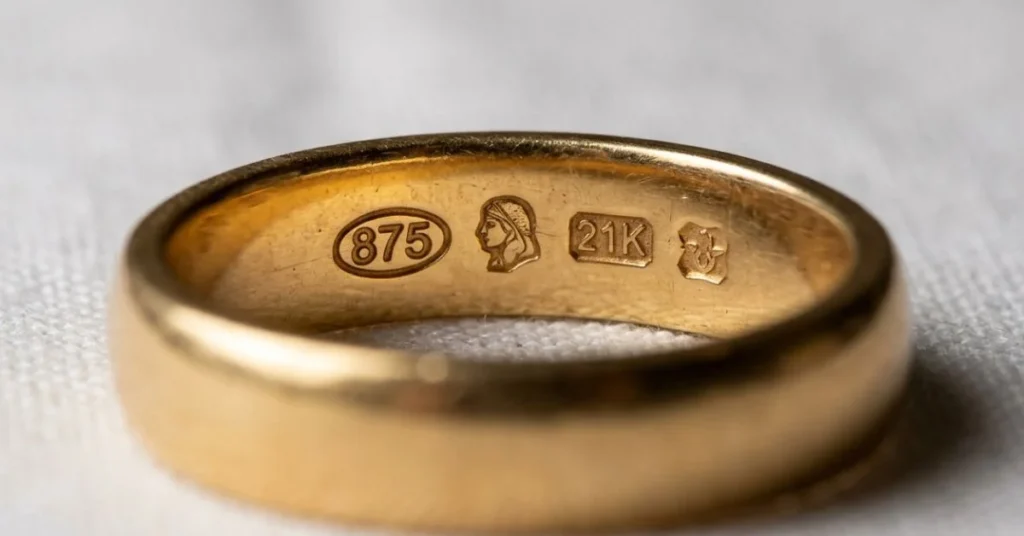
21K gold is also commonly marked as 875 gold — this is an interchangeable term, and the hallmark may be very small but must be visible in order for a piece to be appropriately valued.
Legitimate 21K gold pieces typically show one or more of the following marks:
- 875 — fineness stamp (most common globally)
- 21K or 21KT — karat notation (common in the US and Middle East)
- 0.875 — decimal purity (occasionally used on bars)
- A country-specific assay mark alongside — required in UAE, UK, and most regulated markets
In Dubai, XRF testing is the standard method for pre-hallmarking purity verification and post-market compliance inspection. For buyers purchasing 21K pieces outside regulated markets, an acid test or XRF reading from a certified jeweler remains the only reliable verification method. Hallmarks can be forged; metal composition cannot.
Conclusion
21 karat gold occupies a precise position in the global market: 87.5% pure gold, fineness-stamped 875, deeply embedded in Middle Eastern jewelry culture, and worth approximately $118.88 per gram at June 2026 spot prices. It’s not a compromise karat. In the UAE, Saudi Arabia, and across the Gulf, it’s the deliberate choice of buyers who want maximum purity without sacrificing the durability needed for pieces worn every day.
For international buyers encountering 21 karat gold for the first time, the most important number to know is 875. That hallmark connects directly to the global spot price of gold through a calculation — spot × 0.875 ÷ 31.1035 — that works at any market, in any currency, on any day the gold market is open.
Past performance does not guarantee future results.
Also Read: Highest Karat Gold: The Surprising Truth About 24K
FAQ
Is 21 karat gold real gold?
It contains 87.5% pure gold (XAU) and 12.5% alloy metals such as copper, silver, or zinc. It carries the fineness hallmark 875 and is legally recognized as a gold standard in the UAE under Federal Law No. 11.
How much is 21 karat gold worth per gram today?
Approximately $118.88 USD per gram as of June 14, 2026, calculated from a spot price of $4,224.41 per troy ounce multiplied by 0.875 (21K’s purity factor) and divided by 31.1035. This melt value changes with every movement in the XAU/USD spot price.
Is 21 karat gold better than 22 karat for jewelry?
If durability matters more than maximum purity. 21K contains 4.17% more alloy than 22K, making it slightly more scratch-resistant for daily wear. The color difference between the two is nearly imperceptible without direct comparison.
Can I sell 21 karat gold anywhere?
No. Markets outside the Middle East and parts of Asia are less familiar with 21K, and some buyers may misprice it or offer 18K rates. Selling in a market where 21K is the cultural standard — Dubai’s Gold Souk, for example — typically yields the most accurate valuations.
What does 875 stamped on gold mean?
875 is the fineness mark for 21 karat gold. It means 875 parts per 1,000 are pure gold — exactly 87.5% purity. The same number on silver indicates a different metal entirely, so the surrounding hallmarks confirming the material type matter as much as the number itself.
This article is for informational and educational purposes only. It does not constitute financial advice. Always consult a qualified financial advisor before making any investment decisions.