This article is for informational and educational purposes only. It does not constitute financial advice. Always consult a qualified financial advisor before making any investment decisions.
UK households are now spending about £3,200 more every year than they were before the 2021 inflation surge began, according to figures from the Office for National Statistics. That’s the kind of number that makes gold versus inflation feel less like an investing debate and more like a household budgeting problem.
Gold versus inflation looks different depending on where you live and which currency you’re counting in. In the United States, the Consumer Price Index rose 4.2% over the year to May 2026, the highest annual rate since April 2023, the Bureau of Labor Statistics reported. In the UK, CPI inflation eased to 2.8% in April 2026, down from 3.3% in March, according to the Office for National Statistics. Gold, meanwhile, has been moving on its own schedule entirely.
Gold Versus Inflation: Why UK Households Are Feeling the Squeeze in 2026
Start with the UK numbers, because they tell a story that contradicts a lot of US-focused gold commentary. UK CPI inflation eased to 2.8% in the 12 months to April 2026, down from 3.3% in March, the Office for National Statistics reported. Core inflation, which strips out food and energy, fell to 2.5% in April, its lowest reading since July 2021.
Sounds like good news. Except motor fuel prices jumped 23% over the same 12 months, the sharpest annual rise since September 2022, and the Bank of England’s Monetary Policy Committee voted 8-1 in April 2026 to hold Bank Rate at 3.75%, with one member pushing for a hike to 4%.
Here’s what people get wrong about gold versus inflation in a UK context. They see falling headline CPI and assume the inflation threat has passed. But the Bank of England’s own Decision Maker Panel survey shows UK businesses now expect inflation to run at 3.5% over the next year, up from 3.0% the month before. Expectations moved up even as the official rate moved down.
That gap between what the data says today and what people expect tomorrow is exactly the kind of environment where gold tends to attract attention. The practical consequence for UK savers? Cash sitting in an account paying less than 3.75% gross is still losing ground in real terms if those inflation expectations turn out to be right, regardless of what last month’s CPI print said.
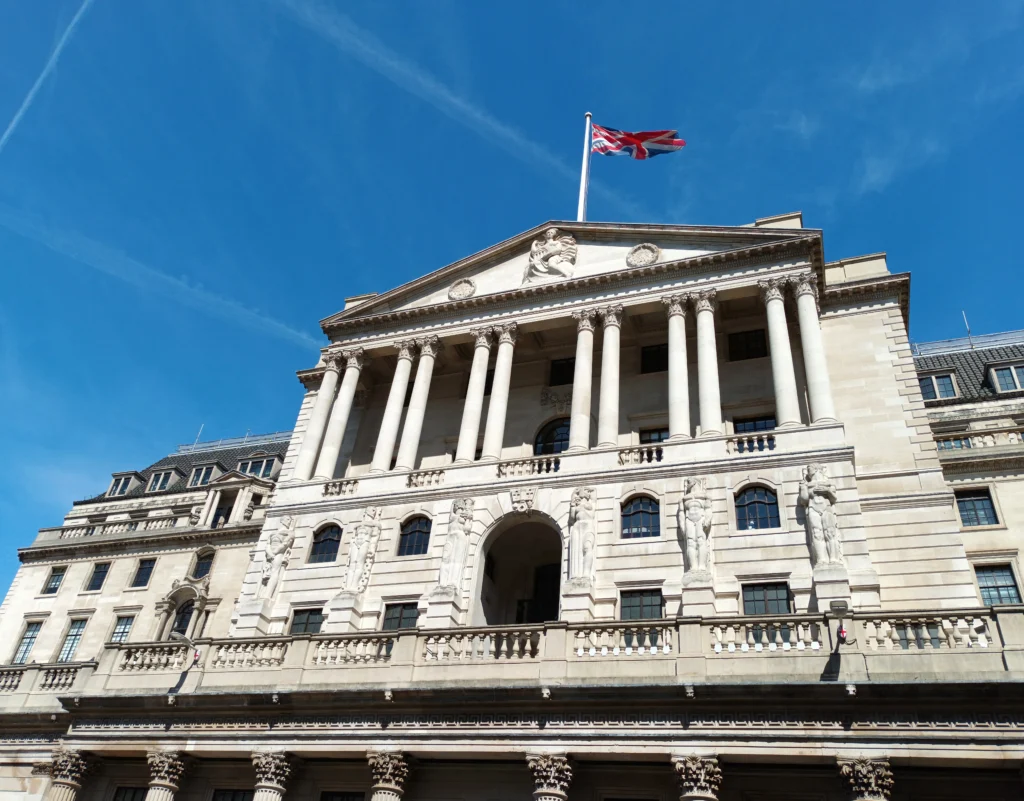
Source: acediscovery, CC BY 4.0 https://creativecommons.org/licenses/by/4.0, via Wikimedia Commons
Gold Versus Inflation on Both Sides of the Atlantic
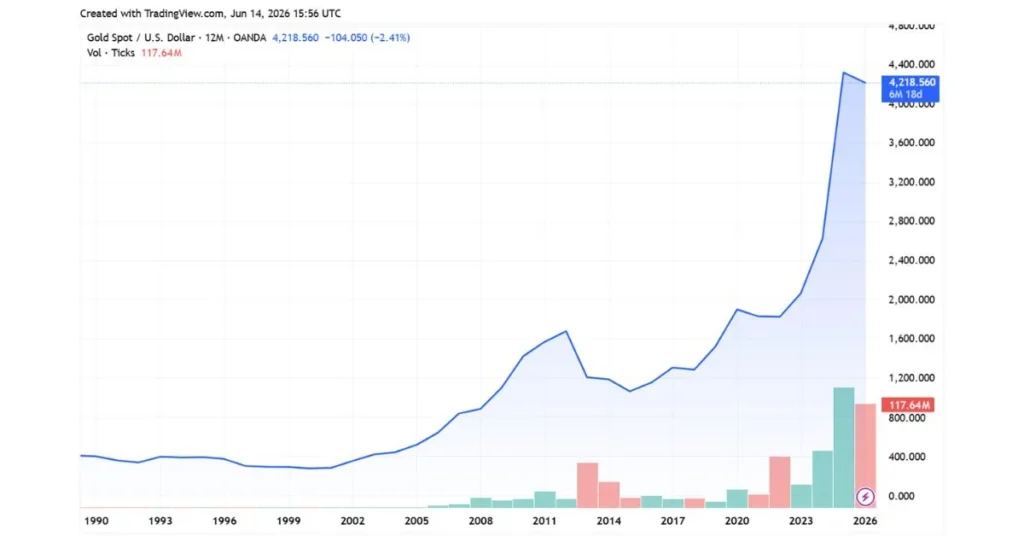
Gold versus inflation produces very different scorecards depending on your currency. In the US, gold traded around $4,200 per troy ounce on June 12, 2026, according to Trading Economics data sourced from ICE Benchmark Administration, up close to 23% from a year earlier. Against a 4.2% CPI print, that’s gold beating inflation by roughly five times over.
Cross the Atlantic and the picture changes. Gold in the UK averaged £3,566.32 per ounce across 2026 so far, according to exchange-rates.org, ranging from a low of £3,216.56 on January 2 to a high of £3,978.49 on March 2. That puts gold’s 2026 gain in GBP terms at around 5.6%, against UK CPI of 2.8%. Gold’s still ahead, but by roughly two times, not five.
What’s surprising is why that gap shrinks so much. It isn’t that gold performed worse for UK holders. It’s that the pound’s movement against the dollar ate into a meaningful chunk of the dollar-denominated gain once it gets converted back into sterling. Gold versus inflation, in other words, is also a story about your home currency.
The practical consequence for UK buyers: returns on gold bought through a UK dealer or stored in a UK vault depend on GBP/USD movements almost as much as on the gold price itself. A weaker pound can flatter returns. A stronger pound can erase them, even while the dollar price of gold climbs.
What Experts Say About Gold’s Role When Inflation Diverges
Anyone who has studied gold markets understands that gold’s inflation-hedge story isn’t a single, universal number. The World Gold Council’s research on Japan makes that point sharply. Looking at data running from January 1985 to February 2026, the Council found that during periods when Japanese inflation rose above the Bank of Japan’s 2% target, gold priced in yen delivered an average nominal return of 23% annually, equivalent to a real return of around 16%.
That’s a bigger gap between gold and inflation than either the US or UK figures show in 2026. What the research shows, overall, is that gold’s inflation-hedging strength depends heavily on the currency you’re measuring in and the monetary policy regime of that country.
Here’s what people get wrong: treating “gold is an inflation hedge” as one fixed statistic, as though it scores the same everywhere. It doesn’t. A Japanese investor holding gold through a period of above-target inflation has historically seen a dramatically different outcome than a US or UK investor holding the same metal over the same calendar period, purely because of currency and local rate dynamics.
The practical consequence? If you’re holding gold specifically as an inflation hedge, the currency you price it in, and the inflation rate in that currency’s home country, both matter as much as the gold price itself. Gold versus inflation isn’t one equation. It’s a different equation in every currency zone.
Three Ways Investors Actually Use Gold During Inflation Spikes
Gold versus inflation isn’t just a theory for institutional trading desks. Real investors and institutions use gold in a few specific ways when inflation accelerates.
- Central banks use it as a reserve diversification tool. The World Gold Council recorded 863.3 tonnes of net central bank gold purchases in 2025, well above the 2010-2021 annual average of 473 tonnes, even after a 21% drop from 2024’s pace. Individual investors copying this approach typically hold gold as a small, permanent slice of a portfolio rather than as a trade.
- Investors lean on gold during stagflation-style conditions. Since 1973, gold has returned roughly 32% annually during periods combining high inflation with weak growth, according to CME Group’s analysis of historical data, compared with about -11.6% for US equities over the same windows. Past performance does not guarantee future results.
- Households in regions with currency instability hold physical gold, including jewelry and coins, as a store of value that doesn’t depend on any single bank or government. This is the oldest use case on this list and remains common across South Asia, the Middle East, and parts of Europe.
Each of these uses treats gold differently. A central bank isn’t trying to “beat” inflation this quarter. A stagflation-focused investor is positioning for a multi-year regime. A household holding jewelry is prioritizing portability and trust over yield. Gold versus inflation means something different in each case.
The Challenges Gold Doesn’t Solve
Gold versus inflation has limits worth being honest about.
Gold pays no interest or dividend. With the Federal Reserve holding its target range at 3.5%-3.75% and the Bank of England holding Bank Rate at 3.75%, cash and bonds are paying returns that gold simply doesn’t offer. Every month gold sits in a vault, it’s competing against yields most investors can get elsewhere.
Short-term price swings can also work against the inflation-hedge narrative right when it matters most. Gold hit a record $5,602.22 per troy ounce on January 28, 2026, according to APMEX pricing data, then fell to around $4,200 by mid-June, even as US CPI inflation accelerated to 4.2%. Anyone expecting gold to climb in a straight line alongside the inflation headlines would have been disappointed for months.
Physical gold adds its own costs too. Storage, insurance, and dealer spreads all eat into returns, whether gold prices are rising or falling.
Most importantly, gold doesn’t pay the bills. A UK household facing £3,200 in extra annual costs needs cash flow, not unrealized gains sitting in a safe. Gold versus inflation can protect long-term purchasing power on paper, but it doesn’t substitute for the income needed to cover today’s grocery and energy bills.
Where Gold Versus Inflation Goes From Here
Looking ahead, the inflation backdrop on both sides of the Atlantic points toward more uncertainty rather than a clean resolution. The Federal Reserve’s latest projections put both headline and core inflation at 2.7% by the end of 2026, with the federal funds rate expected to see just one quarter-point cut this year.
The Bank of England, for its part, projected UK CPI at 3.1% for the second quarter of 2026, rising to 3.3% in the third quarter and climbing further in the fourth, driven by higher energy and food prices tied to the Middle East conflict.
It’s a strange moment, honestly. Two central banks looking at roughly the same energy shock and landing on roughly the same answer: hold rates, wait, and hope the pressure fades on its own.
For gold, the World Gold Council’s 2026 outlook frames a base case where the current price already reflects market consensus on growth, inflation, and policy, meaning a broadly sideways path is plausible from here. The Council also outlines scenarios where a renewed inflation scare or a sharper slowdown could push gold 5% to 20% in either direction from current levels.
None of this amounts to a prediction. Gold versus inflation in the second half of 2026 will depend on data that hasn’t been published yet, on both sides of the Atlantic, and past performance does not guarantee future results.
Also Read: How Much Silver Should I Own? The Surprising Answer
FAQ
Does gold keep pace with inflation over the long term?
The World Gold Council’s research describes gold as a proven long-term inflation hedge, even though its month-to-month correlation with the Consumer Price Index is weak.
Does gold fall when inflation falls?
No. Gold doesn’t move in lockstep with CPI in either direction. In 2026, gold fell sharply from its January record even as US inflation accelerated, showing the relationship can run both ways.
Does the exchange rate affect gold’s inflation-hedge performance?
UK investors measuring gold in pounds saw a smaller 2026 gain than US investors measuring in dollars, largely because of GBP/USD movements rather than the gold price itself.
Should I sell gold once a country’s inflation rate starts falling?
No. UK core inflation fell to 2.5% in April 2026, its lowest since July 2021, yet one-year inflation expectations rose to 3.5% over the same period, the opposite signal.
Does central bank gold buying support its role as an inflation hedge?
Central banks bought 863.3 tonnes of gold in 2025, according to the World Gold Council, well above the 2010-2021 average, adding demand that’s independent of retail inflation hedging.
This article is for informational and educational purposes only. It does not constitute financial advice. Always consult a qualified financial advisor before making any investment decisions.