This article is for informational and educational purposes only. It does not constitute financial advice. Always consult a qualified financial advisor before making any investment decisions.
Here’s something dealers don’t put on their front page: the 1/10 oz gold price today is not just the spot price divided by ten. At today’s spot price, the melt value of a 2026 1/10 oz Gold American Eagle coin is $447.43 — but what you actually hand over at checkout is meaningfully higher. Understanding that gap is the difference between a smart fractional gold purchase and an expensive mistake.
Gold spot price as of June 17, 2026 stands at $4,354.02 per troy ounce, according to JM Bullion’s live feed updated at 10:14 AM EDT. Divide that by ten and you get your baseline. Everything above that number is premium — and with 1/10 oz coins, that premium is substantial.
What the 1/10 oz Gold Price Today Actually Looks Like
The spot price is the starting point, not the finish line. A 1/10 oz Gold Eagle costs around $530 at current prices after dealer premiums are applied. That gap between melt value and retail price — roughly $80 to $100 per coin right now — is the premium, and it’s non-negotiable when buying from any legitimate dealer.
Money Metals Exchange lists a current buyback price of $439.83 per 2026 1/10 oz American Gold Eagle — which means the spread between what you pay to buy and what a dealer pays to buy back from you is approximately $90 per coin at current market conditions. That spread is your immediate paper loss the moment you complete a purchase.
A 1/10 oz Gold Eagle or Maple Leaf might sell at a 10 to 15% higher premium than its full-ounce counterpart — a direct result of minting costs being fixed regardless of the coin’s weight. The US Mint spends roughly the same amount of labour and machinery time striking a 1/10 oz coin as it does a full ounce. That cost gets spread over one-tenth the gold. So the buyer absorbs it.
The practical consequence is clear: if you’re buying fractional gold purely to maximise gold weight per dollar spent, the 1/10 oz size is the least efficient option on the market. But cost-per-ounce efficiency isn’t why most investors buy it.
Why Investors Pay That Premium Anyway
A one-ounce Gold Eagle costs over $5,000 after premiums at current prices. A 1/10 oz Gold Eagle costs around $530. That lower entry point opens gold ownership to investors who cannot commit thousands of dollars at once.
That accessibility is the entire argument for fractional gold — and it’s a legitimate one. For someone putting aside $500 per month toward tangible assets, fractional gold makes gold accessible on a regular schedule. Without fractional sizes, that same investor would need to save for ten months before buying a single coin.
Liquidity is the second argument. If you own one ounce of gold and need $500, you have to sell the entire coin. With fractional gold, you can sell a 1/10 oz piece and keep the rest. That flexibility can be helpful during emergencies or when you want to take partial profits without liquidating your whole position.
And there’s the dollar-cost averaging angle. Fractional coins let you buy a fixed dollar amount on a regular schedule regardless of price. In months when gold is expensive, your $500 buys a 1/10 oz coin. In months when gold pulls back, the same $500 still buys a 1/10 oz coin at a lower cost basis.
Fractional gold also offers flexibility as a gift for birthdays, graduations, and holidays. A 1/10 oz Gold Eagle in a display case is a tangible, lasting present that holds its value. For estate planning, fractional coins are easier to divide among multiple heirs than a single large bar.
What the 1/10 oz Gold American Eagle Actually Is
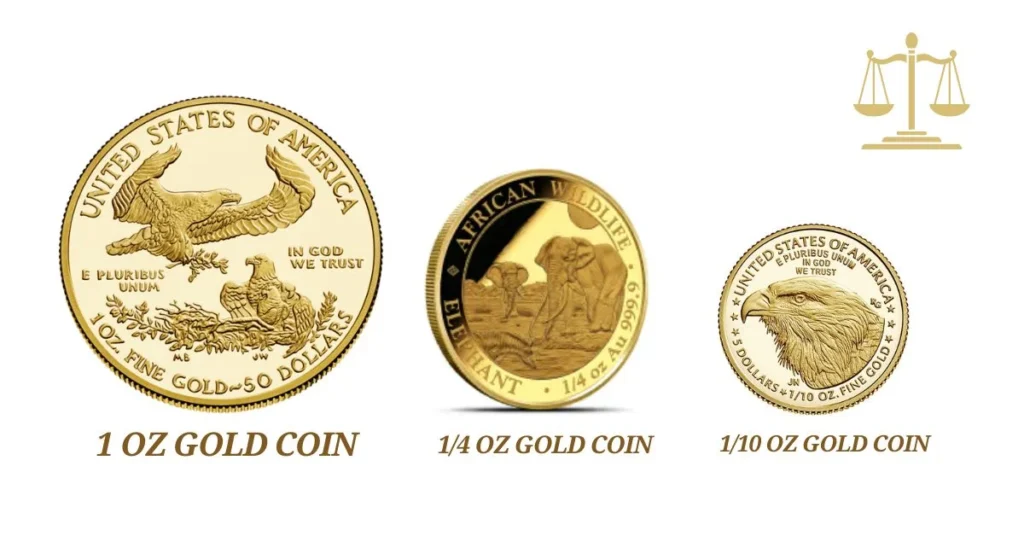
Not all 1/10 oz gold coins are equal — and the American Gold Eagle is the benchmark everything else gets measured against.
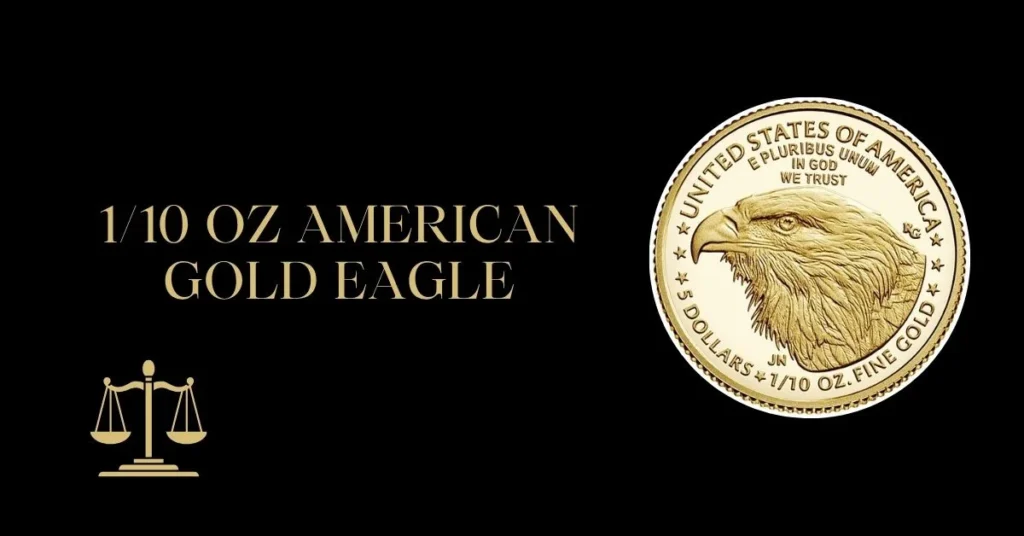
The 2026 1/10 oz Gold American Eagle $5 coin is struck in 22-karat gold, contains 1/10 troy ounce of pure gold, and arrives in Brilliant Uncirculated condition. As a legal-tender bullion coin, it is widely recognised and liquid, with pricing that closely tracks the gold spot price plus a dealer premium.
The 2026-dated issue features the current Type 2 American Eagle design suite introduced in 2021. The US Mint refined the historic Saint-Gaudens Liberty on the obverse using original design assets and adopted a new close-up bald eagle on the reverse.
The 1/10 oz American Gold Eagle is a bit smaller than a dime — a physical detail that surprises most first-time buyers. At 16.5mm in diameter, this is a coin that fits comfortably between two fingers. Its small size is actually an advantage for storage: ten of them stack in the same space as a single full-ounce coin.
The coin contains an alloy called crown gold — 91.7% gold, 3% silver, and 5.3% copper — giving it durability that pure 24-karat gold coins lack. Each coin carries a $5 face value as legal US tender.
What Experts Say: Premiums, Timing, and the 2026 Context
Investors who have studied gold markets understand that the premium question changes depending on where spot prices sit. Right now, that context matters enormously.
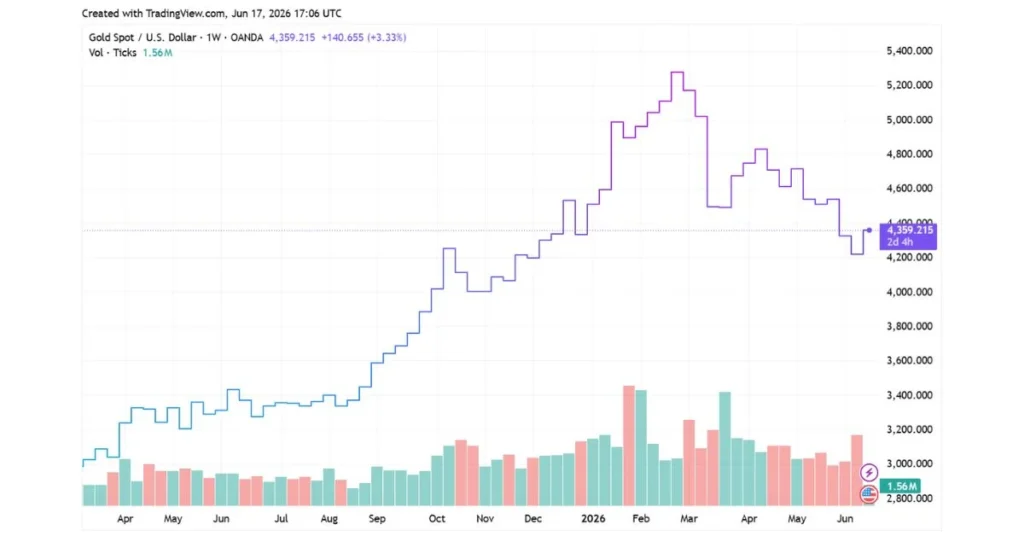
Gold’s current record high was achieved on January 28, 2026, at $5,602.22 per troy ounce — which means the 1/10 oz gold price today, at roughly $530 with premium, represents a meaningful discount from what buyers were paying just five months ago. Anyone who purchased fractional gold at or near the January peak paid significantly more per coin for the same weight of metal.
Gold traded above $4,300 per ounce on Wednesday, up more than 2% so far this week, as investors awaited the signing of a US-Iran peace agreement expected to restore oil flows through the Persian Gulf, helping ease concerns over inflation and interest rates. That geopolitical development shifted rate cut expectations and lifted gold off its spring lows — which directly lifted the 1/10 oz gold price today along with it.
Dollar-cost averaging emerges as the optimal strategy for accumulating fractional gold. By investing a fixed amount monthly — even as little as $50 to $100 — investors smooth out price volatility while building positions gradually. Many dealers offer accumulation programs with reduced premiums for committed monthly buyers.
The one warning experts consistently attach to fractional gold: an investor accumulating ten ounces of gold would pay more in premiums buying all 1/10 oz coins versus buying ten one-ounce coins. For serious long-term accumulators, the premium inefficiency compounds over time. The 1/10 oz format makes most sense as an entry point — not a permanent accumulation strategy.
What People Get Wrong About the 1/10 oz Gold Price
The most common mistake new buyers make is treating the 1/10 oz gold price as simply one-tenth of the spot price. By that logic a coin should cost around $435 today. Walk into any reputable dealer and you’ll pay $490 to $530. The confusion causes sticker shock — and sometimes drives buyers toward less reputable sources offering coins “near spot” that turn out to be counterfeit or heavily worn secondary market pieces.
Physical gold’s costs appear in the form of premiums that dealers charge for their services. The percentage charged depends greatly on the type of physical gold you buy. Gold bars and simple rounds are usually available for 1% to 5% above the spot price, but some gold coins can charge between 10% and 20%, depending on their rarity.
The counter-intuitive insight here: buying a 1/10 oz gold bar instead of a coin is often cheaper per gram of gold while delivering the same fundamental exposure. Rounds and bars carry lower premiums than bullion coins. Fractional gold coins can be great too, but expect to pay a higher government premium for these. If recognition and liquidity in secondary markets matter less to you than cost efficiency, fractional bars are worth comparing before committing to coins.
Also Read: Size of 1 Ounce of Gold: The Surprising Truth Explained
FAQ
What is the 1/10 oz gold price today?
At today’s gold spot price, the melt value of a 2026 1/10 oz Gold American Eagle is $447.43. Retail purchase prices from reputable dealers currently run between $490 and $530 depending on the dealer and payment method.
Why is the 1/10 oz gold coin more expensive per ounce than a full-ounce coin?
Proportionally more expensive. A 1/10 oz Gold Eagle or Maple Leaf typically carries a 10 to 15% higher premium than its full-ounce counterpart, because minting costs are roughly the same regardless of how much gold goes into the coin.
Is the 1/10 oz American Gold Eagle a good investment in 2026?
It depends on your goal. For someone putting aside $500 per month toward tangible assets, fractional gold makes gold accessible on a regular schedule — making it a sensible entry point. For maximising gold weight per dollar, full-ounce coins or bars are more efficient. Past performance does not guarantee future results.
What is the purity of a 1/10 oz Gold American Eagle?
The coin is struck in 22-karat gold — 91.67% pure gold — alloyed with silver and copper for added durability, and contains exactly 1/10 troy ounce of pure gold content.
Can I sell my 1/10 oz gold coin back easily?
Money Metals Exchange buys back the 2026 1/10 oz American Gold Eagle daily at $439.83 per coin, purchasing up to 200 coins at that price. The American Gold Eagle’s US Mint backing makes it one of the most liquid fractional gold coins in any global market.
This article is for informational and educational purposes only. It does not constitute financial advice. Always consult a qualified financial advisor before making any investment decisions. Past performance does not guarantee future results.