This article is for informational and educational purposes only. It does not constitute financial advice. Always consult a qualified financial advisor before making any investment decisions.
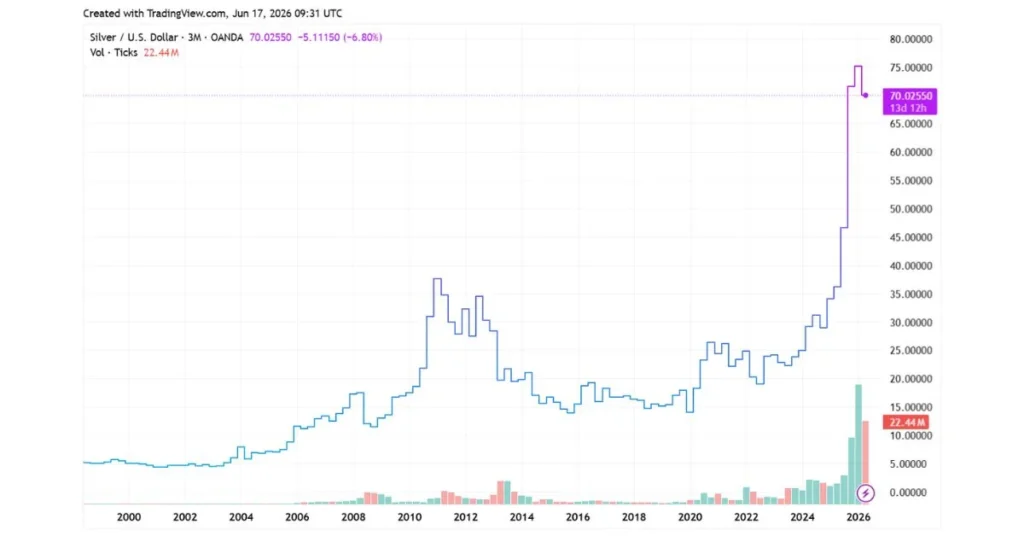
The news on silver in 2026 has been anything but quiet. Silver hit a record high of $121 per ounce in January 2026 — a level the market had never seen — then corrected sharply, leaving investors confused about whether the bull run was over or just pausing. As of June 17, 2026, silver trades at $70.42 per troy ounce, still 91.67% higher than one year ago.
That gap between the January peak and today’s price is where the real story lives.
News on Silver Right Now: Six Years of Supply Deficit
Before looking at price, you need to understand what’s underneath it — because the structural story is more important than any single week’s movement.
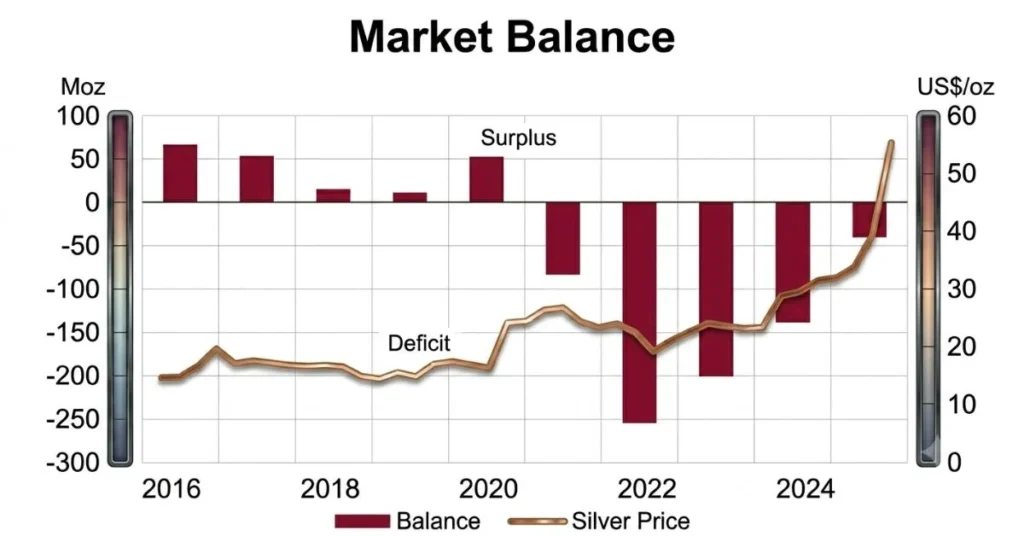
According to the Silver Institute’s World Silver Survey 2026, produced alongside London-based consultancy Metals Focus, the silver market will record a 46.3 million ounce shortfall in 2026, widening from a 40.3 million ounce deficit in 2025. That makes this the sixth consecutive year that global demand has exceeded mine supply. Not six months. Six years.
Since 2021, the cumulative drawdown from above-ground stockpiles has reached 762.1 million ounces. That number has no modern precedent. The market has been quietly consuming its own reserves year after year, and the gap isn’t narrowing.
Total demand of 1.07 to 1.09 billion ounces runs well ahead of mine supply of roughly 847 million ounces — and around 70% of silver is a byproduct of copper, zinc, and lead mining. That last point matters more than most investors realise. Silver miners don’t simply open new silver mines when prices rise. Production is tied to base metal economics, which means supply cannot respond quickly to price signals the way oil or wheat can.
The Silver Institute noted that “the market has clearly entered an era of reduced stocks” — with liquidity thinner, lease rates more volatile, and price moves likely to be larger than investors have historically experienced.
The practical consequence: when physical availability tightens, even a modest surge in investment buying can produce extreme spot price moves. January 2026 proved that exactly.
How Silver Reached $121 — Then Lost 42% in Weeks
Silver’s price soared from $47 to its first-ever break above $100 per ounce, ultimately reaching $116 during the same period that gold was setting monthly records in late 2025 and early 2026. The January peak of $121.64 followed shortly after.
Three forces converged to produce that move. First, the Federal Reserve had been cutting interest rates through 2025, reducing the opportunity cost of holding a non-yielding asset like silver. Second, retail investment demand for physical coins, bars, and exchange-traded products surged to historically high levels. Third, the structural supply deficit had been quietly tightening physical availability for years — and markets finally priced it in.
Then the reversal hit.
A US-Iran conflict beginning February 28, 2026 pushed oil above $100 per barrel and reignited inflation expectations, erasing every anticipated Federal Reserve rate cut from market pricing. Higher rates mean a higher opportunity cost of holding silver. When Trump nominated Kevin Warsh as Fed chair on January 30, silver fell over 30% in a week. Hawkish monetary policy expectations did what no supply story could — they overrode the fundamentals in the short term.
Silver sits near $75 per ounce, around 35% below its January record of $121.64, with the defining tension of this market being a divergence between price and fundamentals — prices have pulled back, yet the structural drivers remain intact or have strengthened.
The Solar Substitution Story Nobody Is Telling Correctly
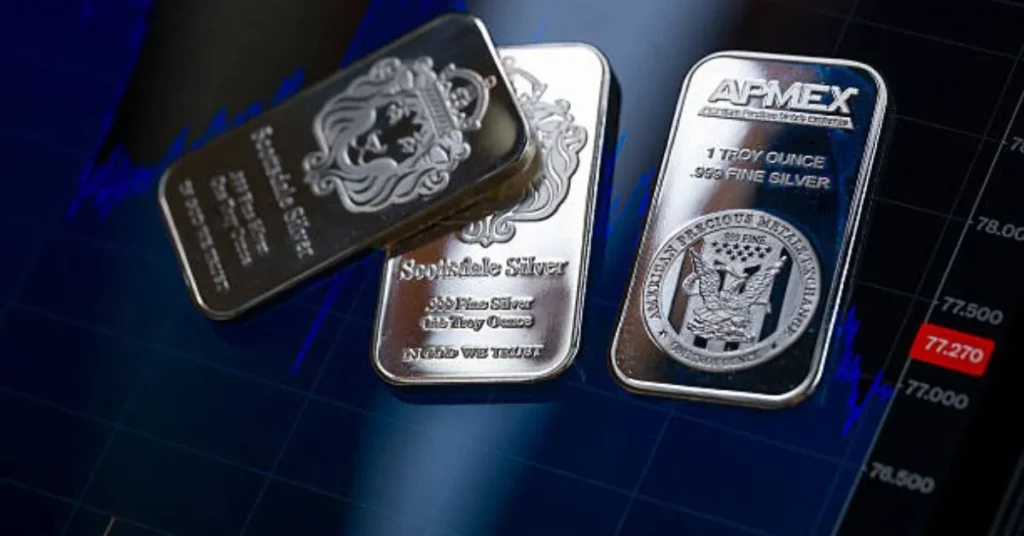
One of the most misread pieces of news on silver in 2026 involves solar panels. The common assumption is that booming solar capacity means booming silver demand. That relationship has broken down.
Silver demand from photovoltaic installations is expected to fall roughly 7% year-on-year in 2026, even as global solar capacity continues to expand by around 15%. Manufacturers under margin pressure are actively reducing the silver content per cell — a process called thrifting — and accelerating the switch to silver-free alternatives where technically possible.
Industrial demand overall is down 3% to 657.4 million ounces, as solar manufacturers thrifted faster than gains from AI infrastructure, automotive electronics, and power-grid spending could offset.
And yet — the deficit is still widening. That’s the counter-intuitive reality buried in the World Silver Survey 2026. Industrial demand is contracting and the supply shortfall is getting larger. Why? Because investment demand from physical coins, bars, and ETPs surged to fill the gap. Coin and bar demand is projected to rise 18% in 2026.
What this tells a serious investor: silver’s bull case no longer depends on solar. AI data center hardware, EV electronics, and investment flows have become the dominant drivers. The metal has quietly changed its demand profile — and most coverage hasn’t caught up yet.
What Experts Say: J.P. Morgan, Citigroup, and the Fed Factor
The most closely watched news on silver right now centres on two questions: where does the Federal Reserve go next, and what are the major banks forecasting?
J.P. Morgan expects silver to average around $81 per ounce during 2026, with quarterly forecasts ranging between approximately $84 and $85 per ounce throughout the year, citing ongoing supply deficits, strong retail demand, and continued industrial usage as key drivers.
Among the most optimistic forecasts currently circulating is Citigroup’s target of $110 per ounce during the second half of 2026, with the bullish case built on expectations of continued physical supply shortages and increasing industrial consumption.
Institutional silver price forecasts for the balance of 2026 cluster in the $79 to $88 per ounce range from major banks, with more bullish strategists citing the potential for a retest of record highs if physical deficits persist and monetary conditions remain accommodative.
The Fed is set to hold its first meeting under new chair Kevin Warsh and is widely expected to leave interest rates unchanged. If Warsh’s press conference confirms the policy rate path follows core inflation — which ran at 2.9% in May, well below the 4.2% headline — markets may start pricing in cuts. That would remove the single biggest headwind silver has faced since February.
Investors who follow silver closely understand that the metal responds faster and more aggressively than gold to rate pivots. When monetary conditions shift, silver tends to move first and furthest. Past performance does not guarantee future results.
What People Get Wrong About News on Silver in 2026
The biggest mistake circulating in silver coverage right now is treating the correction from $121 as evidence the bull market is over. It isn’t — and here’s the specific reason why.
The mechanics are striking: the deficit is widening even as total demand is forecast to fall about 2%, because supply is falling slightly faster. When both sides of the ledger shrink and the gap still grows, the physical market is tightening, not loosening.
Silver mine production remains flat despite elevated prices, with most new projects likely to face delays and not coming online before 2027. Recycling volumes also remain underwhelming, partly due to inefficiencies in recovering silver from high-tech scrap.
A common misconception is that high prices automatically attract new mine supply. In silver’s case they don’t — because most silver comes as a byproduct of other metals, and opening a dedicated silver mine takes seven to ten years from discovery to first production. The structural deficit cannot be solved quickly regardless of where prices go.
Silver’s 2025 surge wasn’t random. It reflected the convergence of monetary tailwinds — central bank gold buying, dollar weakness, rate cut expectations — with the structural industrial demand story. Those drivers haven’t disappeared. In many ways, they’ve strengthened.
June 2026 Price Action: Iran, Warsh, and What Moves Next
Silver July futures opened at $67.49 per ounce on June 12, 2026 — up 5.5% from Thursday’s closing price — after President Trump halted further airstrikes and claimed the US had ended the war in Iran. Ole Hansen, head of commodity strategy at Saxo Bank, warned investors against chasing the headline, advising focus on what Iran was actually doing rather than political statements.
Silver jumped toward $71 an ounce on Monday, advancing for a third consecutive session after the US and Iran reached a peace agreement that would reopen the Strait of Hormuz. The reopening of that critical waterway eased oil supply fears, reduced inflation expectations, and shifted rate cut probabilities back toward the dovish side — all bullish for silver.
Silver recently climbed above $76 per ounce following renewed geopolitical uncertainty and falling Treasury yields, highlighting how sensitive the metal remains to macroeconomic developments.
The news on silver heading into the second half of 2026 is essentially a race between two forces: the structural supply deficit pulling prices higher over time, and short-term rate expectations creating violent swings in either direction. The investors positioned well are those who understand both dynamics simultaneously — not just one.
Also Read: Is Titanium More Expensive Than Gold? Surprising Truth
FAQ
What is the latest news on silver prices in June 2026?
Silver traded at $70.42 per troy ounce on June 17, 2026 — up 0.57% on the day and 91.67% higher than one year ago — after recovering from spring lows following the US-Iran ceasefire.
Why did silver fall from its 2026 record high?
A US-Iran conflict beginning February 28, 2026 pushed oil above $100 per barrel, reignited inflation expectations, and erased anticipated Federal Reserve rate cuts from market pricing — raising the opportunity cost of holding non-yielding silver sharply.
Is silver still in a supply deficit in 2026?
The Silver Institute’s World Silver Survey 2026 projects a 46.3 million ounce shortfall — the sixth consecutive annual deficit — widening from a 40.3 million ounce gap in 2025.
What are banks forecasting for silver in 2026?
J.P. Morgan expects silver to average around $81 per ounce in 2026, while Citigroup has a more bullish target of $110 per ounce for the second half of the year. Past performance does not guarantee future results.
Is solar demand still the main driver of silver prices?
No longer. Silver demand from photovoltaic installations is expected to fall roughly 7% year-on-year in 2026, even as global solar capacity grows by around 15% — with AI data centers, EV electronics, and investment demand now the primary growth drivers.
This article is for informational and educational purposes only. It does not constitute financial advice. Always consult a qualified financial advisor before making any investment decisions. Past performance does not guarantee future results.