This article is for informational and educational purposes only. It does not constitute financial advice. Always consult a qualified financial advisor before making any investment decisions.
Pick up a quarter and seven pennies. Stack them together in your hand. That combined footprint, made entirely of dense yellow metal, is close to the size of 1 ounce of gold. The size of 1 ounce of gold surprises almost everyone who handles it for the first time, because the weight feels completely wrong for how small it looks.
What Is the Size of 1 Ounce of Gold in Coin Form?
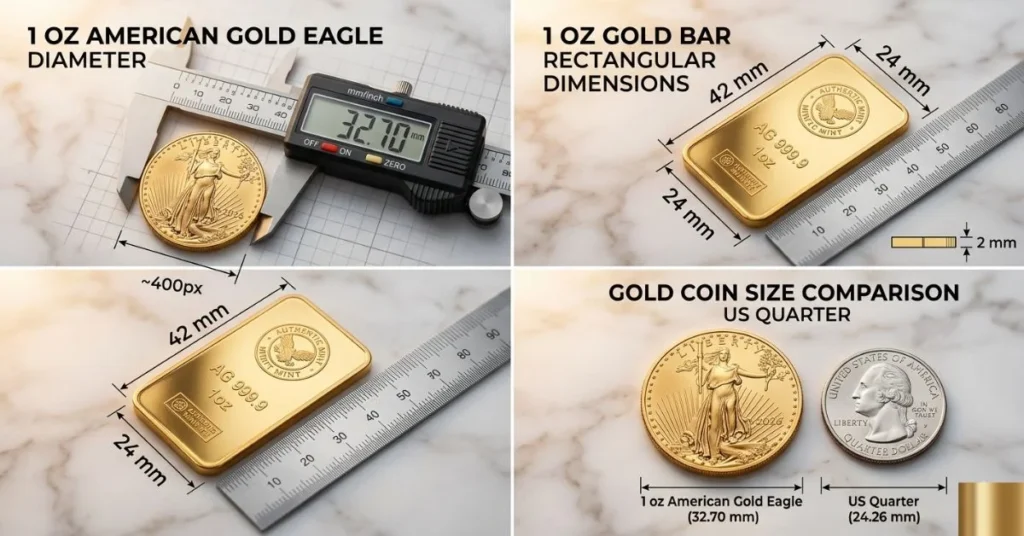
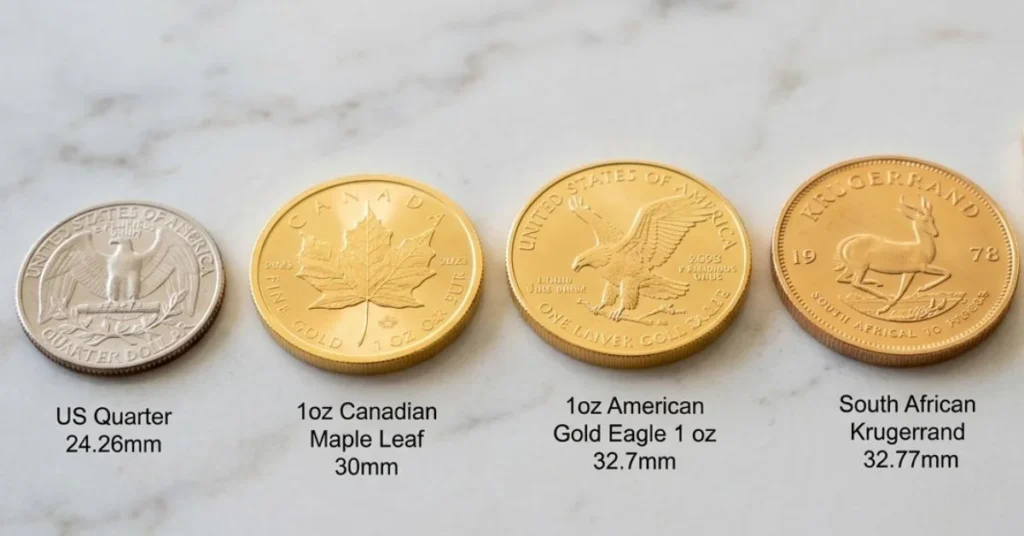
The size of 1 ounce of gold isn’t one fixed number once it’s struck into a coin. It depends on the mint, the alloy mix, and the design choices behind each series. The 2026 American Gold Eagle measures 32.7 mm in diameter and 2.87 mm thick, according to official U.S. Mint specifications. The Chinese Gold Panda runs slightly smaller, at around 32.05 mm in diameter and about 2.70 mm thick.
That half-millimeter gap doesn’t sound like much. But it matters if you’re storing coins in tubes built for one specific series — a Panda-sized capsule won’t always hold an Eagle snugly.
Here’s the deal: alloy content drives most of that variance in the size of 1 ounce of gold across different coins. The American Gold Eagle uses 22-karat gold (.9167 fine) for added durability, so the coin weighs more than a pure ounce even though it contains exactly one troy ounce of actual gold. The coin’s total weight comes to 1.0909 troy ounces, or 33.931 grams, per U.S. Mint data.
What people get wrong: they assume “1 oz gold coin” means the coin itself weighs 31.1 grams. It often doesn’t. Alloy metal adds bulk. Only 24K coins, like the Krugerrand or Canadian Maple Leaf, come close to a gram-for-gram match with pure troy ounce weight.
What Is the Size of 1 Ounce of Gold in Bar Form?
Bars look nothing like coins, and that difference catches new buyers off guard constantly. A 1 oz gold bar typically measures 42 mm by 24 mm by 2 mm — a thin rectangle rather than a thick chunky block like the ones in heist movies.
Compare that to a coin’s round 32–33 mm footprint. The size of 1 ounce of gold in bar form is longer but much flatter, which is exactly why dealers recommend bars for stacking inside a safe deposit box. They nest together without rolling.
- Gold density: 19.3 g/cm³
- Volume for 1 oz of gold: roughly 1.6 cubic centimeters, about the size of a sugar cube
- Pure weight: 31.1 grams, more once alloy is added
Anyone who has studied gold markets understands that density is the real story behind the size of 1 ounce of gold. No other common metal packs that much dollar value into that little space. Lead is dense too, but it’s worth pennies a pound. Gold’s combination of density and market price is what makes a sugar-cube-sized lump worth thousands.
Why the Size of 1 Ounce of Gold Fools First-Time Buyers
The counter-intuitive insight here: gold is dense enough that a small fortune can sit in your palm without you noticing its bulk, but you’ll absolutely notice its weight the second you pick it up. It feels much heavier than it looks, which is actually a key sign of authenticity when checking for counterfeits.
This matters in practice. If you’re buying gold from an unfamiliar seller, the weight-to-size ratio is one of your first checks. A real 1 oz coin or bar should feel disproportionately heavy compared to its visual footprint. If it feels light for its size, that’s a red flag worth investigating before you pay a cent.
As of 2026, gold’s price swings have made the size of 1 ounce of gold even more dramatic relative to its value. Spot gold was trading around $4,358.75 per ounce in mid-June 2026, according to live market data from USAGOLD, following a sharp rally tied to a geopolitical ceasefire announcement. That means a sugar-cube-sized piece of metal carried more value than many used cars. Past performance does not guarantee future results, and prices move daily based on macroeconomic conditions.
Size of 1 Ounce of Gold by Fractional Denomination
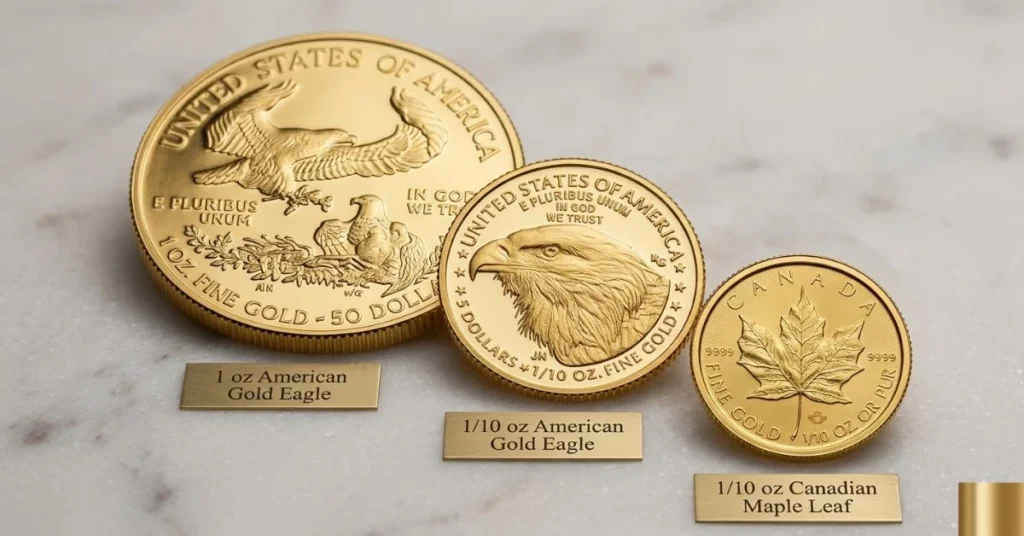
Fractional coins shrink fast once you move below a full ounce. Using official U.S. Mint figures for the American Gold Eagle series:
- 1 oz: 32.70 mm diameter, 33.931 g total weight
- 1/2 oz: 27.00 mm diameter, 16.966 g total weight
- 1/4 oz: 22.00 mm diameter, 8.483 g total weight
- 1/10 oz: 16.50 mm diameter, 3.393 g total weight
Notice the pattern. Diameter doesn’t shrink in step with weight, because thickness changes too at each fractional size. The size of 1 ounce of gold isn’t simply ten times wider than a 1/10 oz piece — it’s a completely different shape ratio. That’s why fractional stacking trays need custom slots for each denomination rather than one universal size.
What Experts Say About Size and Authentication
Dealers and numismatists consistently push one rule: never judge gold by sight alone, even once you know the size of 1 ounce of gold by heart. Focus on the whole picture, gold content, total weight, diameter, thickness, and design features, since two coins with identical gold content can still feel different due to alloy choices, per American Bullion’s analysis.
Investors who track gold closely know mismatched specs are the fastest tell for counterfeit product. If a “1 oz” coin’s diameter or thickness strays from the issuing mint’s published tolerance, that’s grounds to request third-party verification before completing a purchase.
Also Read: 1 Grain of Gold Value: The Real Number Explained
FAQ
Is the size of 1 ounce of gold the same as a quarter?
Roughly. Most 1 oz gold coins measure 30–33 mm in diameter, close to a U.S. quarter’s 24.26 mm, though noticeably larger and thicker.
Does a 1 oz gold bar weigh more than a 1 oz gold coin?
No, not necessarily. A pure 24K bar weighs almost exactly 31.1 grams. A 22K coin like the American Gold Eagle weighs more in total because alloy adds bulk beyond the pure gold content.
Can I judge the size of 1 ounce of gold to spot a fake?
No. Size alone isn’t enough. Authentic verification requires weighing the piece, measuring thickness, checking magnet response, and ideally professional XRF testing.
Why do gold coins vary in thickness between mints?
Different mints use different alloy ratios and anti-counterfeiting features, which changes density and thickness even when gold content and diameter look similar.
Is the size of 1 ounce of gold unusual compared to other metals of equal value?
Gold’s density of 19.3 g/cm³ combined with its market price means a small physical volume holds outsized value, unlike most industrial metals.
This article is for informational and educational purposes only. It does not constitute financial advice. Always consult a qualified financial advisor before making any investment decisions.