This article is for informational and educational purposes only. It does not constitute financial advice. Always consult a qualified financial advisor before making any investment decisions.
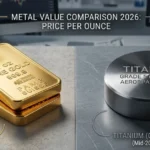
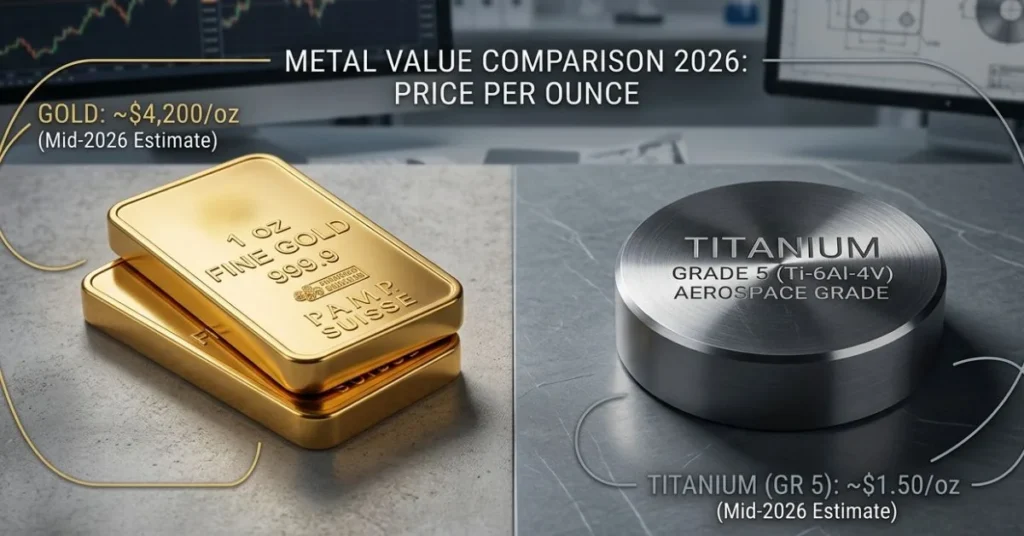
So, is titanium more expensive than gold? The short answer is no — and the price gap between these two metals is far wider than most people expect. As of 2026, titanium costs approximately $0.20 per ounce, based on a market rate of $6.93 per kilogram. Gold, meanwhile, was trading at over $4,200 per troy ounce as of mid-June 2026, according to USAGOLD’s daily market reports. That puts gold roughly 21,000 times more expensive per ounce than titanium.
And yet, this question keeps coming up — and understandably so. Titanium is marketed as a premium material. It shows up in F-22 fighter jet frames, surgical bone implants, and Apple Watch Ultra casings. So the assumption that it might rival gold in price is not completely irrational. But market reality tells a very different story.
Why Is Titanium So Much Cheaper Than Gold?
The core reason comes down to how each metal is classified. Gold is a precious metal — traded under the XAU ticker on global markets, priced by the London Bullion Market Association (LBMA) twice daily through the London Fix, and held in central bank vaults as a reserve asset. Titanium is an industrial metal. It doesn’t trade on COMEX or any precious metals exchange. Markets price titanium in metric tons or kilograms — per-ounce pricing is essentially irrelevant to how it actually trades.
Here’s the thing that surprises most people: titanium is actually the ninth most abundant element in Earth’s crust. Despite its abundance and superior engineering properties, the global market for titanium represents only 1% of the aluminum market and just 0.1% of the stainless steel market — entirely because of its price. But that price isn’t driven by rarity. It’s driven by the brutal complexity of turning titanium ore into usable metal.
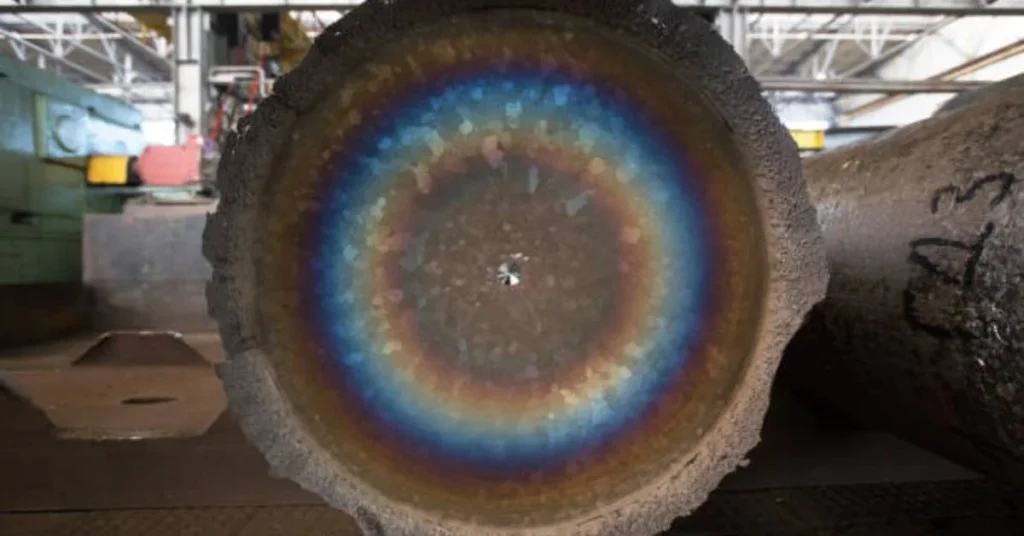
The dominant production method is called the Kroll Process, developed by Wilhelm Kroll in the 1930s. The Kroll process hasn’t changed fundamentally since the 1950s — turning titanium ingots into bars and sheets remains a challenge because titanium readily absorbs impurities, requiring frequent surface removal and costly trimming that involves significant yield loss. When 1 kg of finished titanium is produced for aerospace use, it comes from almost 11 kg of starting material — a 90% material loss during processing. That waste drives cost. But even with all that complexity, the final product still only reaches a few dollars per ounce for standard grades.
Gold’s value doesn’t come from processing complexity alone. It comes from over 5,000 years of human beings deciding it should be valuable — backed by scarcity, monetary history, and institutional demand that titanium will never replicate.
The Actual Price Comparison: Titanium vs Gold in 2026
Here’s the real-world breakdown as of 2026:
| Metal | Price Per Ounce (approx.) | Market Type |
| Titanium (commercial grade) | ~$0.20 | Industrial / OTC |
| Titanium (Grade 5 / Ti-6Al-4V) | ~$1.25–$1.90 | Industrial / OTC |
| Silver | ~$67–$77 | Precious metal / Exchange-traded |
| Platinum | ~$1,968 | Precious metal / Exchange-traded |
| Gold | ~$4,200+ | Precious metal / LBMA / COMEX |
According to USGS and market data, commercially pure titanium costs between $5 and $8 per pound — roughly $0.31 to $0.50 per ounce. Grade 5 titanium (Ti-6Al-4V), the aerospace and medical alloy containing aluminum and vanadium, generally costs $20–$30 per pound, or about $1.25–$1.90 per ounce.
Even at its most expensive commercially available grade, titanium doesn’t approach silver’s price — let alone gold’s. In May 2026, silver was priced at approximately $76.66 per ounce and platinum at $1,968.50 per ounce — both still massively exceeding titanium at any grade.
The practical consequence for buyers: if someone sells you a “titanium” product at gold-adjacent prices, they’re charging almost entirely for labor, design, and branding — not the raw material. A titanium ring priced at $400 is not expensive because titanium is expensive. It’s priced that way because of manufacturing precision and market positioning.
What People Get Wrong About Titanium’s Value
This is where things get interesting. Many buyers and even some financial commentators conflate industrial value with monetary value. Titanium has extraordinary industrial value. Its exceptional strength, corrosion resistance, and heat tolerance make it highly valued in aerospace, automotive, and medical devices. None of that translates into investment-grade monetary value.
Gold can be stored in a vault and retrieved a century later with its purchasing power largely intact. That’s what makes it a reserve asset. Central banks have accumulated over 1,000 tonnes of gold in each of the last three years — significantly up from the 400–500 tonne average over the preceding decade. No central bank holds titanium as a reserve asset. No government has ever backed a currency with titanium. The LBMA doesn’t publish a titanium fix. That tells you everything about where the two metals sit in the global financial hierarchy.
Another misconception: people assume that because titanium is harder to machine than gold, it should cost more. Hardness and market price have no direct correlation. Tungsten carbide is extraordinarily hard and costs a fraction of silver. Titanium sits in a strange middle ground — far more expensive than common metals like iron, but nowhere near the price of precious metals like silver or gold. This positioning is why people often assume titanium is a luxury material, when by actual market value, it’s an industrial one.
Is Titanium More Expensive Than Gold in Jewelry?
This is a genuinely different question from the raw material comparison — and one where context matters more. In the jewelry market, titanium rings typically range from $100 to $600, while a simple 14K gold ring starts at about $500 and can exceed $1,000. One key reason for titanium’s affordability in jewelry is its lower density — less material is needed compared to gold.
So at retail level, a mid-range titanium ring and a basic gold ring can actually overlap in price. But that overlap is explained by manufacturing cost, not raw material value. A 14K gold ring at $600 contains roughly $200–$300 of actual gold (depending on weight and current spot price). A $600 titanium ring contains perhaps $2–$3 of raw titanium.
Which brings us to a practical point investors sometimes miss: when you buy gold jewelry, you’re buying a product that contains a globally liquid asset whose value can be independently verified against the spot price at any moment. When you buy titanium jewelry, you’re buying craftsmanship with almost no recoverable commodity value underneath it.
What the Research Shows: Gold’s Price Drivers in 2026
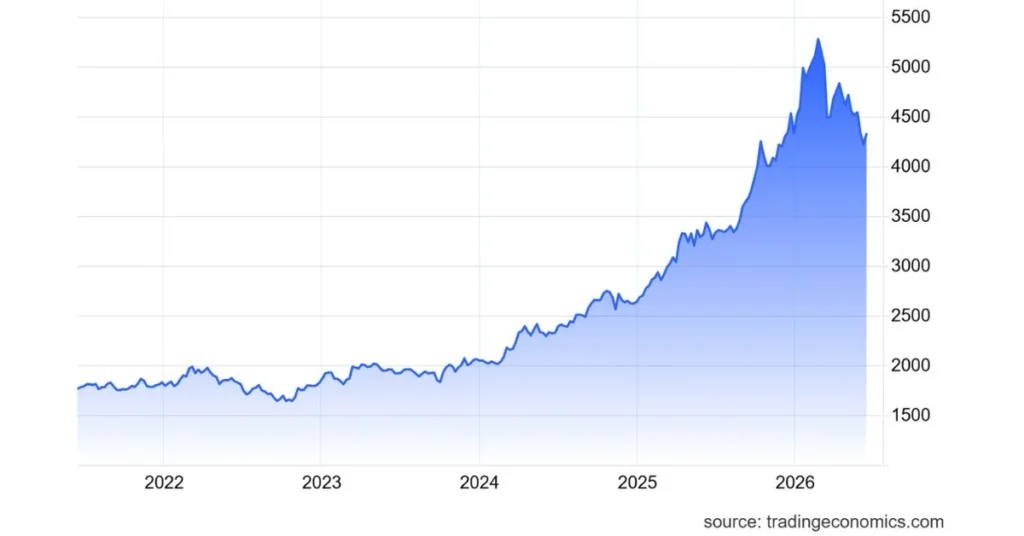
Gold’s price at $4,200+ per ounce in mid-2026 isn’t arbitrary. According to World Gold Council data, 73% of central banks anticipated reducing dollar holdings in favor of gold, and Q1 2026 data confirms this transition has moved decisively from planning to execution. In 2025, gold set 53 new all-time highs and surpassed 5,000 tonnes in demand for the first time in recorded history, according to the World Gold Council. The annual average price of gold increased 44% over 2024, ending that year at $3,431 per ounce.
Investors who track gold closely know that the metal’s price is shaped by four structural forces: central bank demand, inflation expectations, currency debasement fears, and geopolitical tension. Titanium’s price is shaped by: energy costs in the Kroll Process, aerospace and defense procurement cycles, and Chinese supply chain dynamics. The global titanium industry reached $21.78 billion in 2025 and is projected to grow to $33.26 billion by 2034, at a compound annual growth rate of 4.82%. That’s a growing industrial sector — not a monetary asset.
As of 2026, J.P. Morgan has forecast gold reaching $6,000 per ounce by Q4 2026, driven by continued central bank accumulation and dollar reserve diversification. J.P. Morgan Global Research forecasts gold prices per ounce to average $6,000 by the final quarter of 2026, rising toward $6,300 by the end of 2027. Past performance does not guarantee future results, and no analyst forecast should be treated as a certainty.
Should You Invest in Titanium the Way You Invest in Gold?
No — and this is a critical distinction. Silver is a precious metal traded on global commodity exchanges. You can buy silver bullion, silver ETFs, or silver futures contracts. Its price is publicly quoted and updated in real time. Titanium cannot be traded this way.
Gold trades under the XAU/USD pair on forex markets. It has futures contracts on COMEX. There are physically-backed ETFs holding allocated gold bars. The London Fix sets a globally recognized benchmark price twice per day. None of this infrastructure exists for titanium. You can’t buy a titanium ETF. There’s no titanium bullion coin minted by a sovereign government. Titanium doesn’t settle in a recognized good delivery bar at the Bank of England.
If your goal is capital preservation or inflation hedging, gold has a 5,000-year track record and the backing of institutional frameworks that no industrial metal can match. Titanium’s value is locked inside the products it makes — it doesn’t flow freely through financial markets.
Also Read: Gold Versus Inflation: The Hidden Link Investors Miss
FAQ
Is titanium more expensive than gold per ounce?
No. Titanium costs approximately $0.20 per ounce in 2026, based on $6.93 per kilogram. Gold trades above $4,200 per troy ounce — making it roughly 21,000 times more expensive per ounce.
Is titanium a precious metal like gold?
No. Titanium is classified as an industrial metal. Precious metals — gold, silver, platinum, and palladium — are valued for their rarity and monetary role. Titanium is abundant in Earth’s crust and priced for its engineering properties, not its monetary status.
Can titanium be used as an investment like gold?
No. Titanium is not traded on public commodity exchanges and doesn’t hold value as a precious metal. There are no titanium ETFs, bullion bars, or sovereign coins. Gold has all of these, making it genuinely investable as a financial asset.
Why is Grade 5 titanium so much more expensive than regular titanium?
There’s a significant difference. Grade 5 titanium (Ti-6Al-4V), which contains aluminum and vanadium, is used in aircraft components and medical implants, and generally costs $20–$30 per pound — compared to $5–$8 per pound for commercially pure titanium. The alloying process and tighter quality specifications drive the premium.
Has titanium ever been close to gold in price?
No. Even at titanium’s all-time high — titanium reached a historical high of 152.43 CNY/kg in May 2022 — it translated to roughly $3–$4 per ounce, while gold that same month was trading above $1,800 per troy ounce. The gap has only widened since.
The Bottom Line
Is titanium more expensive than gold? Not even remotely — and understanding why matters whether you’re buying jewelry, evaluating materials, or thinking about precious metals investment. Titanium’s strength, lightness, and biocompatibility make it indispensable to modern industry. But gold’s scarcity, monetary history, and global institutional backing give it a price per ounce that titanium will never approach. Central banks accumulated over 1,000 tonnes of gold annually for three consecutive years through 2025 — a level of institutional conviction that reflects exactly why gold commands a price 21,000 times higher than titanium per ounce in 2026.
Each metal is exceptional at what it does. They just operate in entirely different financial worlds.
This article is for informational and educational purposes only. It does not constitute financial advice. Always consult a qualified financial advisor before making any investment decisions. Past performance does not guarantee future results.