This article is for informational and educational purposes only. It does not constitute financial advice. Always consult a qualified financial advisor before making any investment decisions.
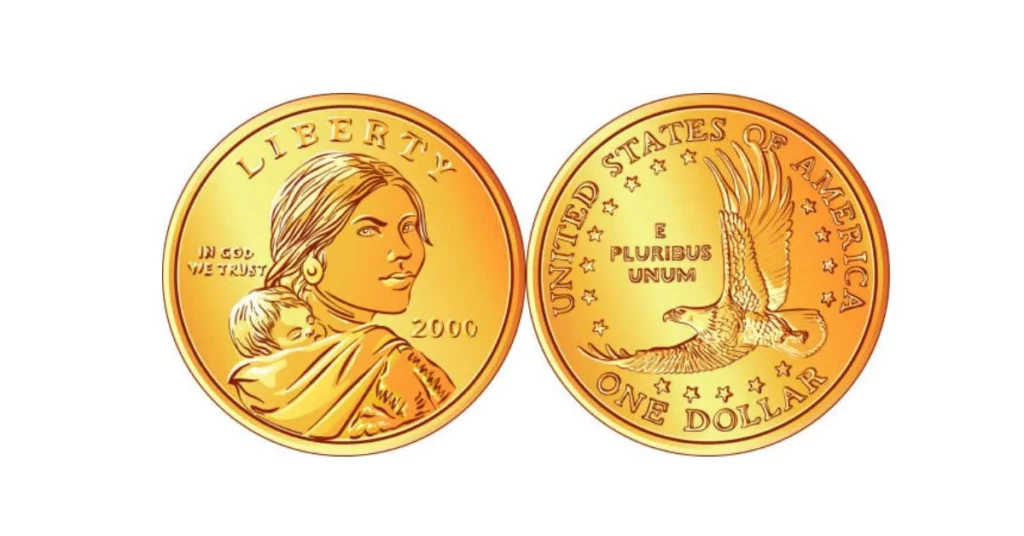
Most people find a 2000 gold dollar in a drawer, assume it’s worth a dollar value, and move on. That’s a mistake that has cost some collectors tens of thousands of dollars. While most circulated pieces are worth exactly $1.00, a tiny fraction of survivors in pristine Mint State grades can fetch thousands — and a handful of special varieties have shattered auction records. One coin from this same series recently changed hands for over half a million dollars.
So before you spend that golden coin on coffee, here’s what you actually need to know about the 2000 gold dollar value.
The 2000 Gold Dollar Is Not Actually Gold — And That’s Where Most People Go Wrong
All Sacagawea coins, while gold in color, contain absolutely no precious metals value. They’re made of copper, manganese, brass, zinc, and nickel. The “gold” appearance comes from the manganese-brass outer layer over a pure copper core. The alloy breaks down as 88.5% copper, 6% zinc, 3.5% manganese, and 2% nickel.
That surprises almost everyone who finds one. People assume a gold-colored dollar must have gold content. It doesn’t. The melt value of a standard 2000 Sacagawea dollar sits at approximately $0.11 — barely a tenth of its face value.
And yet the same year produced one of the most valuable modern U.S. coins ever auctioned.
Philadelphia struck 767,140,000 of these coins in 2000 alone. Denver added another 518,916,000 — 40.3% of total mintage for that year. With over 1.28 billion coins entering circulation in a single year, supply wasn’t exactly limited. For the vast majority, the 2000 gold dollar value stays at face value forever.
What changes everything is condition, variety, and provenance.
Why Grade Determines Almost Everything About 2000 Gold Dollar Value
Collectors who track this series closely know that the Sacagawea dollar’s manganese-brass alloy creates a specific grading nightmare. The metal oxidizes quickly, develops dark spots called “flyspecks,” and picks up microscopic “bag marks” from coins rubbing against each other in mint bags. Finding a truly pristine example from a mintage of over a billion coins is genuinely difficult.
Value is essentially zero below MS65, modestly collectible through MS67, and genuinely scarce at MS68 and above.
Here’s what those grades actually translate to in the market as of 2026:
- Circulated (any grade): Face value — $1.00
- MS65–MS66: $5–$20
- MS67: $30–$100 depending on mint mark
- MS68 (Philadelphia): $500–$2,000+
- MS69 (Denver, NGC certified): An NGC MS69 example sold for $2,160 at Heritage Auctions in November 2022.
PCGS had certified 4,147 Denver examples as of February 2024, with 398 at MS68 and only two graded higher. Two PCGS MS69 examples exist and have not appeared at major public auction as of early 2026 — meaning no one yet knows what the market would pay for them.
Annual price change for coins in MS68 grade sits at approximately plus 4%, while common condition specimens demonstrate zero value growth due to excessive supply. Past performance does not guarantee future results.
The Varieties That Drive 2000 Gold Dollar Value Into the Thousands
Here’s where the story gets genuinely interesting. The inaugural year of the Sacagawea series produced more rare varieties than any other year in the program’s history. Each one commands a dramatically different price.
The Cheerios Dollar
General Mills placed one Sacagawea dollar in every 2,000th box of Honey Nut Cheerios breakfast cereal during the coin’s launch campaign. Those 5,500 coins turned out to have something regular coins didn’t: a prototype reverse die with enhanced tail feather detail on the eagle. The standard release smoothed those details out.
The Cheerios Dollar range in value from $500 to $35,000 depending on grade. The record sale for the Cheerios prototype reverse reached $33,600 in MS68 per PCGS auction records. Finding one requires comparing the eagle’s tail feathers under magnification — the enhanced detail is visible but subtle.
The Goodacre Presentation Coins
The U.S. Mint paid $5,000 to sculptor Glenna Goodacre for creating the winning obverse design by striking 5,000 special Sacagawea dollars as her commission payment. Mint Director Phil Diehl personally delivered the coins to Goodacre at her Santa Fe studio in New Mexico.
These weren’t ordinary coins. They were struck on specially prepared planchets with specially produced dies, giving them a burnished satin-like appearance noticeably different from circulation strikes. Goodacre immediately sent all 5,000 coins to the Independent Coin Grading Company to have them certified and sealed. She sold coins numbered 2003 through 4999 to the public for $200 each while retaining the remainder.
Today, Goodacre Presentation examples carry a 2000 dollar coin value of $400–$1,500+ depending on grade.
The Wounded Eagle Variety
The 2000-P Wounded Eagle features a die gouge through the eagle’s chest, appearing on only a small number of coins. Value ranges from $75 in circulation to $1,500+ in high Mint State. Most owners don’t even know to look for it. The gouge runs through the eagle’s breast area and is visible to the naked eye once you know where to check.
What Experts Say About 2000 Gold Dollar Value at the Top of the Market
Anyone who has studied numismatic auctions understands that the real 2000 gold dollar value story doesn’t end at $35,000. The rarest variety from this year occupies a category few modern U.S. coins have ever reached.
The 2000-P Mule Error
The 2000-P Mule Error, pairing a Washington State Quarter obverse with a Sacagawea reverse, sold for $192,000 in MS67 at Stack’s Bowers in March 2018. An MS65+ example realized $144,000 in May 2022 at the same firm, confirming sustained six-figure demand. This error coin has fetched prices of up to $2.1 million at auction. The Mule occurred because a Sacagawea reverse die was accidentally paired with a Washington quarter obverse die — a production error the U.S. Mint insists should be impossible.
The Space Shuttle Coins
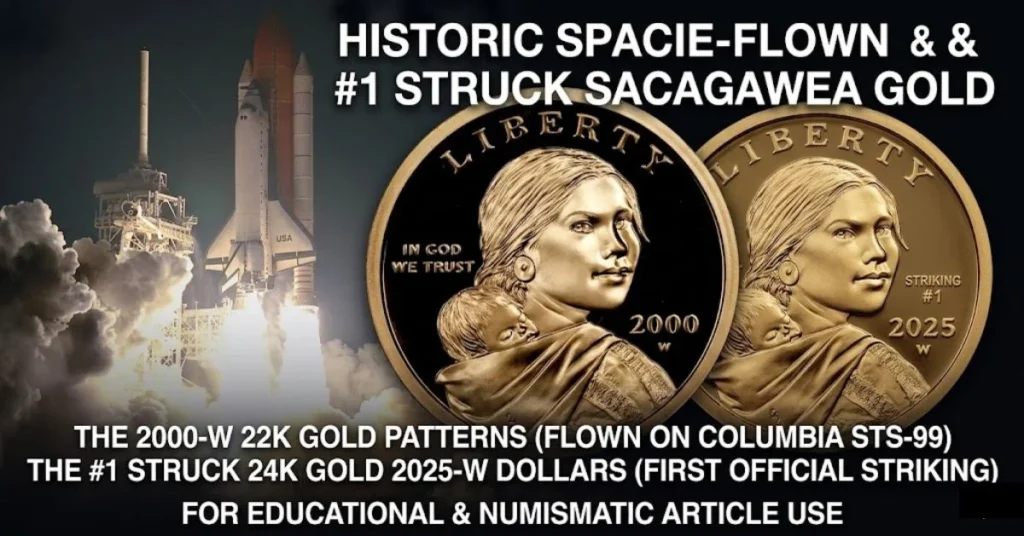
The 2000-W 22-karat gold Space Flown Sacagawea Dollar is exceptionally rare, with only 38 pieces struck as pattern coins. These coins were never released for circulation and hold the distinction of being flown aboard Space Shuttle Columbia mission STS-99 in February 2000.
Two examples reached $550,001 each at Stack’s Bowers Galleries’ September 12, 2025 auction, making them the most valuable U.S. gold dollars struck since the Civil War. The full selection of rare and historic gold dollar coins in that special sale totaled $3.28 million. The lowest price among space-flown pieces at auction was $360,000.
And that’s the thing. A coin series most people dismiss as a failed dollar experiment produced six-figure numismatic results as recently as September 2025.
The Millennium Set: A Less-Known 2000 Dollar Worth Tracking
Denver produced 75,000 special Millennium Sets for the U.S. Mint’s 2000 Holiday Catalog, sold for $39 each. Each set contained a 2000-D Sacagawea dollar with a special proof-like burnished finish, alongside a 2000 American Silver Eagle and a one-dollar bill with “2000” in the serial number.
These sets attract collector interest separately from the coins themselves. The Sacagawea dollar inside carries a Prooflike designation from grading services and commands a premium over standard 2000-D examples. If you have an intact Millennium Set, do not break it open — the set intact is worth more than its components separately.
How to Check Your 2000 Gold Dollar Value Right Now
Follow this order before assuming anything:
- Find the mint mark — under the date on the obverse. “P” = Philadelphia, “D” = Denver.
- Check condition honestly — any visible wear, scratches, or dark spots push it toward face value territory.
- Examine the eagle’s tail feathers — more detail than expected could mean a Cheerios coin.
- Look at the eagle’s chest — a gouge or die mark through the breast area indicates a Wounded Eagle variety.
- Check the obverse — if it shows a Washington quarter design instead of Sacagawea, you may have a Mule Error worth six figures.
- Get it graded — PCGS or NGC certification is non-negotiable for anything above MS65. An ungraded coin loses significant resale value even if it’s genuinely high quality.
The Greysheet Catalog of the Sacagawea Dollars series contains 39 distinct entries with CPG values between $1.00 and $170,000. That range exists entirely because of variety and condition. Two 2000 gold dollars sitting side by side can have values separated by $169,999.
The Practical Consequence of Ignoring Variety Research
If you skip variety identification and spend a Cheerios dollar as pocket change, that’s potentially $10,000+ walking out of your hands for a cup of coffee. The Mule Error examples are rarer still — collector Tommy Bolack holds most known examples, and the most recent Sacagawea/Washington Quarter mule to sell at auction brought a record price of $194,062.50.
The practical step is simple: never spend a 2000 gold dollar without first examining the eagle’s tail feathers and the obverse design. Takes 30 seconds. Could save thousands.
Also Read: How Much Is a Ton of Gold Worth in 2026?
FAQ
Is the 2000 Sacagawea dollar worth more than $1?
High-grade uncirculated examples in MS68 or above can be worth hundreds to thousands of dollars. Special varieties like the Cheerios Dollar, Goodacre Presentation, and Mule Error command anywhere from $400 to over $2 million depending on the specific coin and grade.
Does the 2000 gold dollar contain real gold?
Despite the gold appearance, the coin contains no gold. It’s made of copper, zinc, manganese, and nickel, giving it a golden color without any precious metal content. The melt value is approximately $0.11.
How do I identify a 2000 Cheerios Dollar?
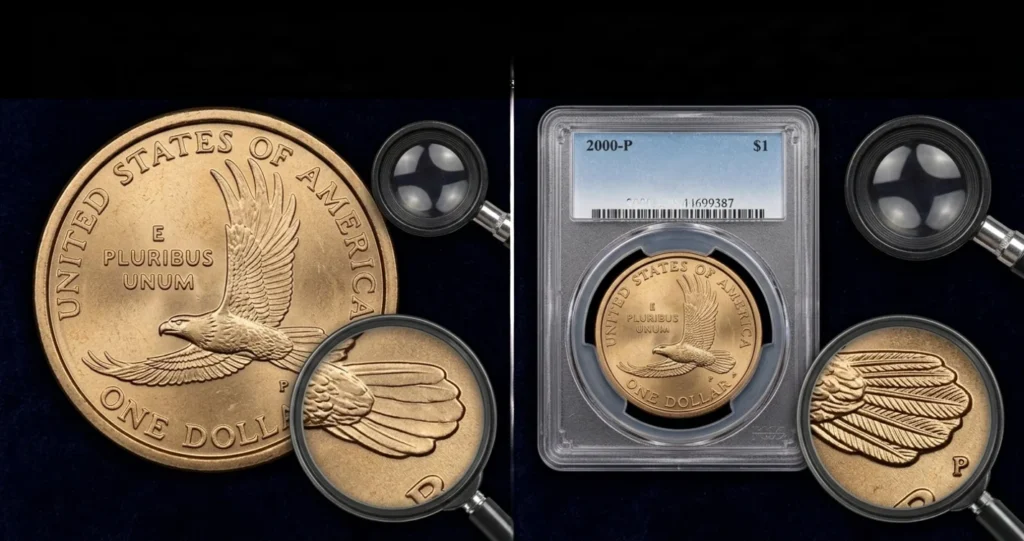
It’s identifiable by examining the eagle’s tail feathers on the reverse. The Cheerios prototype shows more pronounced, detailed feather lines compared to the smoother standard issue. A loupe or magnifying glass makes comparison straightforward.
What is a 2000 Sacagawea Mule Error coin?
It’s a real minting error where a Sacagawea reverse die was paired with a Washington quarter obverse. These coins show a Washington quarter design on one face and a Sacagawea eagle on the other. Authenticated examples have sold for up to $2.1 million.
Should I get my 2000 gold dollar professionally graded?
Any coin you believe might be in MS66 condition or above, or that shows potential variety characteristics, should go to PCGS or NGC. Without third-party certification, dealers and auction houses will discount value significantly regardless of actual quality.
As of 2026, the 2000 gold dollar value spans one of the widest ranges in modern U.S. numismatics — from a $1 coin in your change jar to a $550,000 specimen that orbited Earth. The gap between those two outcomes comes down entirely to what you know before you look at the coin in your hand.
This article is for informational and educational purposes only. It does not constitute financial advice. Always consult a qualified financial advisor before making any investment decisions. Past performance does not guarantee future results.