This article is for informational and educational purposes only. It does not constitute financial advice. Always consult a qualified financial advisor before making any investment decisions.
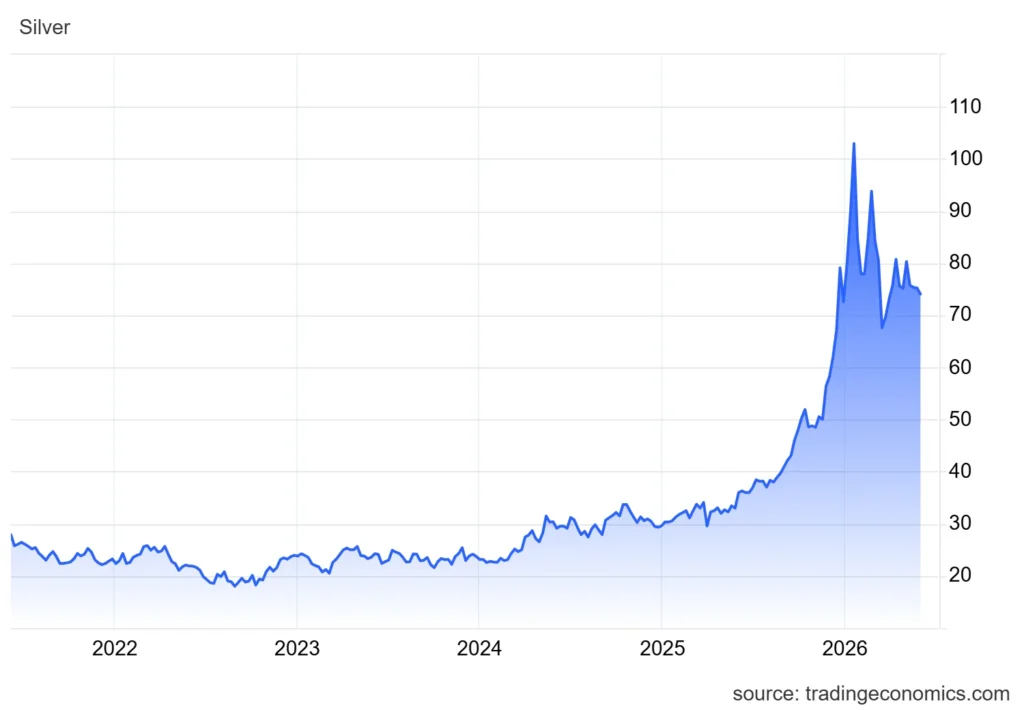
On January 29, 2026, silver hit a nominal all-time high of $121.67 per troy ounce — a price level that stunned analysts who had spent decades watching silver fail at the $50 ceiling twice before. And yet most people searching “what is silver bullion” today have never held a single ounce of it. That gap between market performance and public understanding is exactly the problem this article fixes.
Silver bullion is investment-grade physical silver. Full stop. It comes in the form of coins, bars, or rounds, valued for metal content rather than collectible rarity. But the mechanics behind how it’s priced, traded, and stored — and why its 2026 market tells a fundamentally different story than any precious metal before it — deserve a serious, factual breakdown.
What Silver Bullion Actually Is (And What It Is Not)
Silver bullion is high-purity silver in a form designed for investment. Unlike paper currency, which derives its value from government decree, silver possesses intrinsic value rooted in its physical properties and finite supply.
That distinction matters more than most people realize. A dollar bill’s value exists because a government says it does. Silver’s value exists because the metal itself is real, finite, industrially necessary, and globally recognized. No central bank decision can make silver worthless overnight.
What silver bullion is not: it is not silverware, silver jewelry, or silver-plated items. Those categories involve silver alloyed with other metals or applied as a thin coating. Bullion must meet minimum purity standards — the IRS requires a minimum of .999 fine (99.9%) purity for silver held in an IRA. Most investment-grade bullion on the market today meets or exceeds that threshold.
Silver also trades under the commodity ticker XAG on global exchanges, priced per troy ounce — the same unit of weight used for gold. One troy ounce equals 31.1 grams, slightly heavier than a standard avoirdupois ounce.
The Three Forms of Silver Bullion — and Why the Difference Costs Real Money
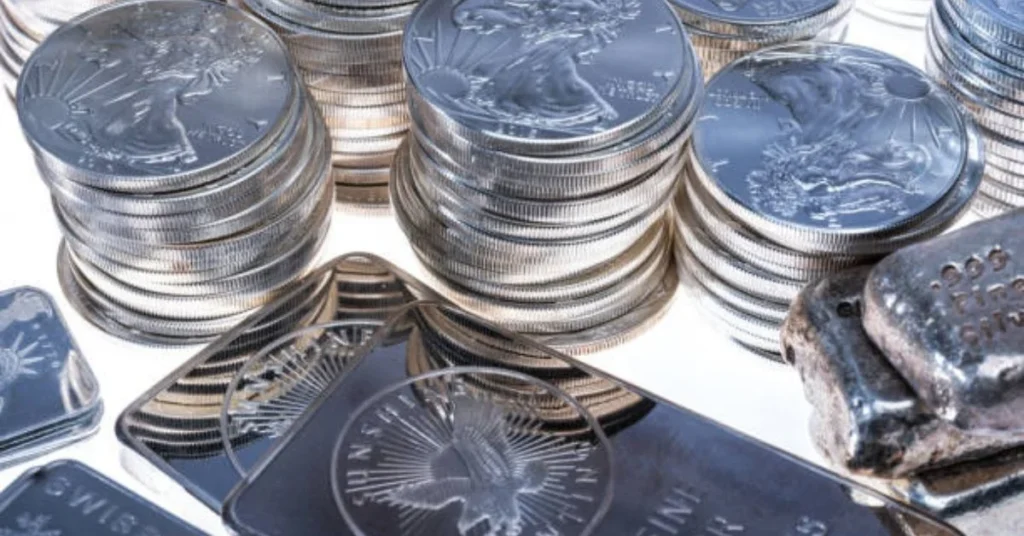
Silver bullion comes in three main forms: government-minted coins (legal tender, higher premiums), bars (lower premiums, efficient storage), and rounds (privately minted, more affordable). Understanding each saves you money on every purchase.
Silver Coins
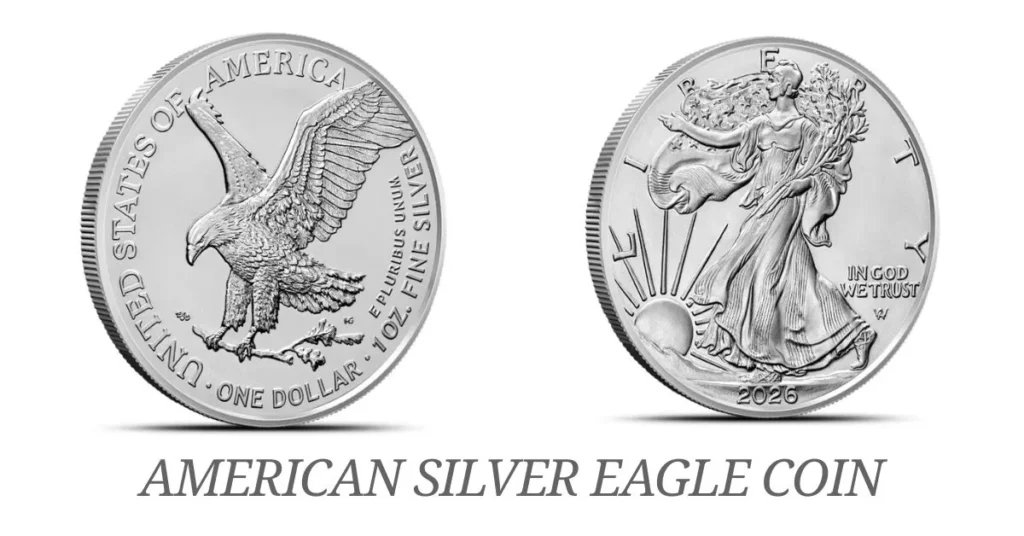
Government mints — including the U.S. Mint, Royal Canadian Mint, and Perth Mint — produce legal tender silver coins. The American Silver Eagle, the Canadian Silver Maple Leaf, and the Australian Silver Kangaroo are the most recognized globally. Government-minted coins from the U.S. Mint, Royal Canadian Mint, and Perth Mint carry the strongest global resale demand. The tradeoff is premium: in 2026, reasonable premiums for government coins run 15–25% over spot price.
Silver Bars
Bars come in sizes ranging from 1 troy ounce to 1,000 troy ounces. The 100 oz bar is particularly popular for bulk buyers looking to minimize cost per ounce. Reasonable premiums for bars run 3–8% over spot — significantly lower than coins. The tradeoff is that bars from lesser-known private mints carry less global recognition and can be harder to sell quickly in smaller markets.
Silver Rounds
Rounds look like coins but carry no government backing and no legal tender status. Premiums for rounds typically run 5–10% over spot, placing them between bars and coins in cost. For investors who simply want silver ounces at the lowest possible entry price, rounds from reputable private mints are a practical option.
And that’s the thing. Two investors can buy the same amount of silver in a given week — one paying 25% over spot for Eagles, the other paying 4% over spot for a 100 oz bar — and end up with vastly different cost bases despite identical metal exposure.
How Silver Bullion Is Priced: Spot Price, Premiums, and the London Fix
Silver’s price doesn’t just appear. A specific global infrastructure sets it.
The spot price is the current market price for silver available for immediate delivery. As of June 4, 2026, the live silver spot price stood at approximately $74.49 per troy ounce. That number changes by the second during market hours, driven by futures contracts on COMEX (the Commodity Exchange in New York) and the LBMA (London Bullion Market Association).
The London Silver Fix — now called the LBMA Silver Price — is set once daily at noon London time. It serves as the globally accepted benchmark for physical silver transactions between banks, refiners, and large institutional buyers. Every silver bullion dealer in the world prices their inventory relative to this number.
The premium over spot is the markup you pay above the raw spot price. It covers minting costs, dealer margins, and shipping. Premiums spike during periods of heavy buying, so timing your purchase to calmer markets can meaningfully reduce your cost basis. During the silver price surge of early 2026, premiums on American Silver Eagles pushed above 30% at several major dealers as demand overwhelmed supply.
What the Research Shows: Silver’s Dual Identity Drives Unique Market Dynamics
Investors who track silver closely know something the casual observer misses: silver behaves like two completely different assets depending on the economic environment.
Around 60% of annual silver demand goes into industrial applications — electronics, solar panels, electric vehicles — because of its exceptional conductivity. Gold industrial demand is roughly 5% of total consumption. That asymmetry means silver prices respond to both financial market sentiment and real-world industrial cycles simultaneously. No other precious metal does this.
According to the Silver Institute’s 2025 World Silver Survey, global industrial silver demand reached approximately 680 million ounces, driven largely by solar energy expansion, electronics manufacturing, and electric vehicle production.
On the supply side, the numbers are structurally concerning for anyone betting on silver remaining cheap. The silver market is heading into its sixth consecutive year of supply deficit in 2026, with the Silver Institute’s World Silver Survey projecting a 46.3 million ounce shortfall — wider than the 40.3 Moz deficit recorded in 2025.
Mine production rose 3% to 846.6 Moz in 2025 but remains uneven and is expected to edge lower in 2026. Nearly two-thirds of the silver supply is a byproduct of mining other metals, leaving overall supply largely unresponsive to silver prices.
That last point is counterintuitive. Rising silver prices don’t automatically bring more silver to market — because most silver mines aren’t primary silver mines. They’re copper, lead, and zinc mines that produce silver as a secondary output. Supply simply can’t react fast enough to demand increases.
What People Get Wrong About Silver Bullion
The single biggest misconception is that silver bullion is just a cheaper version of gold. That framing misses the point entirely.
Gold is almost entirely a monetary and jewelry metal. Silver is a monetary metal, a safe-haven asset, and an irreplaceable industrial input. Those roles create entirely different price dynamics. When global manufacturing accelerates, silver demand rises from factories. When financial uncertainty spikes, silver demand rises from investors. Both can happen simultaneously — which is precisely why silver gained 148% in 2025, far exceeding most analysts’ expectations.
The second misconception: bigger bars are always better. For most retail investors, 100 oz bars create a liquidity problem. Selling requires finding a buyer for the entire bar at once. Coins and rounds sell unit by unit, giving you flexibility that a 100 oz bar cannot. The lowest cost-per-ounce entry point and the most practical entry point are often two different choices.
The practical consequence: if you buy exclusively in large bars to save on premiums and then need to liquidate quickly, you may accept a worse price than if you’d bought coins. Storage efficiency and selling efficiency are separate problems that require separate solutions.
Silver Bullion vs. Silver ETFs: The Distinction That Matters
A silver ETF lets you buy exposure to silver prices through a brokerage account the same way you’d buy a stock. Physical silver means you own the actual metal. The most widely traded silver ETF is SLV (iShares Silver Trust).
ETFs offer convenience and liquidity. Physical bullion offers something an ETF cannot: direct ownership with no counterparty risk. In a genuine economic crisis or financial system disruption, physical silver retains its value independent of what happens to banks, brokerages, or ETF structures.
The tradeoff is storage. Physical silver requires a home safe, a bank safe deposit box, or a third-party vault depository. Third-party vault storage with insured, allocated holdings is widely available through services like BullionVault and others — but it comes with annual fees.
Neither option is universally superior. Which one makes sense depends entirely on your investment goals, storage capacity, and time horizon. Past performance does not guarantee future results.
The 2026 Silver Bullion Market: Where Things Stand Right Now
Silver broke through the $50 per troy ounce ceiling for the first time in history in 2025–2026, a level it had failed to breach twice before — once in 1980 at $49.45 and once in 2011 at $48.70.
J.P. Morgan Global Research forecasts silver averaging $81 per troy ounce across 2026, citing industrial demand and structural supply constraints as the primary drivers. Physical investment demand in bars and coins is projected to rise 20% in 2026, reaching a three-year high of 227 million ounces according to the Silver Institute’s World Silver Survey 2026.
As of 2026, physical silver bullion demand has outpaced dealer inventory at multiple major bullion houses globally. Bullion Star reported record-breaking demand for silver, with replenishing physical inventory becoming increasingly challenging due to rising acquisition premiums and longer delivery lead times from suppliers.
Also Read: The Silver Shortage Is Real: Hidden Causes Explained
FAQ
Is silver bullion the same as sterling silver?
Sterling silver is 92.5% pure (marked .925) and primarily used in jewelry and flatware. Investment-grade silver bullion is typically .999 fine (99.9% pure) or .9999 fine (99.99% pure) — a higher standard required for most investment products and IRA-eligible metals.
Is silver bullion a good inflation hedge?
Historically it has functioned as one. Physical silver holds intrinsic value independent of any currency’s purchasing power. That said, silver prices can be volatile in the short term, so it works better as a long-term diversification tool than a short-term inflation trade. Past performance does not guarantee future results.
Can silver bullion be held in a retirement account?
IRS-approved silver bullion meeting .999 purity can be held in a self-directed IRA. American Silver Eagles and certain silver bars from approved refiners qualify. Regular brokerage IRAs cannot hold physical silver — a self-directed IRA with a qualified custodian is required.
What is the difference between silver bullion coins and numismatic coins?
Silver bullion coins are valued for their metal content and trade close to the silver spot price. Numismatic coins are valued for rarity, historical significance, and condition — and can trade at multiples of their melt value regardless of silver’s spot price. The 2000-W Space Flown Sacagawea gold dollar is an example of a numismatic premium far beyond any underlying metal value.
How do I verify that silver bullion is genuine?
There are several practical tests. A strong neodymium magnet test — silver is not magnetic, so strong attraction suggests a fake — is a quick first check. An ice cube test works because silver has the highest thermal conductivity of any metal and will melt ice immediately on contact. For definitive verification, XRF (X-ray fluorescence) testing equipment used by coin dealers and PCGS/NGC certification for coins provide authoritative authentication.
Silver bullion, at its core, is one of the oldest stores of value in human civilization — now sitting at the intersection of monetary history and 21st-century industrial demand. A sixth consecutive annual supply deficit, a 46.3 million ounce shortfall, and surging physical investment demand make the 2026 silver bullion market unlike anything in the metal’s modern history. Understanding what you’re buying — its forms, pricing mechanics, and real-world supply dynamics — is the foundation of any informed decision.
This article is for informational and educational purposes only. It does not constitute financial advice. Always consult a qualified financial advisor before making any investment decisions. Past performance does not guarantee future results.