
This article is for informational and educational purposes only. It does not constitute financial advice. Always consult a qualified financial advisor before making any investment decisions.
Two funds. Both hold physical gold. Both trade on NYSE Arca. Both move in near-lockstep with the spot price of gold. And yet PHYS vs GLD is one of the most consequential decisions a gold investor can make — because under the surface, these two products are structured completely differently, and that difference directly affects how much of your gains you actually keep.
The PHYS vs GLD debate comes down to four things: what you actually own, what you pay annually in fees, how you’re taxed when you sell, and how easily you can exit when markets move fast. Every serious gold investor should understand all four before committing capital to either.
PHYS vs GLD: What Each Fund Actually Is
Most buyers assume PHYS and GLD are basically the same product with different tickers. That’s the first mistake.
GLD was set up not as a way to invest in physical gold, but as an ETF that tracks the price of gold. Much like when you buy the SPDR S&P 500 ETF you are not planning on buying all 500 stocks, when you buy GLD your goal should be profiting from future increases in gold price. GLD shareholders hold beneficial interests in a grantor trust — they have exposure to gold price movements, but no right to redeem shares for actual metal.
PHYS was set up as a convenience for investors who truly want to buy physical gold. By holding PHYS, you actually own gold without having to store or deliver it. Sprott’s structure allows unitholders to redeem shares for physical gold bullion on a monthly basis. The Trust only holds fully allocated and unencumbered gold — no exceptions. PHYS exclusively invests in London Good Delivery physical gold bullion.
That’s a structural difference with real consequences. GLD’s gold sits in vaults maintained by JPMorgan Chase and HSBC Bank. SPDR Gold Trust is the largest and most liquid gold ETF, with over $141.7 billion in assets under management as of June 2026. PHYS, by contrast, stores its gold at the Royal Canadian Mint — a Canadian Crown corporation — and currently holds 3,692,388 ounces of gold as of May 2026. Both vaults are audited regularly, but the custodian relationship and redemption rights differ significantly.
Fees: What PHYS vs GLD Costs You Every Year
In the PHYS vs GLD comparison, fees look similar on paper but diverge meaningfully over a long holding period.
GLD’s only recurring fixed expense is the Sponsor’s fee, which accrues daily at an annual rate of 0.40% of the daily NAV. PHYS carries a total expense ratio of 0.42%. At face value, PHYS costs two basis points more per year than GLD — on a $100,000 position, that’s $200 versus $420 annually. Not a deal-breaker either way.
But comparing PHYS vs GLD purely on headline expense ratios misses the bigger cost factor: taxation. And that’s where the real divergence happens.
For cost-conscious investors who don’t plan to hold for decades, there are cheaper alternatives in the same category. SPDR’s own GLDM carries just a 0.10% expense ratio. But lower fees don’t offset a higher tax bill at exit — which is exactly why the PHYS vs GLD tax comparison matters more than the fee comparison for most long-term holders.
The Tax Difference in PHYS vs GLD — the Biggest Factor Most Investors Miss
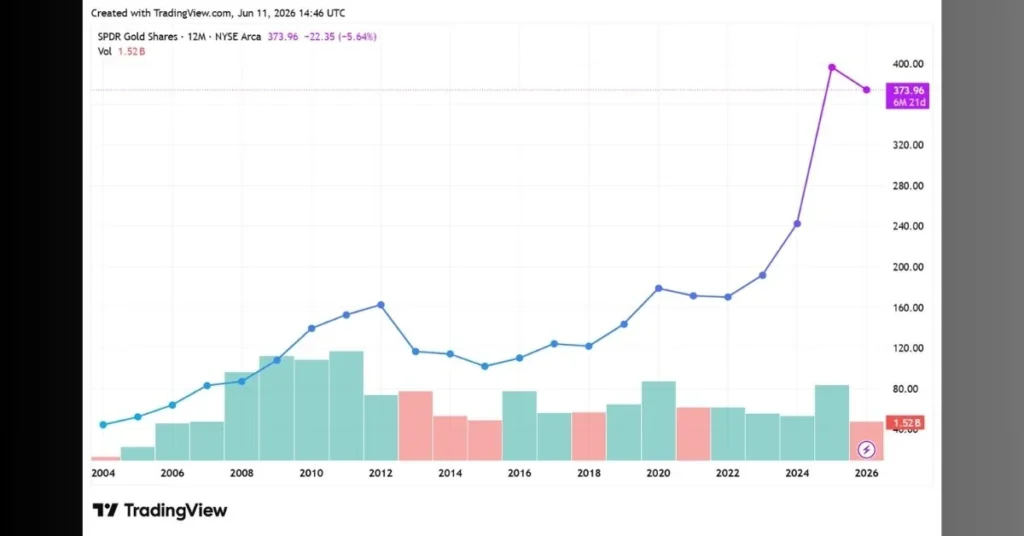
This is the most misunderstood dimension of the PHYS vs GLD comparison — and the one with the most direct impact on after-tax returns.
The IRS treats gold and other precious metals as collectibles for tax purposes. The same is true of exchange-traded funds backed by physical gold. Collectibles carry a 28% top federal tax rate for long-term capital gains. Investors in GLD may be surprised to learn they face a 28% top tax rate on long-term capital gains — the IRS treats such ETFs the same as an investment in the metal itself.
PHYS takes a different approach. For US investors, Sprott Physical Bullion Trusts may offer more favorable tax treatment than owning metals directly or through certain ETFs. However, because the Trusts are generally classified as Passive Foreign Investment Companies (PFICs) by the IRS, US investors generally must make a timely Qualified Electing Fund (QEF) election by filing IRS Form 8621 in the first taxable year they own Trust units to preserve capital gains tax treatment — generally applicable to taxable accounts, not qualified retirement accounts such as IRAs.
Make that election correctly and the result is significant: capital gains will be taxed at either 15% or 20%, depending on your income level — considerably lower than the 28% collectibles rate applied to GLD gains.
And that’s the thing. On a $50,000 gain, the difference between a 20% rate and a 28% rate is $4,000 kept or surrendered to the IRS. For high-income investors holding large positions over multi-year periods, the PHYS vs GLD tax gap can dwarf any fee difference by a wide margin.
One important caveat: the only real advantage GLD has is that it is much more liquid than PHYS, based on average daily share volume — and that may be of greater interest to traders, not investors.
Liquidity: Where GLD Wins the PHYS vs GLD Debate Outright
Anyone evaluating PHYS vs GLD for active trading strategies needs to understand just how large the liquidity gap is.
SPDR Gold Trust is the largest and most liquid gold ETF, with over $141.7 billion in assets under management as of June 2026. GLD’s assets under management currently stand at approximately $152.1 billion. Daily trading volume runs into hundreds of millions of dollars — making GLD one of the most liquid financial instruments anywhere in the world. Bid-ask spreads are razor thin, entry and exit during volatile markets are fast, and options markets on GLD are deep and well-established.
PHYS Trust units are highly liquid, with average daily trading volume of $40 million, and can be sold on any open trading day for the New York Stock Exchange or Toronto Stock Exchange. That’s respectable for a specialist gold trust — but it’s a fraction of GLD’s daily volume. During a gold sell-off or a risk-off panic event, GLD’s liquidity advantage becomes a meaningful practical edge for anyone needing to exit quickly.
GLD’s liquidity offers several advantages: lower risk of slippage, more precise actualization of exit and entry points during times of panic or gold sell-offs, and options strategies — with options strategies perhaps being the biggest benefit here.
For long-term buy-and-hold investors, PHYS’s lower liquidity is largely irrelevant. For traders, portfolio managers, and institutions using gold as a tactical hedge, GLD’s depth wins the PHYS vs GLD liquidity argument without contest.
Physical Redemption: The Feature That Makes PHYS Unique
One capability separates PHYS from GLD in a way that no fee comparison or tax table can fully capture: the right to take delivery of real gold.
The Sprott Physical Gold Trust was created to invest and hold substantially all of its assets in physical gold bullion — providing a secure, convenient, and exchange-traded investment alternative for investors who want to hold physical gold without the inconvenience typical of a direct investment in physical gold bullion. Investing in PHYS offers fully allocated gold, redeemability for metals, and secure storage.
GLD shareholders have no such right. GLD’s structure as a grantor trust protects investors in that trustees cannot lend the gold bars — but holders cannot redeem shares for physical metal.
The practical relevance of this matters most in tail-risk scenarios. In an extreme black swan event, investors who fear fiat currency collapsing may take money from GLD and place it into PHYS — and that phenomenon would raise the price of PHYS relative to GLD. Whether that scenario ever materializes is speculative — but the structural option to redeem for allocated gold has real value to investors who hold gold precisely because they distrust paper-based systems.
In 2026, with global debt trajectories rising and central banks continuing to accumulate gold at pace — sustained central bank accumulation projected at 500–600 tonnes quarterly — that redemption right is one reason PHYS maintains a dedicated following among investors who want more than just price exposure.
What Experts Say: PHYS vs GLD for Different Investor Types
Investors who track gold markets closely understand that PHYS vs GLD isn’t a universal question — it’s a profile question. The right answer depends entirely on what the investor is trying to accomplish.
Compared to buying coins or bars, the Sprott Physical Gold Trust is more convenient and eliminates storage concerns. But compared to modern gold ETFs, it offers no clear advantages for cost-conscious investors — the premium and discount behavior adds a layer of complexity, and if units trade at a premium at time of purchase, investors may overpay.
GLD, meanwhile, is the instrument of choice for institutional investors, hedgers, and traders. GLD’s large size makes it a favorite of institutional investors such as pension funds, which use it to hedge against inflation and other risks. The LBMA PM Gold Price — the London Fix — is used to determine GLD’s NAV daily, giving the fund an extremely close relationship with the global spot price benchmark.
For the retail investor in a taxable account who plans to hold gold for three or more years and has no interest in trading, PHYS’s potential tax advantage at the 15%/20% capital gains rate versus GLD’s 28% collectibles rate makes the QEF election paperwork worth completing. For the investor using gold as a short-term hedge or running options strategies, GLD is the clearly superior instrument.
Past performance does not guarantee future results, and tax treatment depends on individual circumstances — always consult a qualified tax advisor before making decisions based on PFIC or QEF election rules.
PHYS vs GLD: A Direct Comparison Table
| Feature | PHYS (Sprott) | GLD (State Street) |
| Issuer | Sprott Asset Management | State Street Global Advisors |
| Launch Date | February 25, 2010 | November 18, 2004 |
| Expense Ratio | 0.42% | 0.40% |
| AUM (2026) | ~$17.9 billion | ~$143–152 billion |
| Custodian | Royal Canadian Mint | JPMorgan Chase / HSBC |
| Physical Redemption | Yes (monthly, minimums apply) | No |
| Gold Standard | London Good Delivery | London Good Delivery |
| LT Capital Gains Tax (US) | 15%/20% (with QEF election) | 28% (collectibles rate) |
| Avg Daily Volume | ~$40 million | Hundreds of millions |
| Options Market | Limited | Deep and liquid |
| Structure | Closed-end trust (PFIC) | Grantor trust |
What People Get Wrong About PHYS vs GLD
The most common mistake: assuming both funds are structured identically because both hold physical gold. They’re not. GLD is a grantor trust — you own a beneficial interest in a pool of gold. PHYS is a closed-end trust organized under Canadian law — you own units redeemable for bullion.
A second error: ignoring the PFIC classification of PHYS. US investors generally must make a timely Qualified Electing Fund (QEF) election by filing IRS Form 8621 in the first taxable year they own Trust units to preserve capital gains tax treatment. Miss that first-year election and the favorable tax treatment disappears — replaced by even more complex PFIC default rules. This isn’t a minor technicality; it’s a required action that many retail investors miss entirely.
A third misunderstanding: the NAV premium and discount behavior of PHYS. Because PHYS trades as a closed-end fund, its market price can diverge from the underlying gold value per unit. Buying when PHYS trades at a significant premium to NAV means paying above the value of the gold the trust holds. GLD, as an open-ended ETF structure, has authorized participant creation/redemption mechanisms that keep its price far tighter to NAV throughout each trading day.
Conclusion: PHYS vs GLD — Which One Should You Choose?
The PHYS vs GLD decision comes down to three questions every investor should answer before buying either.
First: do you plan to hold in a taxable account for several years? If yes, PHYS’s potential 15%/20% capital gains treatment versus GLD’s 28% collectibles rate could save thousands of dollars per $100,000 of gains — and that saving compounds over time.
Second: do you value the right to redeem for physical gold? If PHYS vs GLD is partly a question of systemic trust, PHYS’s monthly redemption window and Royal Canadian Mint custody gives it a structural edge no paper-based instrument can replicate.
Third: do you need deep liquidity for short-term trading or options strategies? GLD’s $143+ billion in AUM and institutional-grade daily volume make it the only realistic choice for active traders. PHYS simply doesn’t have the depth.
For long-term holders in taxable accounts who want allocated physical gold exposure with meaningful tax advantages, PHYS represents a well-structured case. For traders, institutions, and investors holding gold inside IRAs — where the tax advantage disappears — GLD’s liquidity and cost structure hold up well. Neither is categorically superior. The right answer in the PHYS vs GLD debate depends on the investor, not the fund.
Past performance does not guarantee future results.
Also Read: Is Gold Jewelry a Good Investment? The Hidden Truth
FAQ
Is PHYS better than GLD for US investors in a taxable account?
Potentially — PHYS offers 15%/20% long-term capital gains tax treatment for US investors who make a timely QEF election, compared to GLD’s 28% collectibles rate. However, the QEF election requires filing IRS Form 8621 in year one of ownership. Missing that deadline eliminates the advantage.
Does GLD hold real physical gold?
GLD holds physical gold bullion stored in secured vaults managed by JPMorgan Chase and HSBC Bank. However, GLD shareholders cannot redeem shares for physical metal — they hold price exposure only.
Can you take delivery of gold from PHYS?
PHYS unitholders can redeem their units for physical London Good Delivery gold bullion on a monthly basis, subject to minimum redemption requirements. GLD offers no equivalent right.
Which has lower fees — PHYS or GLD?
GLD charges 0.40% annually; PHYS charges 0.42%. The difference is two basis points — $20 per year on a $100,000 position. The tax treatment difference is far more financially significant for most long-term holders.
Is PHYS a good investment for gold held inside an IRA?
No, not necessarily. The tax advantage of PHYS — lower capital gains rates via QEF election — generally does not apply to qualified retirement accounts such as IRAs. Inside a retirement account, GLD’s superior liquidity and marginally lower fee make it the simpler choice.
This article is for informational and educational purposes only. It does not constitute financial advice. Always consult a qualified financial advisor before making any investment decisions.