This article is for informational and educational purposes only. It does not constitute financial advice. Always consult a qualified financial advisor before making any investment decisions.
Eighty feet beneath the streets of Manhattan, inside a vault protected by a 90-ton steel cylinder, sit approximately 497,000 gold bars — each one roughly the size of a paperback novel, each weighing around 400 troy ounces. That’s the Federal Reserve Bank of New York’s gold vault. Fort Knox, Kentucky, holds another 147.3 million fine troy ounces in the same standardized format. These aren’t collector pieces or decorative displays. A 400 oz gold bars is the unit of account for the entire global wholesale gold market — the physical building block upon which central bank reserves, COMEX futures, London Fix settlements, and international trade all rest.
At the gold spot price of $4,472.10 per troy ounce recorded on June 4, 2026 (per live market data), a single 400 oz gold bars carries a market value of approximately $1.79 million. That figure makes understanding what these bars actually are — and who controls them — far more than an academic exercise.
What a 400 oz Gold Bars Actually Is: The LBMA Specification
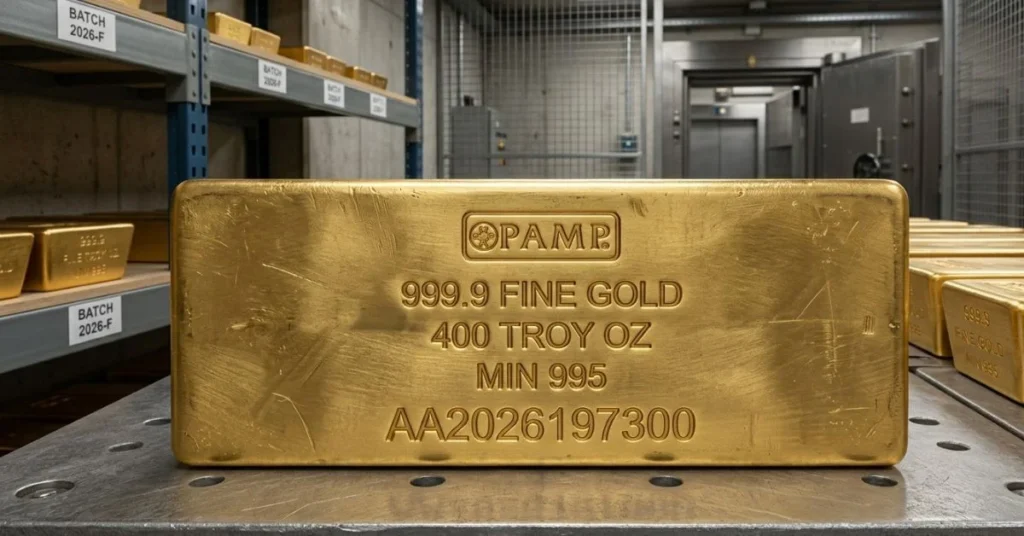
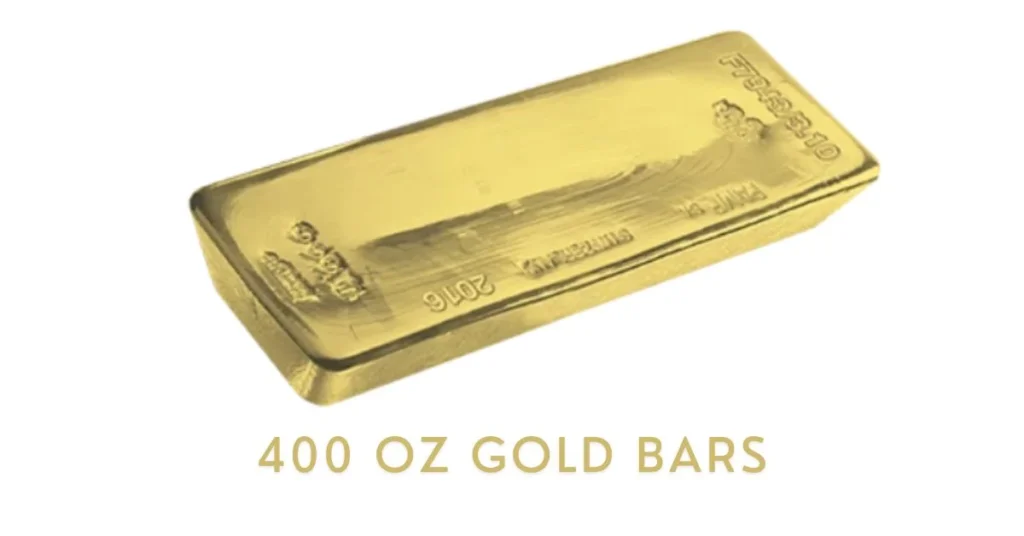
The term “400 oz gold bars” is widely used but imprecise. The correct designation is the LBMA Good Delivery bar — and the specification is considerably more exacting than the name suggests.
Bars typically weigh a few ounces either side of 400 troy ounces, roughly 12.5 kilograms, but the precise LBMA specifications require a minimum gold content of 350 fine troy ounces (approximately 10.9 kilograms) and a maximum gold content of 430 fine troy ounces (approximately 13.4 kilograms). No two Good Delivery bars weigh exactly the same. That weight range exists deliberately, because gold refining produces bars that vary by batch. What matters is that the exact gross weight is stamped on every bar and expressed in troy ounces, in multiples of 0.025, rounded down.
Each bar must carry four mandatory markings: the refiner’s hallmark, the bar’s serial number, the assay (fineness) stamp, and the year of manufacture. The minimum purity for LBMA Good Delivery gold is 995 parts per thousand — 99.5% pure gold. In practice, most modern bars from accredited refiners come in at 999.9 fine, but 995 is the contractual floor below which a bar is rejected from the London market entirely.
Gold is one of the densest metals on earth at 19.32 g/cm³ — a bar measuring roughly 250mm long, 70mm wide, and 45mm tall packs in 12.4 kilograms of metal. Hold one and it feels entirely wrong for its size — impossibly heavy, almost magnetic in density. That physical reality is part of why these bars are stored in vaults rather than moved frequently: each one weighs approximately 27.4 pounds.
To appear on the LBMA Good Delivery List, every refiner must produce at least 10 tonnes of refined gold annually and maintain a tangible net worth of at least £15 million. The list is not a registry anyone can join. It’s an accreditation requiring demonstrated capacity, regular auditing, and ongoing compliance — and removal from the list makes a refinery’s bars unacceptable for London settlement.
The Vault Reality: Where 400 oz Bars Actually Live
Most people picture gold bars in the context of Hollywood heists or Bond films. The operational reality is considerably less cinematic and considerably more consequential.
Fort Knox currently holds 147,341,858.382 fine troy ounces of gold. The facility’s standard gold bar measures 7 inches by 3⅝ inches by 1¾ inches and weighs approximately 400 ounces or 27.5 pounds. The Fort Knox gold is held as an asset of the United States at a book value of $42.22 per ounce — the statutory price set by law, which does not fluctuate with market price. That accounting convention dates back to 1973. At current market prices in 2026, the Fort Knox holdings alone are worth well over $650 billion. The official books say $6.2 billion. That gap between book value and market value — nearly 100-fold — is one of the more striking anomalies in global public finance.
The Federal Reserve Bank of New York stores approximately 6,000 metric tons (193 million troy ounces) of gold belonging to foreign governments and international organizations. Germany stores about one-third of its 3,352 tonnes of gold in New York — roughly 1,200 tonnes. Italy owns about 43% of the gold at the Federal Reserve Bank of New York, around 1,060 tonnes. The New York Fed doesn’t own any of this gold. It acts purely as custodian, holding the bars on behalf of sovereign clients in exchange for storage fees. Every transaction between nations — a gold sale, a currency swap collateralized by gold, a reserve reallocation — moves bars within that vault from one country’s cage to another. No physical transport required. The gold doesn’t leave the building. Only the ownership changes.
And that detail reveals something fundamental about how the 400 oz bar market actually works: physical movement is the exception, not the rule.
The London Fix, COMEX, and How 400 oz Bars Set the World Price
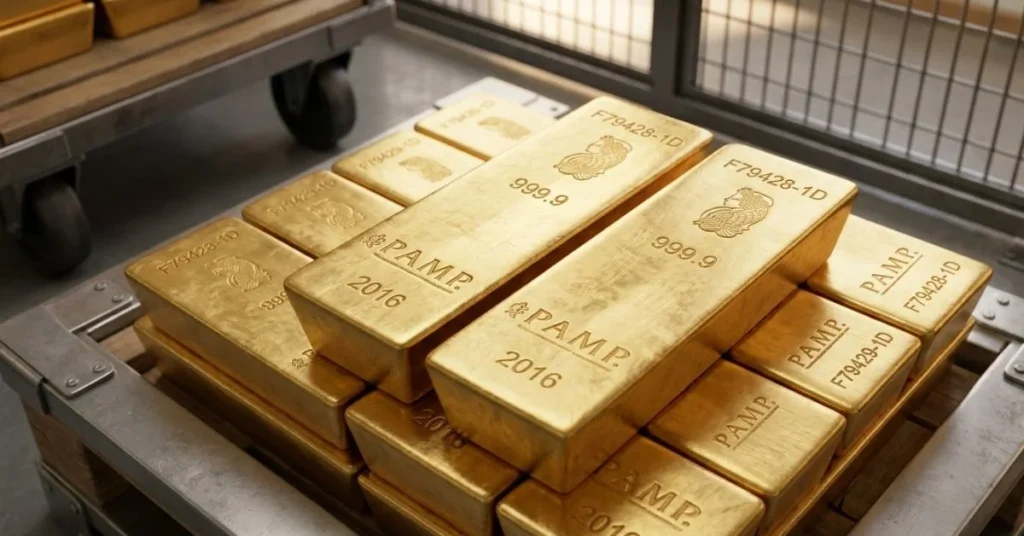
Every gold price you see quoted anywhere on earth — in a jewelry store, on a futures platform, in a central bank reserve report — traces back to a market priced in 400 oz Good Delivery bars.
The LBMA Gold Price (formerly the London Fix) is set twice daily through an electronic auction process administered by ICE Benchmark Administration. The price determined in this process represents the rate at which institutional counterparties — banks, refiners, ETF providers, central banks — agree to buy and sell 400 oz Good Delivery bars in London, in U.S. dollars per fine troy ounce. This is the XAU benchmark. Every gold derivative, every gold ETF net asset value, every gold miner’s hedging contract references this number.
COMEX gold inventory surged from roughly 17.1 million troy ounces around the time of the U.S. election in November 2024 to a peak of 43.3 million troy ounces in March 2025 — a 153% increase in four months, the largest single-quarter inflow on record. That surge was driven by institutional arbitrage between the London spot price and New York futures — a basis trade that became profitable when concerns about potential tariffs on gold imports created a price differential between the two markets. In February 2026 alone, U.S. gold exports reached $17.88 billion, a historic record, accounting for the largest share of that month’s total export growth and pulling overall U.S. exports to an all-time high of $314.8 billion.
This is the overlooked reality of 400 oz bars: they don’t just store value. They move between jurisdictions in response to price differentials, arbitrage opportunities, and geopolitical shifts. The bars themselves are financial instruments in physical form.
What Experts Say: Central Banks Are Still Buying in 2026
The demand picture for 400 oz Good Delivery bars from the world’s most significant institutional buyers has not slowed — even with gold at historic price levels.
According to the World Gold Council’s Gold Demand Trends report, central banks globally purchased 863 tonnes of gold in 2025. While that figure falls slightly below the record-breaking pace of 2022–2024, it remains dramatically higher than the pre-2022 annual average of just 400–500 tonnes. In practical terms: central banks are buying gold at nearly double their historical rate, even after gold set more than 50 all-time price highs in 2025.
The World Gold Council forecasts central banks to purchase roughly 850 tonnes of gold in 2026, with countries such as China and Kazakhstan remaining active buyers, while Indonesia and Malaysia have also turned into buyers after a long hiatus.
The shift began in earnest in 2022, when Russia’s approximately $300 billion in foreign exchange reserves were frozen as part of international sanctions. That single event was a wake-up call for central banks worldwide: paper assets held abroad can be frozen overnight. Gold cannot. BRICS+ nations now hold 17.4% of global gold reserves, up from just 11.2% in 2019.
Anyone who tracks institutional gold closely knows what this structural shift means: the 400 oz bar is no longer just a trading instrument. For an increasing number of sovereign reserve managers, it’s the only asset they fully control across jurisdictions.
What most retail investors get wrong about this market: they assume central bank buying drives the retail bullion market directly. It doesn’t — not immediately. Central banks transact exclusively in Good Delivery bars through the LBMA wholesale system. Retail investors cannot buy into this market directly. The effect is indirect: sustained sovereign demand tightens the above-ground supply of Good Delivery bars, supports the London Fix, and provides a structural bid under spot prices globally.
Can a Retail Investor Own a 400 oz Gold Bars?
Technically, yes. Practically, almost no individual investor should.
400 oz Good Delivery bars are almost exclusively used in wholesale markets and are generally impractical for individual ownership. At a current value near $1.79 million per bar, the capital requirement alone eliminates most buyers. But the practical obstacles go further.
Good Delivery bars require LBMA-approved vault storage to maintain their status. Withdraw a bar from an accredited vault and transport it yourself, and it loses Good Delivery standing — it must be re-assayed and re-hallmarked before returning to the wholesale system, at the owner’s expense. That re-assay process can cost thousands of dollars and takes weeks. The bar’s chain of custody documentation must remain unbroken from the refiner through every subsequent custodian. Break that chain and you own a large, expensive gold brick that no wholesale counterparty will accept without verification.
Every bar carries a unique serial number recorded by the refiner, custodian, and vault operator, ensuring complete traceability through its lifecycle. Storage fees for 400 oz bars in LBMA-approved vaults run from 0.1% to 0.15% of value annually — on a $1.79 million bar, that’s $1,790 to $2,685 per year, just to keep it in a qualifying facility.
For retail investors seeking exposure to the same underlying market, allocated gold accounts through LBMA-member custodians, London-cleared gold ETFs backed by Good Delivery bars (GLD, IAU), and BullionVault’s fractional ownership model all provide economic exposure without the custody complexity. Past performance does not guarantee future results.
The Surprising Thing About 400 oz Bars Nobody Mentions
Here’s the counter-intuitive fact: the 400 oz bar is not the most cost-efficient way to hold physical gold for most institutions, either.
A 400 oz bar at current prices is worth approximately $1.79 million. A 1-kilogram bar (32.15 troy ounces) is worth approximately $143,800. The per-ounce premium on a kilo bar is higher than on a Good Delivery bar — but the kilo bar is far easier to sell, transport, and split between counterparties. Many sovereign wealth funds and mid-tier institutions hold mixed inventories precisely because the Good Delivery bar’s large denomination creates a settlement challenge: you can’t easily pay for a $500,000 transaction with a bar worth $1.79 million.
According to the LBMA’s own OTC guide, the gross weight of a Good Delivery bar must be expressed in troy ounces, in multiples of 0.025, rounded down to the nearest 0.025 of a troy ounce — meaning even the weight documentation is precise to the gram. That level of specificity exists because at $1.79 million per bar, a rounding error of 0.025 troy ounces represents a $112 discrepancy. Precision at this scale isn’t pedantry. It’s contract enforcement.
Conclusion
The 400 oz gold bars is not just a large piece of metal. It’s a precisely specified financial instrument — defined by the LBMA to the nearest 0.025 of a troy ounce, tracked by serial number across its entire custody chain, priced twice daily through the London Fix, and held by central banks, sovereign wealth funds, and government depositories as a reserve asset entirely free from counterparty risk. With central banks purchasing 863 tonnes of gold in 2025 — nearly double their pre-2022 historical average, according to the World Gold Council — and gold reaching an all-time nominal high of $5,602.22 per troy ounce in January 2026, the 400 oz Good Delivery bar has never represented more capital, more sovereign intent, or more concentrated value in a single physical object. Understanding what it is and how it moves through the global financial system is foundational knowledge for anyone who takes precious metals seriously in 2026.
Also Read: Is Gold or Platinum More Expensive? The 2026 Answer
FAQ
How much is a 400 oz gold bars worth in 2026?
At the gold spot price of approximately $4,472 per troy ounce recorded on June 4, 2026, a standard 400 oz Good Delivery bar carries a market value of roughly $1.79 million. The value fluctuates continuously with spot gold pricing through the LBMA Gold Price benchmark.
Can a private individual buy a 400 oz gold bars?
Technically. However, to maintain Good Delivery status — and therefore full liquidity in wholesale markets — the bar must remain in an LBMA-approved vault. Removing it breaks the chain of custody and requires re-assay before the bar can re-enter the institutional market.
Do all 400 oz gold bars weigh exactly 400 troy ounces?
The LBMA permits a weight range of 350 to 430 fine troy ounces for Good Delivery bars. Most bars fall between 395 and 405 troy ounces, but each bar’s precise weight is individually stamped and documented.
Why do central banks still buy gold bars at record-high prices?
They continue buying because gold held in Good Delivery bar form is the only major reserve asset that exists entirely outside the jurisdiction of any foreign government. After $300 billion in Russian reserves were frozen in 2022, reserve diversification into physical gold accelerated structurally among emerging market central banks.
What is the minimum purity of an LBMA Good Delivery gold bar?
A minimum of 995 parts per thousand (99.5% pure gold) is required by LBMA rules for Good Delivery status. Most modern bars from accredited refiners are refined to 999.9 fine, but 995 is the contractual floor for wholesale market acceptance.
This article is for informational and educational purposes only. It does not constitute financial advice. Always consult a qualified financial advisor before making any investment decisions. Past performance does not guarantee future results.