This article is for informational and educational purposes only. It does not constitute financial advice. Always consult a qualified financial advisor before making any investment decisions.
Anyone comparing precious metals eventually asks the same question: is gold or platinum more expensive? The answer in 2026 is clear — gold is significantly more expensive than platinum, and the gap between them is wider than at almost any point in recorded market history. As of June 3, 2026, the live gold spot price stood at $4,455.72 per troy ounce. Platinum, by contrast, was trading at approximately $2,068 per troy ounce as of early May 2026. That’s gold trading at more than double the price of platinum — a reversal of what was true for most of the 20th century.
And here’s the part that surprises most people: platinum is actually rarer than gold. So why is gold or platinum more expensive a question with such a counterintuitive answer? The reasons run deep — into monetary history, industrial economics, and how global investment markets assign value.
Is Gold or Platinum More Expensive Right Now? The 2026 Price Breakdown
The gold-to-platinum ratio currently sits at approximately 3.26, meaning one troy ounce of gold buys over three troy ounces of platinum at today’s prices. That ratio is one of the most closely watched signals in the precious metals world. When the ratio is this high, it tells analysts that platinum is historically cheap relative to gold — not that gold is overpriced.
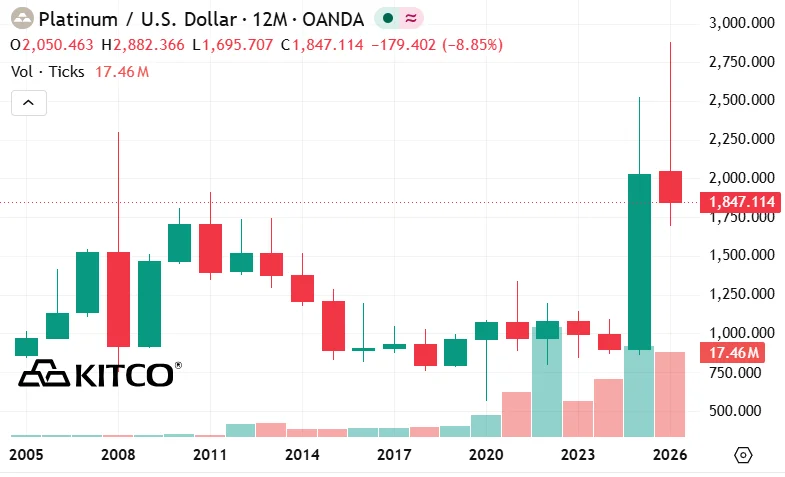
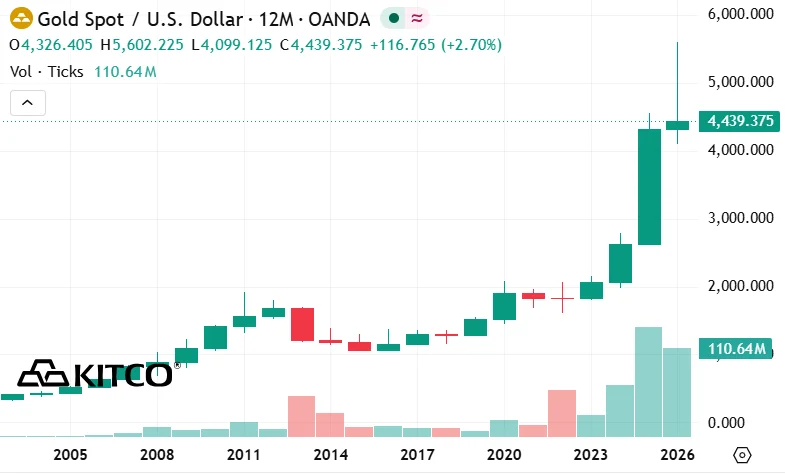
Gold set its current all-time high record on January 28, 2026, reaching $5,602.22 per troy ounce. Platinum’s all-time high, by comparison, was $2,308.80 per ounce, set back in 2008. That $3,293 gap at gold’s peak shows just how far the two metals have diverged over time.
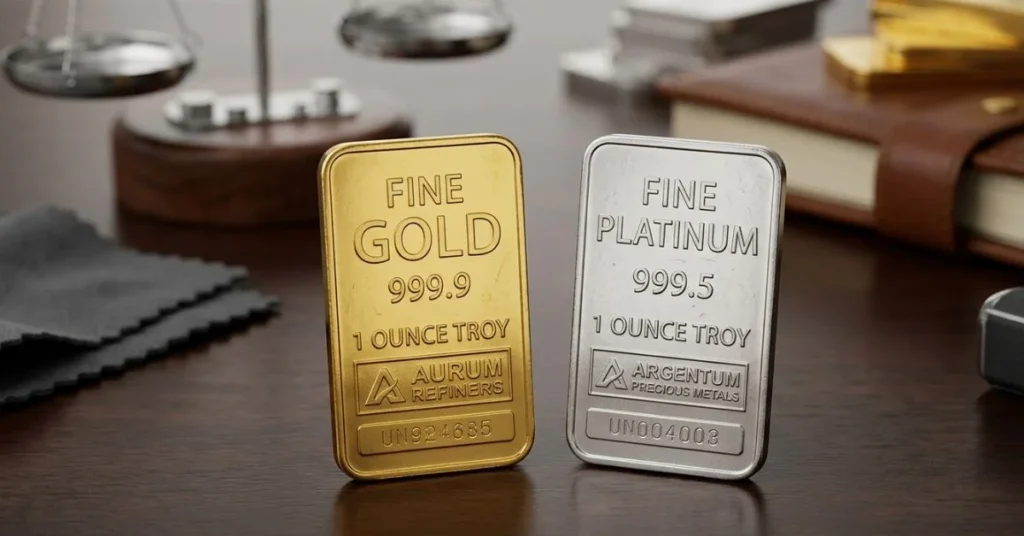
For anyone buying physical bullion today, the practical consequence is straightforward: a one-ounce gold bar or coin costs more than twice what a comparable platinum bar costs at spot. That matters enormously for portfolio sizing and entry-level investment decisions.
Both metals are priced in troy ounces — a unit equal to 31.1035 grams, not the same as the standard avoirdupois ounce of 28.35 grams used for everyday weights. Every LBMA contract, every COMEX futures position, and every bullion dealer invoice worldwide references the troy ounce as the standard.
A Brief History: When Platinum Was the More Expensive Metal
So when people ask is gold or platinum more expensive, they’re often surprised to learn this wasn’t always such a clean answer. From the 1800s through roughly the mid-2000s, platinum was more expensive than gold across most periods. The last time platinum actually traded above gold was mid-2014 — gold has maintained price dominance ever since.
Before gold’s dramatic rise during the 1970s, platinum traded at more than four times the price of gold. In 1970, gold averaged $35.94 per ounce while platinum sat at $151.67 per ounce. Platinum had a genuine mystique — it was harder to refine, harder to work with, and far less understood by markets. Jewelers and industrial buyers competed for limited supply.
When the 2008 financial crisis hit, global manufacturing collapsed and platinum crashed while gold surged — investors seeking safety flooded into gold, not platinum. That divergence never fully reversed.
The counter-intuitive truth here: rarity doesn’t automatically make a metal more expensive. Platinum is rarer than gold by annual mine production — roughly 15 to 20 times rarer. Yet gold commands the higher price because of its monetary role, its deep investment infrastructure, and the institutional habit of treating it as a store of value during uncertainty. Platinum, by contrast, lives or dies by industrial demand. That’s a fundamentally different and more volatile pricing engine.
Why Is Gold More Expensive Than Platinum? The Real Drivers
When investors ask is gold or platinum more expensive and want to understand why, the answer comes down to three structural factors: safe-haven demand, investment infrastructure, and central bank buying.
Safe-haven demand. Gold has a centuries-old role as monetary insurance. When currencies weaken, inflation rises, or geopolitical tensions spike, investors and institutions buy gold. As of June 2026, gold is consolidating near multi-year highs driven by ongoing uncertainty around U.S.-Iran ceasefire negotiations — a reminder of gold’s function when geopolitical risk is elevated. Platinum doesn’t carry that same safe-haven identity.
Investment depth. The total value of annual gold investment more than doubled in 2025 to reach $240 billion. Exchange-traded funds hold billions of dollars of physical gold for retail investors globally — infrastructure that platinum simply doesn’t have at the same scale. Deep, liquid markets attract more capital, and more capital sustains higher prices.
Central bank buying. Central banks around the world hold gold as a reserve asset. The IMF classifies gold as a reserve currency component. No central bank holds platinum reserves. That institutional demand floor simply doesn’t exist for platinum, which means platinum prices are far more exposed to swings in automotive and industrial output.
Platinum’s industrial anchor. Over 80% of annual platinum supply goes directly into the automotive industry — primarily catalytic converters, which require approximately 3 to 7 grams of platinum per unit. When car production slows, platinum demand slumps. Gold has no equivalent industrial dependency, which makes its price far more stable during manufacturing downturns.

Is Gold or Platinum More Expensive in Jewelry? It’s More Complicated
At the raw spot price level, is gold or platinum more expensive is an easy question — gold wins by a wide margin. But walk into a jewelry store and the answer shifts.
Platinum jewelry is typically 95% pure, whereas most gold jewelry is alloyed with other metals — 14-karat gold contains only about 58.3% gold, and 18-karat contains about 75%. A platinum ring of the same size and design will usually weigh more than a comparable gold ring because of platinum’s greater density, and since precious metals are priced by weight, that additional mass increases the overall cost. Platinum is also more difficult to work with, requiring higher temperatures and specialized tools, which raises manufacturing costs.
The result: a platinum engagement ring and a similarly sized 18-karat gold ring can end up at comparable retail prices, even though the underlying metals trade at a 2:1 spot ratio. The purity difference effectively closes the gap.
Investors tracking is gold or platinum more expensive should note that this jewelry premium for platinum doesn’t make platinum a better investment — it reflects craftsmanship cost, not metal scarcity. When you resell platinum jewelry, you’re selling the metal content, not the making charge.
What the Research Shows: Supply Deficits and the Platinum Undervaluation Argument
Precious metals analysts who closely follow the question of is gold or platinum more expensive — specifically whether the current gap is sustainable — point to platinum’s supply fundamentals as a key variable.
According to the World Platinum Investment Council (WPIC), 2025 recorded a platinum market deficit of 1,082 thousand ounces — the largest shortfall in the WPIC’s data series. Strong investment demand combined with constrained supply drove this outcome, with mine supply weakened by flooding and maintenance disruptions in South Africa early in the year.
The platinum market is forecast to record its third consecutive annual deficit through 2025, sitting at 692,000 ounces. Platinum mine supply is predominantly from deep-level underground mines in South Africa, making it structurally difficult to flex output in the near to medium term.
The gold-to-platinum price ratio reached 3.5x in May 2025 — its highest level since 2015 — prompting some Chinese jewelry fabricators to switch from gold to platinum for production, attracted by platinum’s relative affordability.
What people consistently get wrong: they assume that because platinum is rarer and in structural supply deficit, its price must rise to match or exceed gold. That’s not how it works. Price is driven by the type of demand, not just the volume. Investment demand for gold is driven by fear and monetary uncertainty — emotions that are permanent features of the global economy. Industrial demand for platinum is driven by car production cycles — which can fall sharply in recessions. Until platinum builds a comparable investment demand base, the answer to is gold or platinum more expensive will keep returning the same verdict: gold.
Is Gold or Platinum More Expensive for Investment? A Practical Comparison
Anyone seriously weighing the two metals should understand exactly what they’re buying into.
- Gold trades under the symbol XAU. It’s liquid globally, recognized by every central bank, and priced through the LBMA London Fix twice daily. It performs well during currency crises, inflation, and geopolitical instability. Past performance does not guarantee future results.
- Platinum trades under XPT. Its pricing is heavily influenced by the London Platinum and Palladium Market (LPPM) and NYMEX futures. It offers potentially higher upside if industrial demand recovers and the supply deficit deepens — but it also carries more downside risk if automotive production slows or electric vehicles replace catalytic converters at scale.
Platinum was once considered “rich person’s gold” due to its rarity and historical premium over gold. Gold’s ascent over recent years has left platinum behind — but analysts tracking the gold-to-platinum ratio note significant room for platinum to narrow the price gap if current supply deficit trends persist.
The investor who skips this distinction and buys platinum assuming it must be worth more because it’s rarer will be caught off-guard by how differently these two markets behave. Rarity is one input. Demand structure is the dominant one.
Is Gold or Platinum More Expensive: The Historical Timeline at a Glance
| Year | Gold Price (approx.) | Platinum Price (approx.) | Which Was More Expensive? |
| 1970 | $36/oz | $152/oz | Platinum |
| 2008 | ~$870/oz | ~$2,250/oz | Platinum |
| 2014 | ~$1,200/oz | ~$1,400/oz | Platinum (last time) |
| 2020 | ~$1,900/oz | ~$900/oz | Gold |
| 2025 | ~$3,300/oz | ~$1,000/oz | Gold |
| 2026 | ~$4,455/oz | ~$2,068/oz | Gold (by 2:1+) |
Sources: Kitco, JM Bullion, Fortune, World Platinum Investment Council
The table makes plain that the question is gold or platinum more expensive has had different answers at different moments in history. Right now, gold wins — by a margin that few would have predicted even a decade ago.
Conclusion: Is Gold or Platinum More Expensive in 2026?
Gold is more expensive than platinum in 2026 — and by a historically wide margin. With gold trading above $4,455 per troy ounce as of June 2026 and platinum sitting near $2,068, the gap exceeds $2,300 per ounce. Anyone asking is gold or platinum more expensive for bullion investment, jewelry buying, or portfolio planning needs to start with that number.
The reason isn’t that gold is rarer — it isn’t. It’s that gold has a global monetary identity, central bank backing, and a deep investment infrastructure that platinum simply doesn’t match. Platinum’s story is compelling — supply deficits, green energy demand, historical undervaluation — but until those factors drive the same kind of fear-driven safe-haven buying that powers gold, the price gap will persist.
If you’re deciding between the two metals, the right question isn’t just which one costs more today. It’s which one serves your actual purpose — inflation hedge, industrial exposure, or long-term store of value. Those are very different answers. Always consult a qualified financial advisor before making investment decisions. Past performance does not guarantee future results.
Also Read: How to Invest in Gold for Beginners: The Real 2026 Guide
FAQ
Is gold or platinum more expensive per ounce right now?
Gold is more expensive. As of June 2026, gold trades above $4,455 per troy ounce while platinum sits near $2,068 — making gold more than double the price of platinum per ounce.
Was platinum ever more expensive than gold?
Platinum traded above gold for most of recorded market history, from the 1800s through roughly 2014. The last time platinum was more expensive than gold was mid-2014.
Is platinum rarer than gold?
Platinum is approximately 15 to 20 times rarer than gold by annual mine production — yet gold commands a much higher price because investment and safe-haven demand for gold far outweigh platinum’s industrial-driven demand base.
Does platinum cost more than gold in jewelry stores?
Sometimes. Platinum jewelry is typically 95% pure and denser than gold, which means a platinum ring of the same size uses more metal by weight and costs more to manufacture — narrowing the price gap at retail even though platinum’s spot price is half of gold’s.
Could platinum become more expensive than gold again?
Possibly. The WPIC recorded platinum’s largest-ever annual supply deficit in 2025 at 1,082,000 ounces, driven by South African mine disruptions and rising investment demand. If those deficits persist and industrial demand for hydrogen fuel cells grows, the gold-to-platinum ratio could narrow — though no specific price outcome is guaranteed.
This article is for informational and educational purposes only. It does not constitute financial advice. Always consult a qualified financial advisor before making any investment decisions.