This article is for informational and educational purposes only. It does not constitute financial advice. Always consult a qualified financial advisor before making any investment decisions.
What does karat mean in gold? Most people have seen the stamps — 10K, 14K, 18K, 24K — on rings, chains, and bullion coins, but very few buyers could tell you precisely what those numbers represent or why they stop at 24. Understanding what karat means in gold is one of the most practical things any buyer or investor can learn before spending money on the metal.
Here’s the plain answer: karat measures how much of a gold piece is actually pure gold. A gold karat is 1/24 part — or 4.1667% — of the whole, and the purity of a gold alloy is expressed as the number of these parts of gold it contains. So 18K gold contains 18 of those 24 parts as pure gold. The remaining 6 parts are other metals — copper, silver, zinc, or nickel — depending on what the maker added for strength and color. That fraction-out-of-24 formula is the complete answer to what karat means in gold, and once it clicks, every hallmark on every piece of jewelry becomes immediately readable.
What Does Karat Mean in Gold — and Where Did the 24-Part Scale Come From?
Most people assume someone picked 24 arbitrarily. They didn’t. The origin goes back over a thousand years to a very specific object: a medieval coin.
In the Byzantine Empire, the widely circulated gold solidus coin weighed approximately 24 carats. The word “carat” itself derives from the Greek word “kerátion,” meaning carob seed. The carob seed was used as a point of reference because of its relatively uniform weight.
A medieval denomination called a Mark weighed 24 carats — 24 carob seeds. Pure gold was too soft for these coins, so copper and other metals were added to produce a harder alloy. The purity of the coin’s gold content was therefore expressed by the proportion of its carat weight made up from pure gold.
We don’t use 24 because it’s a nicer number than 100. We use it because historical coin standards fixed the benchmark at 24 units, and jewelers kept that convention across centuries. There’s also a practical arithmetic reason: 24 divides cleanly into halves, thirds, quarters, sixths, and eighths — making trade calculations much easier long before calculators existed.
By the medieval period, European goldsmiths had standardized the 24-karat scale. The system was formalized by assay offices and guilds, particularly in London, where the Goldsmiths’ Company has been hallmarking gold since 1300. Seven centuries later, that same framework for what karat means in gold still governs every ring, bar, and bullion coin sold globally.
The Karat Scale: 10K Through 24K Explained
Answering what karat means in gold gets much more useful when you look at each common grade side by side. The formula is always the same — divide the karat number by 24 to get the gold percentage.
| Karat | Gold Content | Fineness Stamp | Common Uses |
| 24K | 99.9% | 999 | Bullion coins, investment bars |
| 22K | 91.7% | 916 | High-end jewelry, American Gold Eagle |
| 18K | 75.0% | 750 | Fine jewelry (Europe, Middle East) |
| 14K | 58.3% | 585 | Everyday jewelry (US-dominant) |
| 10K | 41.7% | 417 | Budget jewelry, US legal minimum |
| 9K | 37.5% | 375 | Common in UK and Australia |
Common karat grades include 24K (pure), 22K (91.7% gold), 18K (75% gold), 14K (58.3% gold), 10K (41.7% gold), and 9K (37.5% gold).
Anyone asking what karat means in gold for investment purposes should note something counter-intuitive: a higher karat number doesn’t mean a better product for every use. It means more gold — which in some applications is actually a problem. Due to pure gold’s softness at 2.5 on the Mohs hardness scale, 24K gold rarely appears in jewelry and instead dominates investment bullion markets. A 24K ring scratches visibly from regular daily wear within weeks. The very softness that makes 24K gold ideal for a vault makes it impractical for a finger.
What Does Karat Mean in Gold Bullion vs. Jewelry?
The answer to what karat means in gold shifts depending on whether you’re buying jewelry or investment bullion — and the difference matters.
In jewelry, karat is a purity label that also predicts durability and color. In bullion, karat is a certification of gold content that directly determines melt value. 14K gold represents 68% of US gold jewelry sales, while 18K accounts for 24%. American consumers have settled on 14K as the default — not because it’s the cheapest option, but because it balances gold content against the practical demands of everyday wear. 14K gold accounts for about 90% of engagement and wedding rings sold in the United States.
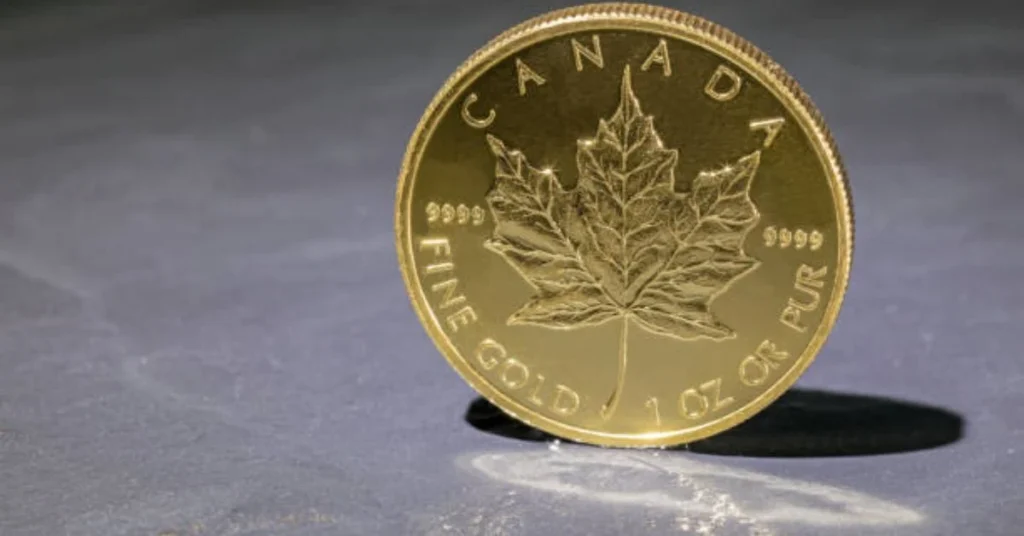
Bullion coins sit at the higher end. The Canadian Gold Maple Leaf and Austrian Philharmonic are struck in 24K (.9999 fine). The American Gold Eagle — the most widely held gold coin in the US — uses 22K gold. At 91.67% purity, 22K gold balances high gold content with enhanced durability through strategic alloying with silver and copper for scratch resistance. Both coins contain exactly one troy ounce of pure gold — the alloy simply adds a small amount of gross weight above that.
So when investors ask what karat means in gold for coins: the karat stamp certifies gold content, but it’s the weight guarantee from the issuing mint — the U.S. Mint, the Royal Canadian Mint, or the Perth Mint — that confirms actual investment value.
What People Get Wrong About What Karat Means in Gold
This question — what does karat mean in gold — seems simple, but it comes with several widespread misconceptions worth clearing up directly.
Misconception 1: Higher karat = better gold. It means purer gold, which isn’t always better. For a bracelet worn daily, 14K outperforms 18K in durability. For a vault holding bar, 24K makes more sense. What karat means in gold depends entirely on the intended use.
Misconception 2: Karat and carat are the same word spelled differently. They’re not. Carats measure physical weight using precise decimals — such as 1.75 ct for a gemstone. Karats measure gold purity in whole numbers: 10K, 14K, 18K, 24K. Both operate on completely different scales. A single piece of jewelry can carry both measurements — a 1-carat diamond set in 14K gold involves two separate numbers describing entirely different properties.
Misconception 3: All countries define minimum gold purity the same way. They don’t. In the United States, the Federal Trade Commission requires that the minimum karat legally sold as “gold” jewelry is 10K (41.7% pure). Items below 10K cannot be marketed as gold in the US. In the UK, the legal minimum is 9K (37.5%). Germany and France permit 8K items to be sold as gold. Buying gold jewelry abroad without checking local standards means you might receive metal that wouldn’t qualify as gold under US law.
If you skip checking the hallmark on a piece of gold jewelry, you lose the one independent verification that confirms what karat means for that specific item.
What the Research Shows: How Karat Affects Color, Not Just Purity

Anyone who has studied gold markets understands that karat conversations rarely start with color — but they probably should. What karat means in gold reaches well beyond purity into something immediately visible: the appearance of the metal itself.
Yellow gold in 18K typically contains gold, silver, and copper in set proportions — copper adds warmth, silver adds brightness. Rose gold uses the same base but with copper content increased significantly, shifting the hue toward pink. White gold gets its color not from a different alloy composition but from rhodium plating applied over a gold-nickel or gold-palladium base.
Here’s the part that surprises most buyers: the color of white gold has nothing to do with karat. An 18K white gold ring and an 18K yellow gold ring contain identical gold content — 75%. The color difference is entirely a function of which metals fill the remaining 25%. As of 2025, yellow gold holds 43% of the US market, rose gold 31%, and white gold 26%.
The most pure gold ever produced commercially was made in 1957 by Australia’s Perth Mint, reaching 999.999 fineness — known as six nines fineness. The Royal Mint has since used it as its benchmark for purity. Standard investment-grade bullion sits at 999.9 fineness (four nines), considered functionally equivalent to 24K in commercial terms. And as of 2026, every major sovereign mint — from the US Mint to the LBMA-approved refiners — certifies gold to this four-nines standard.
Reading Hallmarks: What Karat Means in Gold Jewelry Stamps
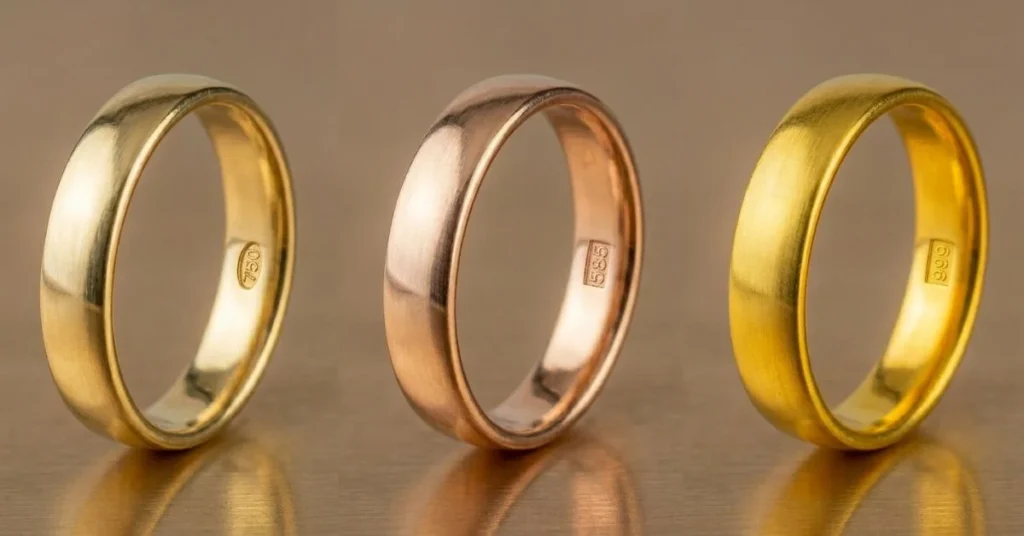
What karat means in gold shows up physically on every properly made gold piece as a hallmark — a tiny stamped number inside a ring band, on a clasp, or at the back of a pendant.
Stamps include fineness numbers such as 585 (which equals 14K, or 58.3% pure gold), 750 (18K, or 75% pure), or 999 (24K, essentially pure gold). The fineness system (parts per thousand) and the karat system describe the same thing from two angles. 750 fineness and 18K are identical in meaning. A European ring might be marked “18K 750” to serve both markets.
When you see a three-digit fineness number on gold jewelry, divide by 10 to get the gold percentage: 585 ÷ 10 = 58.5% = 14K. That’s it. The FTC also permits a half-karat tolerance — meaning a piece stamped “14K” must contain at least 13.5 karats of gold. That small margin is legal. Anything below it constitutes misrepresentation under federal consumer protection law.
In 2026, with gold prices continuing to attract new buyers, understanding what karat means in gold through hallmarks is the single most reliable verification tool available to any buyer without a laboratory.
What Karat Means in Gold for Investors: The Melt Value Connection
The karat number on any gold item directly determines its melt value — the floor price recoverable if the piece were refined back into raw gold. This is where what karat means in gold translates most directly into dollars and cents.
A 10K gold bracelet weighing 10 grams contains only 4.17 grams of pure gold. An 18K bracelet of the same gross weight holds 7.5 grams. At any given spot price — which the London Bullion Market Association (LBMA) publishes twice daily via the London Fix — those translate into meaningfully different valuations. Every gram of alloy metal in a lower-karat piece is weight you paid gold prices for but didn’t receive in gold content.
Jewelry nearly always sells at a retail premium well above melt value. A branded 14K ring may price at 3–4x its raw gold content due to design, brand, and retail markup. Investors specifically seeking gold exposure — rather than wearable pieces — typically target 22K or 24K products where a higher percentage of purchase price is actual gold.
Understanding what karat means in gold is, at its core, understanding exactly how much of your money is buying the metal itself versus everything else attached to it. Past performance does not guarantee future results, and resale values for gold jewelry vary widely depending on condition, brand, and market timing.
Conclusion: What Does Karat Mean in Gold — The Final Word
What does karat mean in gold? It means a fraction. Specifically, the number of pure gold parts present out of a fixed total of 24. A system that traces back to Byzantine coinage and carob-seed weights, standardized by London’s Goldsmiths’ Company starting in 1300, and still governing every gold transaction globally in 2026.
Whether you’re buying a 14K engagement ring, evaluating a 22K American Gold Eagle, or comparing 24K bullion bars, knowing what karat means in gold gives you the one number that cuts through every sales pitch and price tag. Check the hallmark, divide by 24, and you know exactly what you’re holding.
Also Read: 22 Karat Gold: Hidden Value Most Buyers Never Check
FAQ
What does karat mean in gold, exactly?
It measures the proportion of pure gold in a piece, expressed as parts out of 24. 18K gold contains 18 parts gold and 6 parts other metals — 75% pure gold by weight.
Is 24K gold the purest you can buy?
24K represents 99.9% to 99.99% pure gold — all 24 parts of the 24-part scale are gold with no added metals. Major bullion mints including the Royal Canadian Mint and Austria’s Vienna Mint produce 24K products backed by government weight and purity guarantees.
Does a higher karat mean better gold for everyday jewelry?
No. Higher karat means more gold content, but also less durability. 24K gold scratches easily from normal wear. For rings or bracelets used daily, 14K or 18K provides a practical balance of gold content and surface resistance.
What is the minimum karat legally sold as “gold” in the US?
10K — equivalent to 41.7% pure gold. The Federal Trade Commission prohibits marketing any item below 10K as gold in the United States. In the UK, the legal minimum is 9K (37.5%).
What’s the difference between karat and carat?
Karat measures gold purity on a 24-point scale (14K, 18K, 24K). Carat measures the weight of gemstones — one carat equals 0.2 grams. A single piece of jewelry can carry both: a 1-carat diamond set in 18K gold involves two separate measurements describing entirely different properties.
This article is for informational and educational purposes only. It does not constitute financial advice. Always consult a qualified financial advisor before making any investment decisions.