This article is for informational and educational purposes only. It does not constitute financial advice. Always consult a qualified financial advisor before making any investment decisions.
Most first-time buyers hold a 1 oz silver coin and are genuinely caught off guard — it’s bigger than expected. A 1 oz silver coin is noticeably larger than a regular pocket coin, and understanding exactly how big is a 1 oz silver coin matters whether you’re planning storage, buying capsules, or just trying to picture what you’re getting before your order arrives.
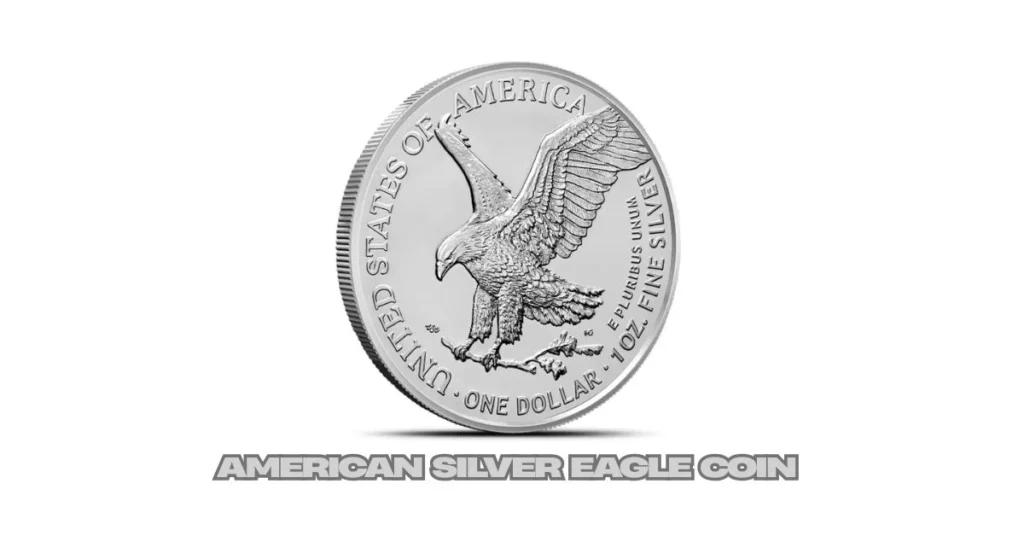
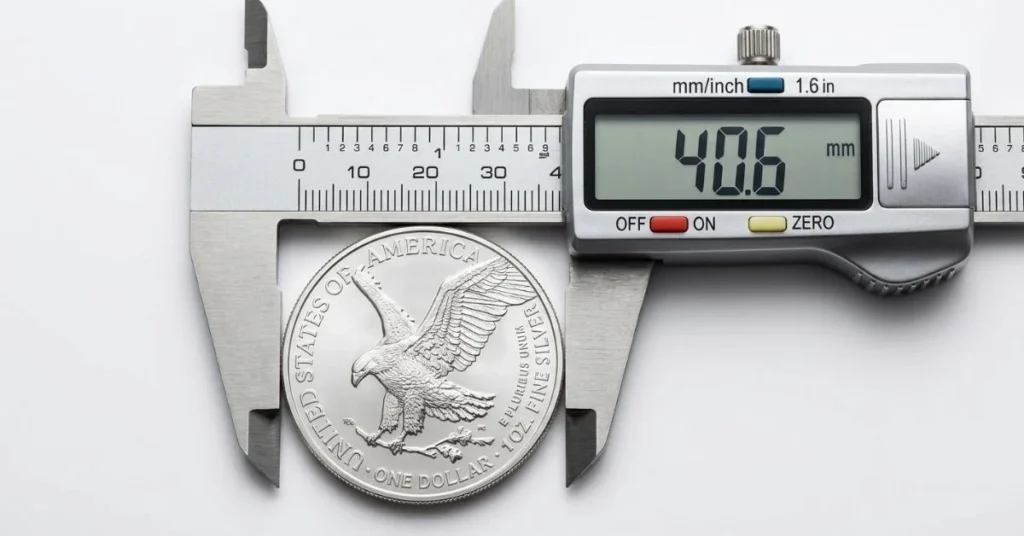
The short answer: the most widely-owned 1 oz silver coin — the American Silver Eagle — measures 40.6 mm in diameter (about 1.6 inches) and 2.98 mm thick, containing exactly 31.103 grams of .999 fine silver. But that’s the starting point, not the whole picture.
The Exact Dimensions of a 1 oz Silver Coin
The American Silver Eagle, the official silver bullion coin of the United States, contains one troy ounce of .999 fine silver, has a diameter of 40.6 mm (1.598 inches), a thickness of 2.98 mm, and a nominal face value of $1 USD. The U.S. Mint has produced it continuously since 1986 — and those measurements have not changed in nearly four decades of production.
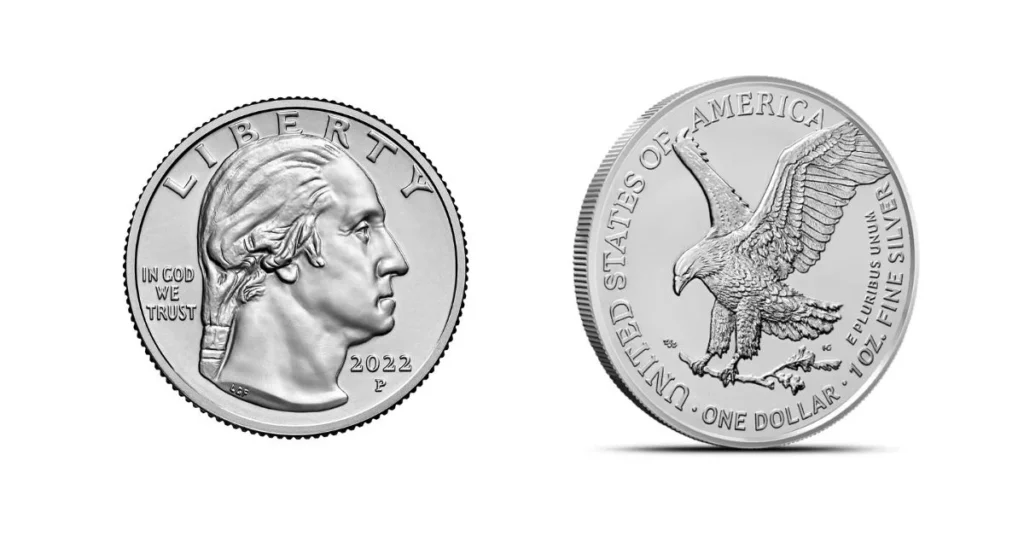
To put that diameter in context: a standard US quarter measures just 24.26 mm across. The Silver Eagle is nearly 67% wider than the coin sitting in your pocket right now. Hold one next to a quarter and the difference is stark.
Other major government-issued 1 oz silver coins follow a similar range:
- Canadian Silver Maple Leaf (Royal Canadian Mint): 37.97 mm diameter, 3.29 mm thick, 31.11 grams, struck in 99.99% fine silver.
- 2026 UK Silver Britannia (The Royal Mint): 38.61 mm diameter, 3.00 mm thick, containing one troy ounce of 999.0 fine silver.
- Armenian Silver Noah’s Ark: 38.6 mm diameter, 2.8 mm thick, 31.103 grams of 99.9% fine silver.
Every major mint lands its 1 oz silver coin somewhere in the 37–41 mm diameter range. The slight differences come down to individual mint tolerances and design choices — not silver content, which stays fixed at one troy ounce.
Why Is a 1 oz Silver Coin Bigger Than a 1 oz Gold Coin?
This surprises a lot of buyers who own both metals. Two coins, both labeled “1 oz” — yet the silver one is clearly larger. How?
Physics. Specifically, density.
The density of gold is 19.32 grams per cubic centimeter, while the density of silver is 10.49 grams per cubic centimeter. Gold is almost twice as dense as silver. That means to reach the same troy ounce weight, silver needs nearly double the volume. More volume = bigger physical coin.
The American Gold Eagle has a diameter of 32.70 mm and is 2.87 mm thick, while the American Silver Eagle has a diameter of 40.6 mm and is 2.98 mm thick — despite both weighing one troy ounce. That’s a diameter difference of nearly 8 mm — visible to the naked eye and meaningful when ordering coin holders.
A 1 troy ounce piece of gold occupies just over half the volume of a troy ounce of silver. So if you’ve ever wondered why gold storage is cheaper per ounce than silver storage — this is a big reason.
How Big Is a 1 oz Silver Coin Compared to Everyday Objects?
Numbers help, but real-world comparisons make it click.
The American Silver Eagle at 40.6 mm sits comfortably between the size of a golf ball (42.67 mm) and a standard bottle cap (32 mm). Place it on a palm and it covers roughly the width of three fingers side by side. That’s the tactile reality of a 1 oz silver coin.
Here’s how it stacks up against familiar objects:
- US Quarter: 24.26 mm — the Silver Eagle is 67% wider
- US Half Dollar: 30.61 mm — still notably smaller than the Eagle
- Standard poker chip: 39 mm — almost identical in diameter to a Maple Leaf
- A UK 50p coin: 27.3 mm — the Britannia is 41% wider
For practical handling, the 40.6 mm size is actually well-suited for storage. The 2026 UK Britannia fits a standard 39 mm coin capsule, while most Silver Eagles require a 41 mm capsule. Buying the wrong size capsule is one of the most common rookie mistakes — and one easily avoided by confirming dimensions before purchasing.
What Experts Say: The Troy Ounce Standard Behind the Size
Anyone who follows precious metals closely knows that the “1 oz” on a silver coin doesn’t mean the same ounce as on a bag of sugar. A troy ounce weighs approximately 31.103 grams — about 10% heavier than the standard avoirdupois ounce of 28.35 grams used for everyday goods.
This matters for sizing. Because silver bullion is measured in troy ounces, a coin sold as “1 oz” contains 31.103 grams — not 28.35 grams. If a manufacturer struck a coin to avoirdupois standards instead, it would be measurably lighter and physically smaller. That coin wouldn’t meet the specifications of the London Bullion Market Association (LBMA), COMEX, or any credentialed institutional standard.
Almost all well-known silver coins — the Maple Leaf, the Kangaroo, the Britannia — are standardly struck at one troy ounce. The troy ounce system dates back to Troyes, France, where medieval merchants established standardized weights for precious metals trading. In 2026, every major sovereign mint still honors that standard exactly.
Here’s the counter-intuitive part: the “oz t” abbreviation — standing for troy ounce — is technically the correct notation, but most well-known mints worldwide simply use “oz” to indicate this weight. So when a coin reads “1 oz .999 Fine Silver,” it means troy ounce — always.
What People Get Wrong About 1 oz Silver Coin Sizes
New buyers frequently assume all 1 oz silver coins are identical in size. They’re not — and ordering the wrong coin capsule because of this assumption costs money.
The American Silver Eagle (40.6 mm) requires a 41 mm capsule. The Canadian Maple Leaf (37.97 mm) fits a 38 mm capsule. The UK Britannia (38.61 mm) needs 39 mm. These are not interchangeable. A capsule that’s too tight can scratch coin surfaces; one that’s too loose allows movement that causes wear.
Private mints producing silver rounds are not allowed to use the same dimensions as government-issued coins — this prevents counterfeiting and confusion. So a privately-minted 1 oz silver round might measure 39 mm while an American Silver Eagle measures 40.6 mm, even though both contain exactly one troy ounce of .999 silver.
A second common mistake: assuming thickness is irrelevant. It isn’t. Counterfeiters who work with inferior molds often produce coins that are slightly smaller or thicker, and a basic set of calipers can reveal that discrepancy within seconds. Any investor holding physical silver should own a cheap digital caliper. Measuring diameter and thickness takes ten seconds and removes any doubt about authenticity.
1 oz Silver Coin vs. 1 oz Silver Bar: How the Sizes Compare
A 1 oz silver coin and a 1 oz silver bar contain the same weight of silver but look completely different. A typical minted 1 oz silver bar measures approximately 50 mm × 29 mm × 3 mm (roughly 2 inches × 1.14 inches × 0.12 inches).
The bar is longer and narrower than a coin — more rectangular, thinner, and easier to stack uniformly in a safe or vault. Coins are bulkier by comparison and require individual capsules or tubes. The Silver Eagle ships from the US Mint in tubes of 20 coins or sealed Monster Boxes of 500 coins — each tube approximately 88 mm tall, giving a useful physical benchmark for storage planning.
From a pure space-efficiency standpoint, bars win. Bars are often easier to store in secure vaults than coins of the same weight. But coins carry government-backed weight and purity guarantees that private bars don’t always provide, and their recognizability makes them more liquid in secondary markets.
As of 2026, the American Silver Eagle marked its 40th anniversary — the 2026 Proof Silver Eagles feature a 1776–2026 dual-date and a Liberty Bell 250 privy mark — a collector milestone that has added numismatic interest to the standard bullion size specifications that haven’t budged since 1986.
Practical Consequences: Storage, Capsules, and Tube Counts
If you skip confirming the exact dimensions of a 1 oz silver coin before buying accessories, you’ll wind up with capsules that don’t fit, storage boxes that aren’t calibrated correctly, or tubes that hold the wrong coin count.
Most US dealers sell Eagle tubes holding 20 coins, Maple Leaf tubes holding 25 coins, and Britannia tubes holding 25 coins — because tube diameter is calibrated to each coin’s specific measurements. Order Maple Leaf tubes for your Silver Eagles and nothing fits right.
For wall safes and home vaults, a useful benchmark: a standard US Mint Monster Box holds 500 Silver Eagles (25 tubes × 20 coins) and measures approximately 298 mm × 225 mm × 89 mm. Knowing the physical footprint of a 1 oz silver coin means you can calculate exactly how many coins fit your storage before buying a single one.
Also Read: How Many Grams in Ounce of Silver? Surprising Truth
FAQ: How Big Is a 1 oz Silver Coin?
Is a 1 oz silver coin bigger than a US quarter?
A US quarter is 24.26 mm in diameter; the American Silver Eagle is 40.6 mm — nearly 67% wider. They are not comparable in size at all.
Are all 1 oz silver coins the same size?
The American Silver Eagle is 40.6 mm, the Canadian Maple Leaf is 37.97 mm, and the UK Britannia is 38.61 mm. Each mint sets its own dimensions, so coin capsule sizes are not interchangeable.
Is a 1 oz silver coin bigger than a 1 oz gold coin?
A 1 oz American Silver Eagle is 40.6 mm in diameter versus 32.70 mm for a 1 oz American Gold Eagle. Silver’s lower density means it needs more volume to achieve the same troy ounce weight.
How much does a 1 oz silver coin weigh in grams?
Exactly 31.103 grams — one troy ounce. This is roughly 10% heavier than a standard avoirdupois ounce of 28.35 grams used in everyday measurements.
Does the size of a 1 oz silver coin affect its value?
No. Bullion value is determined by silver content (one troy ounce of .999 fine silver) and the current spot price — not by diameter or thickness. Proof or commemorative editions may carry a premium for collector reasons, but the base bullion value stays tied to weight and purity only. Past performance does not guarantee future results.
This article is for informational and educational purposes only. It does not constitute financial advice. Always consult a qualified financial advisor before making any investment decisions.