This article is for informational and educational purposes only. It does not constitute financial advice. Always consult a qualified financial advisor before making any investment decisions.
Most people shopping for 18 karat white gold think they’re buying a silver-colored metal. They’re not. Underneath its rhodium-plated surface, 18 karat white gold is actually yellow — and that surprises nearly everyone who finds out. The white color isn’t natural. It’s engineered. And that single fact changes how you buy, maintain, and value this metal for life.
What 18 Karat White Gold Actually Contains
18 karat gold means 18 parts out of 24 are pure gold, with the remaining 6 parts composed of other metals — giving it a precise purity of 75%. In white gold, those remaining 25% are specifically chosen to lighten the metal’s color. The finished alloy, however, still carries a faint yellow tone from the dominant gold content.
Palladium-based alloys are now standard for hypoallergenic safety in 18kt white gold, with most pieces carrying rhodium plating that requires reapplying every 12–24 months to maintain the bright finish. The Vickers hardness sits around 150 HV, and the hallmark ‘750’ confirms 18kt purity.
Nickel alloys produce harder, stronger material suited for rings and pins, while gold-palladium alloys are softer and more pliable — making them the preferred choice for gemstone settings where flexibility during stone-setting is needed. Most buyers don’t realize they could be wearing two structurally different metals both sold under the same name.
Here’s the consequence if you skip checking: buying an 18kt white gold piece with a nickel-based alloy when you have sensitive skin will likely cause contact dermatitis — a reaction that rhodium plating temporarily prevents but doesn’t permanently block once plating wears through.
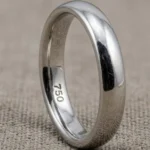
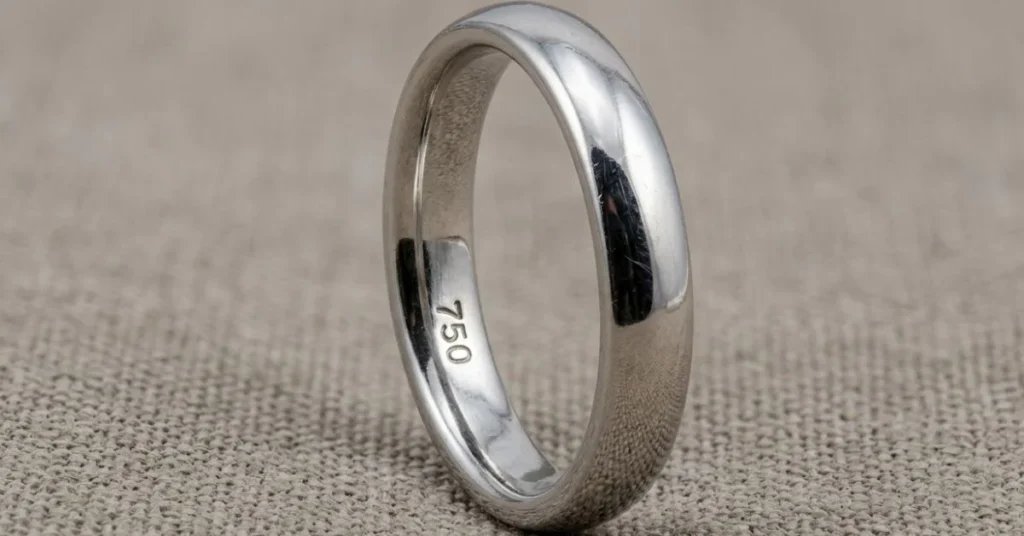
The hallmark system is straightforward. Worldwide, a “750” stamp always means 18 karats or 75% pure gold, whether marked in Europe as “750,” in the US as “18K” or “18KT,” or on older British pieces as “18ct.” All three notations are legally equivalent. Seeing “750” on the inside of a ring band is the fastest verification a buyer can make before purchase.
The Rhodium Plating Reality Nobody Mentions
18k white gold starts with a blend of 75% pure gold and 25% white metal alloys, commonly palladium or manganese. Once the jewelry has been crafted, it is plated with rhodium to provide its recognizably bright white appearance. Without that rhodium layer, 18kt white gold looks noticeably warmer and grayer than most buyers expect.
Rhodium itself belongs to the platinum group of metals — rarer than gold and priced accordingly. The plating layer applied to jewelry is microscopic, typically between 0.1 and 0.5 microns. That’s thinner than a strand of human hair. Under normal daily wear — rings especially — this layer wears through unevenly, starting at edges and high-contact surfaces.
Once the plating wears away, white gold can turn yellowish, which is a factor buyers should account for at the time of purchase. Re-plating by a jeweler typically costs between $40 and $120 depending on the piece’s complexity and the rhodium spot price at the time of service.
And here’s what most guides leave out entirely: rhodium-plated pieces shouldn’t be cleaned with ultrasonic cleaners at home. The vibration thins the plating faster. A soft cloth and mild soap is the correct maintenance method for rhodium-coated white gold between professional services.
How the 750 Hallmark Is Verified Across Markets
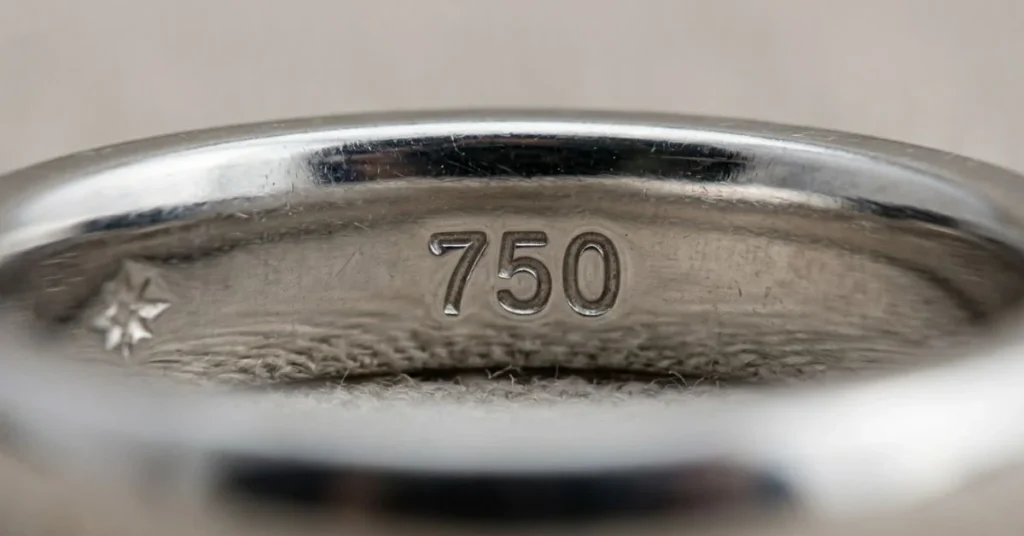
The 750 stamp is universal, but its context differs by country. The 750 mark is the common European and UK notation for 18-karat gold, while in the US you might simply see “18K” or “18KT” stamped on the jewelry. Older British pieces sometimes carried a “18ct” mark, but modern hallmarking standards have largely unified around the numeric 750 stamp for clarity.
Importantly, the stamp confirms gold content — not alloy composition. The 750 gold hallmark does not detail the specific alloy ingredients; it only confirms the gold purity. The remaining 25% could be copper, silver, zinc, nickel, palladium, or a mix, depending on the desired color and properties.
That distinction matters practically. Two rings both stamped 750 white gold can have entirely different compositions — one hypoallergenic, one not. Buyers with metal sensitivities should always ask specifically which alloying metals are present, not just check the karat mark. A reputable jeweler will have this information on the alloy certificate or manufacturer spec sheet for any piece they stock.
In Italy and France, 18kt is the minimum purity standard for fine jewelry at established retailers — a fact worth knowing when purchasing abroad or through international e-commerce platforms.
What People Get Wrong About 18 Karat White Gold Value
The most common misconception: white gold is worth less than yellow gold of the same karat because the white color “dilutes” the gold. Wrong. When it comes to purity, an 18K white gold ring will contain the same amount of gold as an 18K yellow gold ring, making them worth the same in terms of gold content alone.
Where value differences appear is in the alloy metals themselves. Palladium is more expensive than nickel, so pieces made with palladium carry a higher price tag. A palladium-alloyed 18kt white gold ring contains more intrinsically valuable secondary metal than a nickel-alloyed version — yet both carry the same 750 stamp.
The alloy composition is adjusted to produce white gold using palladium or nickel, all while maintaining the same 750 purity standard. The spot price of the secondary metal fluctuates separately from gold’s spot price — meaning the full material value of an 18kt white gold piece isn’t captured by the gold price alone.
As of 2026, with gold trading above $4,455 per troy ounce according to data from COMEX and LBMA-referenced prices, the 75% gold content in every 18kt piece represents substantial material value. Past performance does not guarantee future results, and gold prices fluctuate with macroeconomic conditions.
What Experts Say: Palladium vs. Nickel — the Industry Divide
Anyone who has studied white gold alloy chemistry understands why the industry shifted. Nickel-based white gold dominated manufacturing for most of the 20th century because nickel is inexpensive and produces a very white result. The problem is biological, not metallurgical.
Some people may experience allergic reactions to the nickel in white gold alloys. Palladium-based alloys are now standard for hypoallergenic safety. The European Union’s Nickel Directive, enforced under EN 1811 standards, restricts the rate at which nickel can be released from jewelry in contact with skin — effectively pushing European fine jewelry manufacturers toward palladium alloys for 18kt white gold.
The US hasn’t adopted the same regulatory threshold, which is why American-market jewelry may still contain nickel-based alloys while European-market pieces at the same karat often don’t.
Here’s the counter-intuitive part: palladium-alloyed 18kt white gold is actually less brilliantly white than nickel-alloyed 18kt white gold before rhodium plating. Palladium produces a slightly warmer, gray-white tone. Nickel produces a brighter, cooler white. The metal that looks better unplated is the one more likely to cause skin reactions. The solution — rhodium plating — is what makes both versions look identical in the display case.
18 Karat White Gold vs. Platinum: The 2026 Price Reality
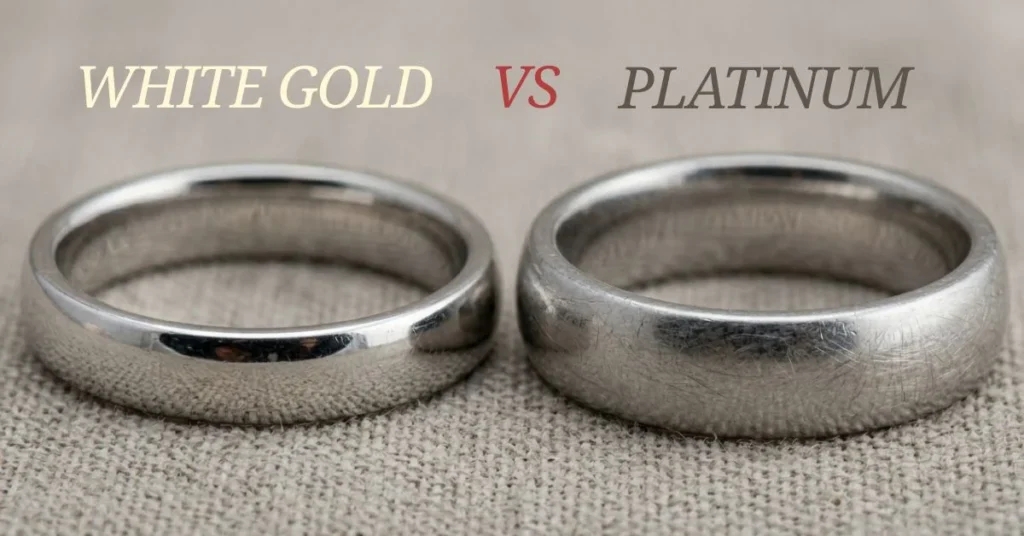
Gold prices have skyrocketed in 2025–2026 due to global economic instability, with central banks buying bullion aggressively. Platinum prices have remained comparatively stable. The result: the price gap between an 18kt gold setting and a platinum setting is smaller than it has been in decades. In some configurations, platinum is now actually cheaper than 18kt gold.
An 18K white gold wedding band will run roughly 20–30% higher than a 14K version due to its greater gold content. A platinum version of the same band typically adds another $500–$800 on top of the white gold price, a premium reflecting both material density and labor involved.
Platinum’s manufacturing costs are structurally higher regardless of spot price. Platinum melts at 1,768°C versus gold’s 1,064°C — the higher working temperature requires specialized furnaces and tools, adding labor cost that doesn’t exist in gold fabrication. That’s the durable reason platinum jewelry commands a premium even when platinum’s raw spot price sits below gold’s.
Platinum scratches more easily than 18 karat or 14 karat gold. Upkeep for platinum tends to be higher, because it must be cleaned and polished regularly to maintain its smooth appearance. Buyers who assume platinum is a lower-maintenance choice because it’s “stronger” typically discover the opposite after a year of daily wear.
Who Should Consider 18 Karat White Gold
Investors who track gold closely know that jewelry-grade metal and investment-grade bullion serve entirely different purposes. 18 karat white gold is not a bullion investment — the making charges, rhodium plating costs, and jeweler margins mean retail jewelry sells at a significant premium to melt value. Recovering that premium on resale is rarely possible.
For wearable jewelry with high gold content, 18kt white gold occupies a specific position:
- Engagement and wedding rings: The standard choice for major European luxury houses including Cartier and Bulgari for their white metal collections.
- High-end watch cases: Used by Swiss manufacturers including Rolex (white gold Daytona models), Patek Philippe (Nautilus white gold references), and Audemars Piguet.
- Diamond settings: White gold plated with rhodium provides a bright, silvery finish that is ideal for diamond settings, making diamonds appear whiter by eliminating the color reflection that yellow gold produces.
- Heirloom pieces: The 75% gold content makes 18kt white gold resistant to corrosion and tarnish over decades of storage.
For buyers prioritizing durability over purity, 14kt white gold at 58.3% gold content is harder — paradoxically, the higher the gold content, the softer the metal, since pure gold (24K) is too soft for most jewelry applications.
Also Read: 21 Karat Gold: Hidden Facts Most Buyers Never Learn
FAQ
Does 18 karat white gold tarnish over time?
But not from the gold itself. The rhodium plating wears away after 12–24 months of regular wear, exposing the underlying alloy’s slightly yellowish or grayish tone. Replating by a jeweler restores the bright white finish.
Is 18kt white gold safe for people with nickel allergies?
Provided the piece uses a palladium-based alloy rather than a nickel-based one. Always confirm the alloy composition with the jeweler before purchasing — the 750 hallmark confirms purity but not alloy type.
What does “750” stamped on white gold mean?
750 stamped on any gold piece confirms it is 18 karat — 75% pure gold. The mark is the European millesimal fineness standard and is legally equivalent to “18K” or “18KT” used in US and UK markets.
Is 18 karat white gold worth more than 14 karat white gold?
Both contain the same type of alloy metals, but 18kt holds 75% pure gold versus 58.3% in 14kt. At current gold prices, the higher gold content translates directly to greater material value and a higher retail price.
Can 18kt white gold be resized by a jeweler?
Its composition is workable enough for standard resizing procedures. Palladium-alloyed versions are slightly more challenging to work with than nickel-alloyed ones due to higher melting characteristics, so inform your jeweler of the specific alloy when requesting modifications.
This article is for informational and educational purposes only. It does not constitute financial advice. Always consult a qualified financial advisor before making any investment decisions. Past performance does not guarantee future results.