This article is for informational and educational purposes only. It does not constitute financial advice. Always consult a qualified financial advisor before making any investment decisions.
Walk into any jewelry store in the United States and you’ll see two numbers stamped on almost everything: 10K and 14K. Most buyers assume the only difference is price. They’re wrong — and that assumption costs people money every year, whether they’re buying an engagement ring, selling scrap gold, or building a small precious metals position. The gap between 10 karat and 14 karat gold goes deeper than a single line on a price tag, and understanding it changes every purchase decision you make from here on.
Both 10 karat and 14 karat gold are real gold. With spot gold reaching an all-time high of $5,602.22 per troy ounce on January 28, 2026, according to APMEX data, the purity distinction between these two grades now carries a larger dollar difference per gram than at any point in history.
The Purity Numbers That Actually Drive Value
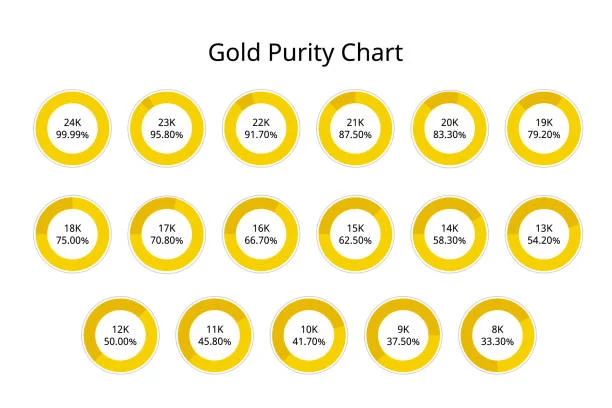
Gold purity runs on a 24-part scale. Pure gold is 24 karats — 100% gold, 0% alloy. Nothing else.
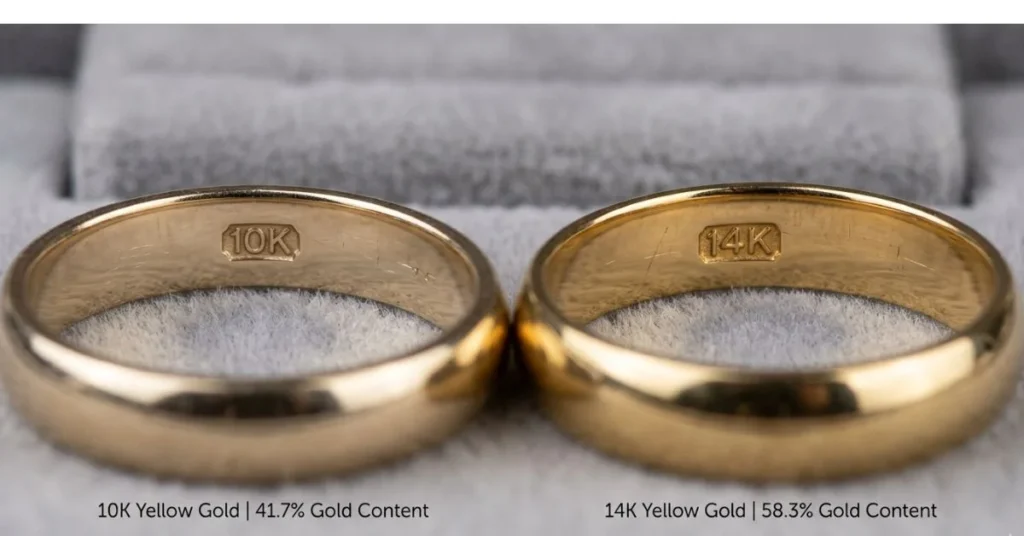
10 karat gold is made up of 41.7% gold and 58.3% alloy. 14 karat gold consists of 58.3% gold and 41.7% alloy metals. Those alloy metals — typically copper, silver, zinc, and sometimes nickel — are added specifically to harden the metal for wearable use. Pure gold is far too soft to hold a gemstone setting or survive daily wear.
In the international fineness system used by bullion markets and the LBMA, 10 karat gold is expressed as 417 fine and 14 karat gold as 583 fine. Those numbers represent parts per thousand of pure gold content.
As of June 4, 2026, the gold spot price stood at $4,472.10 per troy ounce, with a per-gram price of $143.78 for pure 24K gold. Applying the purity multipliers: 10K gold carries a melt value of approximately $59.95 per gram, while 14K gold melt value sits near $83.90 per gram. On a 10-gram piece — the weight of a solid wedding band — that’s a spread of roughly $240 purely from purity difference. This gap widens further when premiums are applied at retail.
Here’s what most buyers don’t know: the percentage difference in gold content between 10K and 14K (16.6 percentage points) sounds modest, but it represents a 40% increase in pure gold mass when comparing the two gram-for-gram. You’re not buying slightly more gold. You’re buying meaningfully more.
Durability: Where 10 Karat Gold Has a Genuine Edge
Because 10K gold has a higher percentage of alloy metals, it is extremely durable and resistant to scratching or bending. More alloy means a harder crystal structure. In metallurgy terms, the alloying metals interrupt the regular atomic lattice of gold, making plastic deformation harder — which translates directly to scratch resistance in the real world.
10K gold’s toughness means fewer repairs and less worry about damage for pieces worn in demanding conditions — rings worn during manual labor, bracelets worn through gym workouts, or any jewelry exposed to repeated physical contact.
14K gold is very durable and, given its balance between purity and alloy content, is the gold of choice for approximately 90% of engagement rings sold in the United States. And that statistic deserves a moment’s thought. The U.S. jewelry industry — with every incentive to sell higher-priced products — has converged on 14K as the practical standard. Not 18K. Not 10K. The 14K sweet spot between durability and gold richness has held that dominant position for decades.
65% of people prefer a 14K gold band over 18K gold for its increased hardness, according to wedding ring market data. So durability is a factor buyers consciously weigh — and 14K wins over higher-purity options on that measure, while 10K wins only when scratch resistance is the single overriding concern.
The practical consequence: if you work with your hands, wear rings constantly through physical activity, or tend to lose or damage jewelry, the extra hardness of 10K is a genuine functional advantage. If you sit at a desk, wear jewelry occasionally, or care about long-term resale, that hardness advantage shrinks to near zero.
Color: The Visible Difference You Can’t Unsee Once You Know It
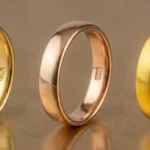
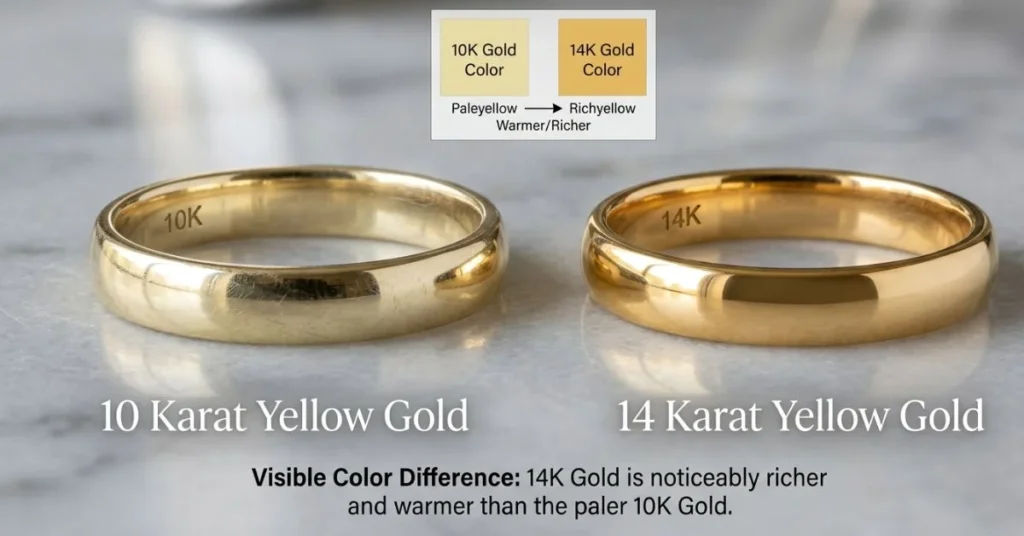
10K gold rings look noticeably paler than the warmer, richer tone of 14K gold. This isn’t a subtle difference. Side by side under normal lighting, 10K yellow gold reads as pale, almost brassy. 14K yellow gold has the warm, rich color most people associate with fine gold jewelry.
The reason is straightforward chemistry. Gold’s characteristic yellow color comes from its atomic electron structure — specifically, relativistic effects that cause gold to absorb blue light and reflect yellow-orange. The more gold present, the more pronounced this optical effect. Adding copper and zinc alloys dilutes that signal.
14K gold has a richer yellow appearance due to the higher presence of gold pigments, while 10K is far lighter in appearance overall. For rose gold, 10K appears too copper-heavy, while 14K achieves a perfectly balanced pink tone.
White gold behaves differently. White gold won’t have much color difference between 10K and 14K, since both are alloyed with palladium or rhodium plating to achieve the white appearance. Rhodium plating eventually wears off both grades at the same rate — so for white gold specifically, the karat distinction matters less for appearance and more for base metal value.
Anyone who has studied gold jewelry closely knows: clients rarely return a piece for being “too durable.” They do return pieces for looking cheap. The color difference between 10K and 14K is visible to untrained eyes in direct comparison, and that visibility has direct consequences for secondary market value.
What the Research Shows: Skin Sensitivity and Alloy Composition
This is where the 10K versus 14K debate gets genuinely personal — and where many buyers get a nasty surprise months after purchase.
10K gold is only 41.7% gold. The remaining 58.3% is other metals, which may include nickel depending on the alloy formulation. Even 14K gold can contain nickel if the alloy wasn’t specifically formulated to be nickel-free.
According to the Mayo Clinic, nickel allergy is most often associated with earrings and other body-piercing jewelry containing nickel. Symptoms appear at the contact point and typically develop within 12 to 72 hours. The reaction is delayed — meaning you might wear a new ring for two days before noticing the redness and itch, by which point the return window may have closed.
Low-karat jewelry pieces such as 10K gold contain more nickel as they have less gold. For those with a confirmed nickel allergy, sticking with 18K or 22K gold is the safer approach.
The counter-intuitive reality: the problem isn’t the gold itself. Pure gold is hypoallergenic. The problem is what fills the remaining 58.3% of a 10K piece — and that alloy composition varies by manufacturer, by batch, and by color (white gold formulations differ from yellow). Two 10K yellow gold rings from different manufacturers can have entirely different nickel content. Gold karat alone tells you nothing about nickel content. You need the alloy specification. Most retailers don’t publish it. Ask before you buy.
Resale Value and Investment Considerations
When resold, a piece made from 14K gold will fetch a higher price than an identical piece made from 10K gold — a direct consequence of the higher gold content per gram.
Gold buyers and pawn shops typically pay 70–85% of melt value for 14K gold jewelry, and 14K has the strongest resale liquidity in the U.S., with active buyers across the secondary market. 10K gold has its own buyer base, but commands smaller absolute dollar returns per gram sold.
The calculation matters more in 2026 than in prior years. With the gold spot price trading above $4,400 per troy ounce as of early June 2026, the melt-value gap between a 10K and 14K piece of equal weight is now measured in hundreds of dollars for anything substantial. A 20-gram gold chain in 10K carries approximately $1,199 in melt value. The same chain in 14K carries approximately $1,678 — a $479 difference purely from purity. Past performance does not guarantee future results.
What people consistently get wrong: they assume the retail premium they paid reflects the piece’s secondary market value. It doesn’t. Secondary buyers pay melt value, adjusted for a margin. Design, brand, and retail markup evaporate at resale. What remains is the gold content — and 14K delivers 40% more of it per gram than 10K.
Who Should Choose 10 Karat — and Who Shouldn’t
The honest answer: 10K gold serves a specific buyer profile well and a different profile poorly.
10K gold works well for:
- Buyers on a tight budget who want real gold jewelry without paying 14K premiums
- Pieces worn in physically demanding environments where scratch resistance matters more than appearance
- Children’s jewelry, where size, replacement frequency, and budget outweigh investment considerations
- Fashion jewelry bought for short-term wear rather than long-term holding
10K gold works poorly for:
- Engagement rings or heirloom pieces where appearance, resale value, and long-term integrity matter
- Anyone with documented or suspected nickel sensitivity
- Investors buying jewelry as a store of value — the lower gold content reduces melt value proportionally
- Buyers in markets outside the U.S. where 10K is not widely recognized or liquid
10K gold is the lowest gold purity that can legally be sold in the United States as “gold.” Below 41.7% gold content, U.S. law prohibits using the word “gold” without qualification. That legal floor is the only hard boundary in the entire 10K-versus-14K conversation — everything else is buyer preference and use case.
Conclusion
The difference between 10 karat and 14 karat gold comes down to four things: gold content (41.7% versus 58.3%), melt value, color richness, and alloy composition risk. Neither is fraudulent, neither is inferior in every scenario — but they serve different buyers. With gold spot prices at historic levels in 2026, the financial gap between these two grades is larger in absolute dollar terms than it has ever been. Anyone buying, selling, or investing in gold jewelry who treats 10K and 14K as interchangeable is leaving real money on the table. The stamp on the metal tells you exactly what you own. Read it before you buy.
Also Read: 14k Gold Price Per Gram at Pawn Shop: The Hidden Truth
FAQ: 10 Karat vs 14 Karat Gold
Is 14K gold better than 10K gold for everyday wear?
14K gold offers a richer color, higher resale melt value, and sufficient durability for daily use, which is why it accounts for approximately 90% of engagement ring sales in the United States.
Is 10K gold real gold?
10K gold is 41.7% pure gold and meets the U.S. legal minimum to be sold as gold. It contains real gold but is alloyed with a majority of other metals including copper, zinc, and sometimes nickel.
Does 10K gold tarnish faster than 14K gold?
Pieces below 14K carry a higher risk of tarnishing over time due to the greater proportion of reactive alloy metals. 14K gold and above generally don’t tarnish under normal wearing conditions.
Is there a significant price difference between 10K and 14K gold?
With spot gold above $4,400 per troy ounce in June 2026, the melt-value gap between 10K and 14K runs approximately $24 per gram — meaning a 20-gram piece in 14K holds roughly $479 more in intrinsic gold value than the same piece in 10K.
Can 10K gold cause a skin rash?
10K gold can cause contact dermatitis if the alloy contains nickel, which is common in lower-karat formulations. According to the Mayo Clinic, nickel allergy symptoms typically appear within 12–72 hours of contact and manifest as itching, redness, and rash at the point of contact.
This article is for informational and educational purposes only. It does not constitute financial advice. Always consult a qualified financial advisor before making any investment decisions. Past performance does not guarantee future results.