This article is for informational and educational purposes only. It does not constitute financial advice. Always consult a qualified financial advisor before making any investment decisions.
There is one kilogram equals 32.1507 troy ounces. That is the exact figure. Write it down, bookmark it, tattoo it on your wrist — because getting this wrong when pricing gold or silver isn’t a minor arithmetic slip. At current 2026 gold prices above $4,500 per troy ounce, a miscalculation on a single kilo bar costs you over $140. On a larger position, it costs significantly more.
Most people stumble here because two numbers sit dangerously close together: there are 32.1507 troy ounces in one kilogram, and one troy ounce weighs 31.1035 grams. Similar figures, completely different meanings, and confusing them is one of the most common errors in bullion pricing.
The Exact Conversion: Troy Ounces in a Kilogram
One kilogram equals exactly 32.1507466 troy ounces, rounded to 32.1507 for practical use. That’s the number every dealer, refiner, and institutional buyer works from when converting kilo bar prices to the per-troy-ounce spot price that COMEX and the LBMA publish.
One troy ounce is 31.1034768 grams, or 0.0311034768 kilograms. BullionVault specifically flags a common source of confusion: 1 kg is 32.1507466 troy ounces, a number coincidentally close to the grams-per-troy-ounce figure of 31.1034768 — and people regularly mix them up. Dividing a per-kilogram price by 31.1034768 instead of the correct conversion factor gives a result attractively close to the right answer, but always wrong.
Here is the correct method. To convert a per-kilogram gold price into a per-troy-ounce price, multiply the kilogram price by 0.0311034768. To go the other direction — spot price per troy ounce to per-kilogram value — divide the troy ounce price by 0.0311034768. Getting that direction right matters every time you’re comparing a kilo bar quote against a spot price chart.
Why Precious Metals Use Troy Ounces at All
Good question — and the answer is older than most countries.
The troy system for weights and measures has its origins in medieval Europe. The name is believed to come from the city of Troyes in France, a bustling trade hub during the Middle Ages where merchants from across Europe gathered for large-scale fairs trading wool, silk, fur, spices, and precious gold and silver wares.
King Henry II of England adopted the troy weight system, which was widely used in Britain’s coinage system in the 1400s. By the early 1500s, the troy ounce was accepted as the official standard for gold and silver in Britain. The US adopted it in 1828.
Today, the troy ounce is used by the London Bullion Market Association (LBMA), COMEX exchange, and other global markets to quote prices for Good Delivery gold, silver, platinum, and palladium.
The troy system persisted not out of sentimentality but because it worked. A standard emerged, merchants trusted it, governments codified it, and by the time metric weights entered global commerce, the precious metals market had five centuries of contracts, vaults, and settlement systems built around troy ounces. Switching wasn’t practical. And that’s the thing — the troy ounce isn’t an anachronism. It is the active, living standard for every gold and silver price you’ll ever read.
Troy Ounce vs Standard Ounce: Why the Difference Matters
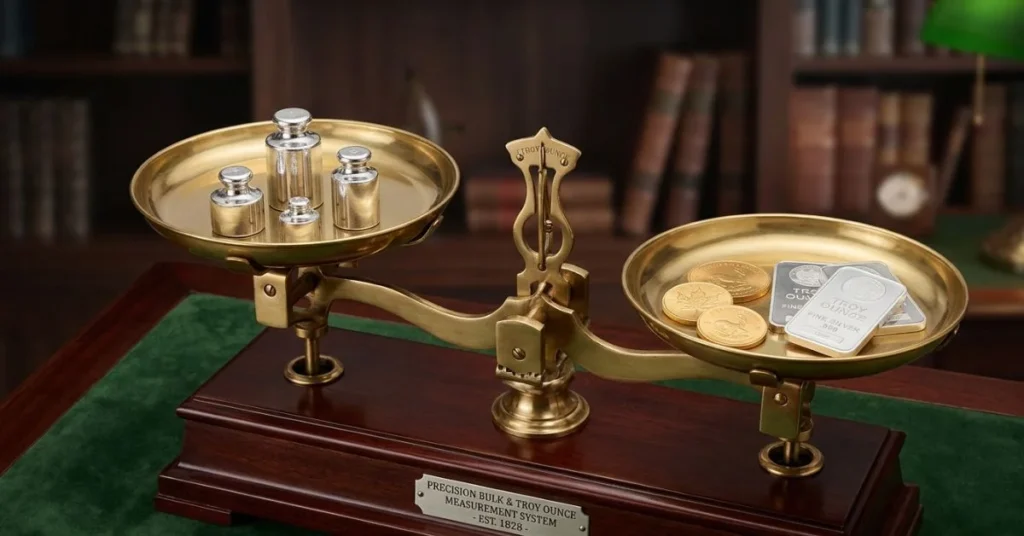
A troy ounce is equal to approximately 31.1035 grams, while the avoirdupois ounce — the standard ounce used for most everyday goods — equals approximately 28.35 grams. Using the wrong measurement when dealing in precious metals can lead to significant financial discrepancies.
That gap — roughly 2.75 grams per ounce — sounds small. Scale it across a 100-ounce position and you’re off by 275 grams. On a 400-ounce London Good Delivery bar, the difference between using a standard ounce and a troy ounce in your calculation is over 1.1 kilograms of gold. At current prices, that’s a six-figure error.
A troy pound is also non-standard. It comprises 12 troy ounces — not the traditional 16 used in avoirdupois weight. This is why troy pounds are almost never quoted in the bullion market. The troy ounce is the only unit from the entire troy weight system that survived into modern practice. Everything else was abandoned. The troy ounce stayed because it is the foundation of how gold and silver get priced at every exchange on earth.
How Kilo Bars Are Priced Using the 32.1507 Conversion
Investors who track gold closely know that kilo bars are the standard format for retail-to-institutional crossover buying — too large for casual purchases, too practical to ignore for serious allocations.
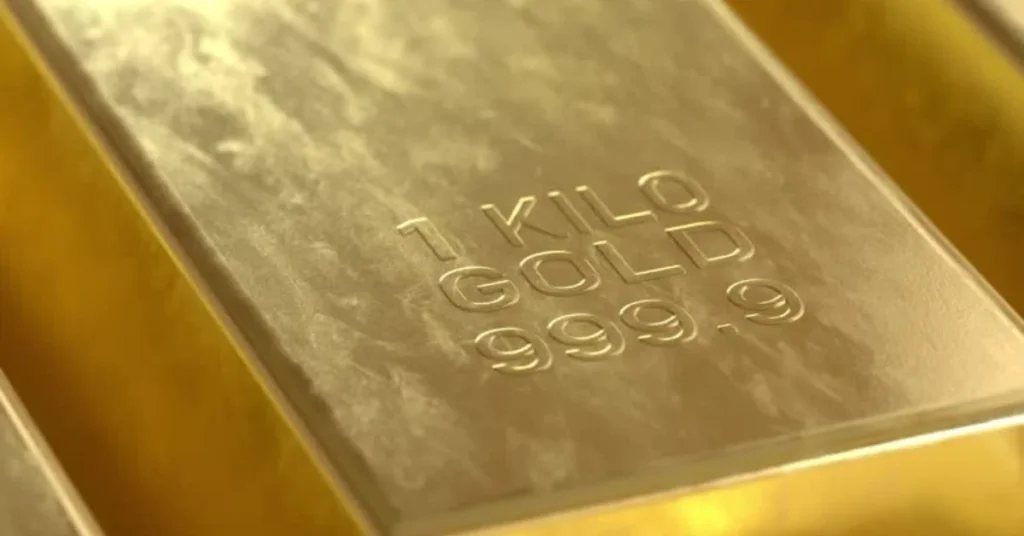
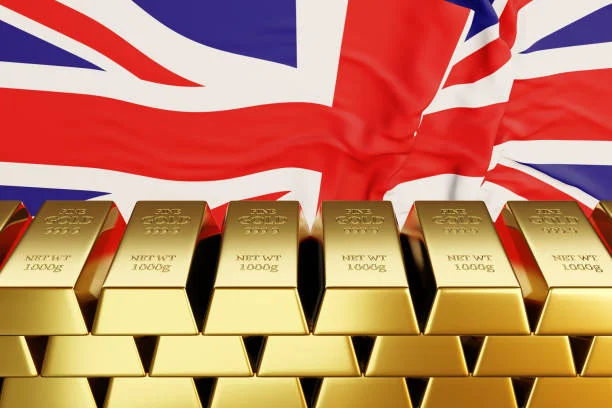
The kilo bar price is calculated by multiplying the current spot price per troy ounce by 32.1507. LBMA-accredited refiners like PAMP Suisse, Valcambi, and Heraeus produce the most widely recognised kilo bars. These bars carry the refiner’s hallmark, a unique serial number, and an assay certificate verifying weight and purity.
LBMA-accredited kilo bars require a minimum fineness of 995 parts per thousand — 99.5% pure gold — and must originate from one of roughly 70 approved refiners worldwide. These standards ensure kilo bars are universally accepted and fungible across global markets, from the Bank of England vaults to the Shanghai Gold Exchange.
Kilo bars carry premiums of 0.5–2% over spot, while 1-ounce coins carry 3–8% premiums. The trade-off is divisibility: you can sell one coin at a time, while a kilo bar requires a single buyer willing to transact at the full weight.
What Experts Say: The 400-Ounce Bar and Why Kilograms Underpin the Whole System
Above the kilo bar sits the London Good Delivery bar — the institutional benchmark against which all other gold products are ultimately measured.
Bars typically weigh a few ounces either side of 400 troy ounces, roughly 12.5 kilograms. The precise LBMA specifications allow a minimum gold content of 350 fine troy ounces, approximately 10.9 kilograms, and a maximum of 430 fine troy ounces, approximately 13.4 kilograms.
The LBMA sets the specification: each Good Delivery bar must weigh between 350 and 430 troy ounces with a minimum fineness of 0.995 — not 0.999, a detail many sources get wrong. They measure approximately 255 × 81 × 37 mm with a trapezoidal cross-section and weigh roughly 27.4 pounds or 12.4 kilograms. These bars are not practical for individual investors.
The bar in every movie vault scene is meant to represent a London Good Delivery bar — a roughly brick-sized object worth, at recent prices, well over $1.7 million per unit. Central banks and sovereign funds don’t price these in grams. They use troy ounces. And the only way to connect that to a kilogram weight is through 32.1507.
What People Get Wrong About This Conversion
The most damaging mistake isn’t the 31 vs 32 confusion. It’s assuming the conversion is the same for silver as for gold.
It is. One kilogram of silver, platinum, or palladium also equals 32.1507 troy ounces. The conversion is purely about mass — it has nothing to do with the metal itself. What changes between metals is the spot price per troy ounce, not the unit conversion.
The second error is using standard grams-to-ounce conversions from kitchen scales. Regular scales show avoirdupois ounces or grams. To get troy ounces from grams, divide by 31.1034768. From regular avoirdupois ounces, divide by 1.09714. If you weigh a bar on a postal scale and divide by 28.35 (the standard ounce weight in grams), you’ll overestimate the troy ounce content of your gold — and overpay if you’re buying based on that calculation, or undersell if you’re on the other side.
A practical consequence: if you skip the correct conversion when pricing a 1-kilogram silver bar against the COMEX spot price and use 31.1 instead of 32.1507, you underestimate its value by roughly 3.3% on every single trade.
Quick Reference: Troy Ounce Conversion Table
For anyone working across weights regularly, here are the key figures:
- 1 kilogram = 32.1507 troy ounces
- 1 troy ounce = 31.1035 grams
- 1 troy ounce = 1.09714 avoirdupois ounces
- 1 avoirdupois ounce = 28.3495 grams
- 1 kilogram = 1,000 grams
- 400 troy ounces (London Good Delivery bar) = approximately 12.4 kilograms
To price any kilo bar in 2026: multiply 32.1507 by the current XAU spot price. That is your melt value before any premium. Past performance does not guarantee future results.
Also Read: Why Gold Price Goes Up and Down: The Real Drivers
FAQ
How many troy ounces are in a kilogram of gold?
There are exactly 32.1507 troy ounces in one kilogram — the same conversion applies whether the kilogram is gold, silver, platinum, or palladium.
Is a troy ounce heavier than a regular ounce?
A troy ounce equals approximately 31.1035 grams, while the standard avoirdupois ounce equals approximately 28.35 grams — making a troy ounce roughly 10% heavier than the ounce used for everyday goods.
Why do gold and silver use troy ounces instead of grams or kilograms?
The troy ounce has been the global standard for gold and silver since the Middle Ages, originating in Troyes, France, and today it is used by the LBMA, COMEX, and all major bullion exchanges to quote benchmark prices.
How do I convert a per-kilogram silver price to a per-troy-ounce price?
Multiply the per-kilogram price by 0.0311034768 to get the per-troy-ounce equivalent. The common error is dividing the kilogram price by 31.1034768 — which gives a result close to correct but always wrong.
What does a 400-troy-ounce London Good Delivery gold bar weigh in kilograms?
A London Good Delivery bar at 400 troy ounces weighs approximately 12.4 kilograms, with the LBMA specifying an acceptable range of 350 to 430 fine troy ounces, or roughly 10.9 to 13.4 kilograms.
This article is for informational and educational purposes only. It does not constitute financial advice. Always consult a qualified financial advisor before making any investment decisions.